Climbing history is rich with stories of impressive feats of strength, endurance, and determination. However, the lesser-known history is that of the equipment which makes returning safely from these ascents possible. In our series on innovations in climbing equipment we have discussed belay devices, rock protection, and climbing helmets. In this article, we will turn our attention to the development of the climbing harness.
The direct tie-in method
Since the earliest days of climbing, a rope has been used to prevent or arrest a fall. If a fall were to occur, the rope would theoretically stop the fall and prevent the climber from hitting the ground. Of course, for this to be effective, the climber must have a way to attach themselves to the rope. Before the 1960’s climbers would tie in directly to the rope using a bowline. While this method did work to keep a climber attached to the rope, it had several negatives. It was uncomfortable and did not allow for the climber to be independent of the climbing rope. More importantly, it tended to cause injury in the event of a longer fall. The thin rope, wrapped around the waist, did little to dissipate force in the event of a fall. This could result in spine fractures or other internal injury from a fall. By the late 1960’s, climbers had adopted a better method of attachment which came to be called the swami belt.

Climber using a direct tie-in, circa 1960’s, OpenLibrary.
The Swami Belt
By 1970, many climbers had adopted the swami belt as a slightly more comfortable and safer alternative to the direct tie-in method. The swami belt was created using 1-inch tubular webbing. This was tied by wrapping the webbing around the waist several times, usually 5-6 wraps, and finishing with a water knot. This offered several advantages. Using this set up, a climber can secure themselves to an anchor independent of the main climbing rope. This is useful during multipitch climbing and rappelling. A further advantage was the decreased injury risk during a fall. Using multiple wraps of wide, flat webbing created increased surface area to dissipate force during a fall. The swami belt was used during many hard ascents throughout the 1970’s. However, by the end of the decade, climbers began to adopt the precursors to modern harnesses. While these older methods could possibly still be used in a situation where a harness must be improvised, better alternatives exist.
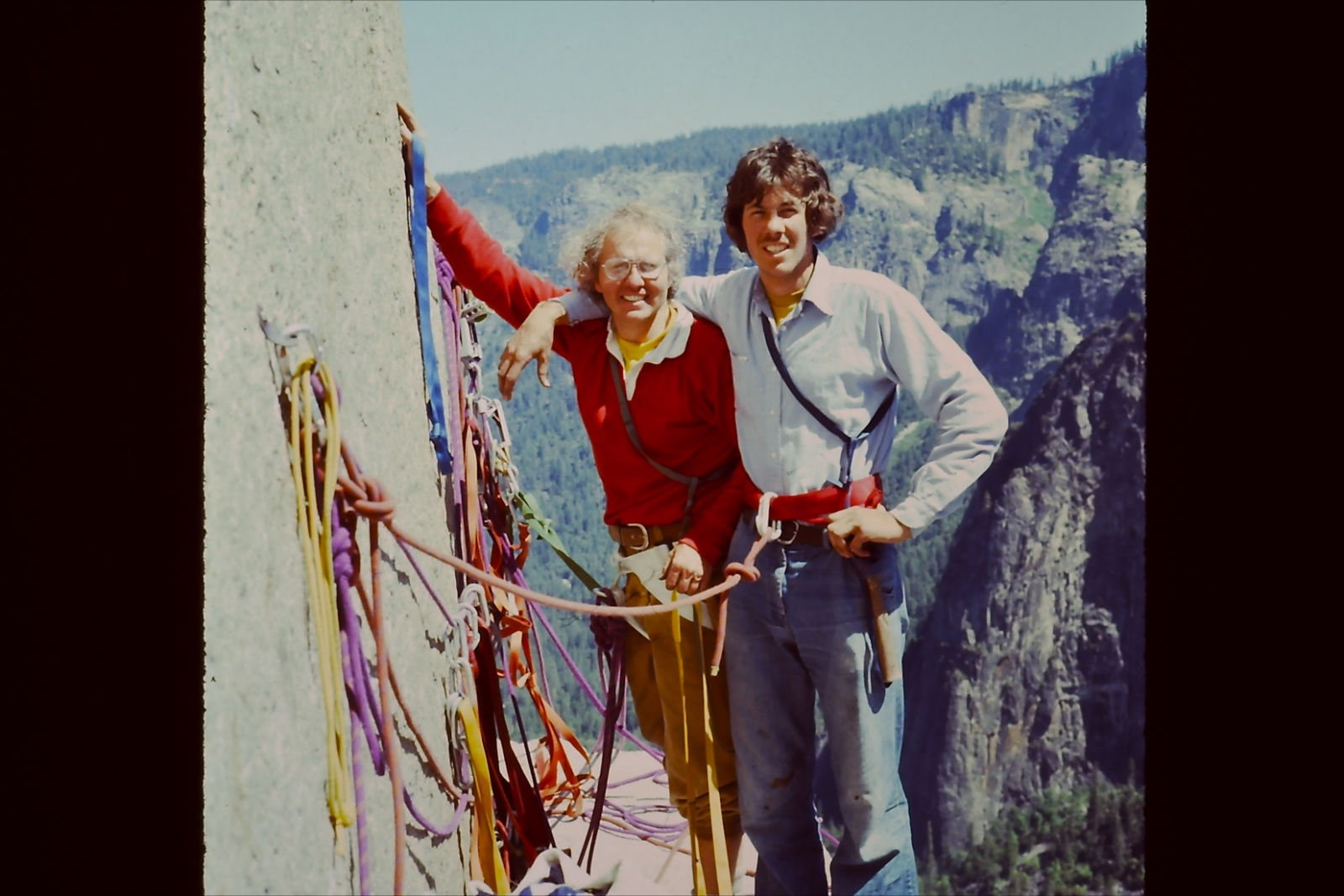
Climber using a swami belt, circa 1970’s, Mountain Project
The modern era
By the early 1970’s, commercial harnesses became available. These modern designs, while they have been improved throughout the decades, are recognizable to climbers today and were largely adopted by the early 1980’s. Constructed of webbing with integrated leg loops, these harnesses offered increased comfort, safety, and convenience features. Colorado based climber Bill Forrest is credited with the first commercial harness available in the US. A British harness also existed, called the Whillans Seat Harness.

The Whillans Seat Harness, Climbing
Over the years, the design has been continuously improved. The webbing used has become increasingly lighter, thinner, stronger, and more durable. Padding is also integrated into the webbing allowing climbers to hang in a harness in relative comfort. This also helps with distribution and dissipation of forces during a fall. Adjustable buckles have been added to the waist belt and leg loops which allow a single harness to accommodate a variety of body sizes. Gear loops, typically four, have been added around the waist belt for convenient access to climbing gear such as carabiners, quickdraws, and protection. Arguably, the most significant feature added is the belay loop. This is a loop of webbing integrated into the front of the harness which is used as an efficient connection point for belaying, rappelling, and attaching to an anchor. Modern harnesses are now also optimized with different feature sets depending on the use such as sport climbing, trad climbing, ice climbing, alpine climbing, big wall climbing, or mountaineering.
In addition to a robust feature set, harnesses are now engineered to high standards. Harnesses are certified to the UIAA-105 or EN-12277 standards. For sit style climbing harnesses, also known as type C in UIAA nomenclature, the belay loop must be able to withstand a pull of at least 15 kN. The waist belt must withstand a 10 kN pull. This is well in excess of the forces generated during climbing falls. The load bearing potions of the harness must have a contrast of colors which aids in identifying wear and need for retirement. Like all climbing equipment, harnesses must be routinely inspected and retired when showing signs of wear. Depending on the type of climbing and frequency of use, a harness will typically last one to five years.
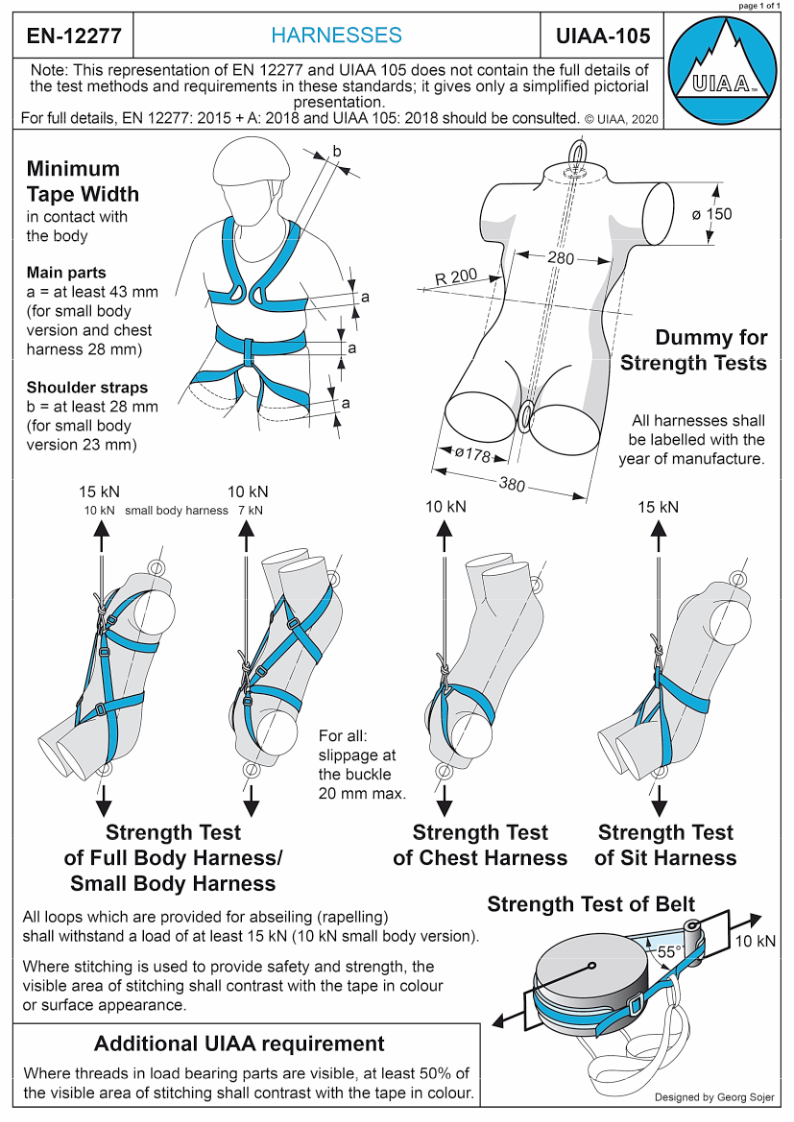
UIAA testing standard for harnesses, UIAA.