As you may
have seen in Part I of this two part “Avvy Tech Series,”
at the time of their creation, transceivers were a revolutionary technology in
avalanche rescue. Over the last several decades, they have proven to reduce rescue
times in avalanche victims. However, with only a 10-20 minute window before
asphyxiation begins, naturally, a major focus in avalanche safety is avoiding
burial altogether. This is firstly achieved with proper avalanche education –
recognizing at-risk terrain, snowpack patterns, and weather conditions to avoid
triggering an avalanche. Another approach in highly trafficked areas
(ski resorts, mountain passes) is to set off small, controlled avalanches in areas with unstable snowpack using mechanical (boot packing, snow
grooming vehicles) or explosives means.
Despite these training and safety measures,
inevitably avalanche events occur and additional tools have been developed to
help decrease burial depth and/or delay asphyxia. In Part II of this series, we
review avalanche airbags, air diverters/air pocket devices, and the newest
player on the market, the Safeback SBX system. But first, a quick review of
avalanche statistics.
Breaking Down the Numbers
Studies of avalanche survival and mortality rates are conducted worldwide and have slightly varying numbers based on region and terrain (e.g., Canada vs. United States vs. Switzerland). However, the general survival rate of avalanche accidents is around 80%, with a mortality rate of about 20%. For simplicity’s sake, we will take a total of 100 people. Of that 100, 80 will survive an avalanche, 20 will die. Of the 80 survivors, many (about 60) will have been involved in small avalanches, be able to exit the edge of the slide, “swim” to the top, not experience critical burial, and/or be seen by companions and quickly rescued.
Of the original 100, about 40 will have been critically buried with about a 50% mortality rate in that group (critical burial ranges from about 40-50%, but to keep simple numbers, an estimate of about 40% is used). The other 50% will experience rapid companion rescue, perhaps with the aid of transceivers. Essentially all mortality events are a result of critical burial, with about 75% caused by asphyxia, and 25% from trauma (note that higher trauma rates are cited in North America than in Europe). As burial time goes beyond 30 minutes, meaningful survival plummets to 30%.
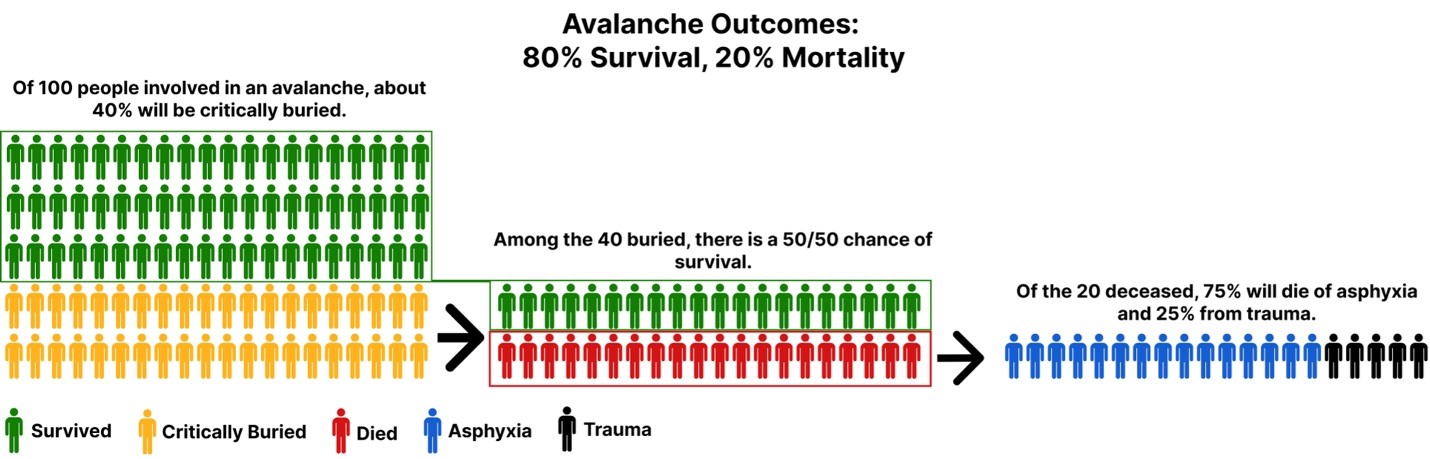
Figure 1: Avalanche Outcomes [Source: Mary Rosegrant]
In this simplistic example, the target of both airbag technologies and airflow systems are the 20 people who are critically buried and not quickly extricated. Based on analyses done on research regarding the use of airbags, it is accepted that they provide at least a 50% mortality benefit, primarily by decreasing burial depth, and possibly secondarily by protecting the head and neck from trauma. Breathing systems, like air diverters and the Safeback system, attempt to extend survivable rescue time.
Airbags
The first avalanche airbag made its debut 40 years ago at the International Trade Fair for Sporting Goods and Sportswear (ISPO) in Munich, Germany. As the legend goes, it was inspired by a German forest ranger, Josef Hohenester, who survived an avalanche while trekking in the backcountry with a deer carcass strapped to his back. Influenced by this experience, he began creating airbags to increase a skier’s volume, exploiting the physical principle of “inverse segregation” in which, during granular flow, particles with greater surface area rise to the top while smaller particles move down.
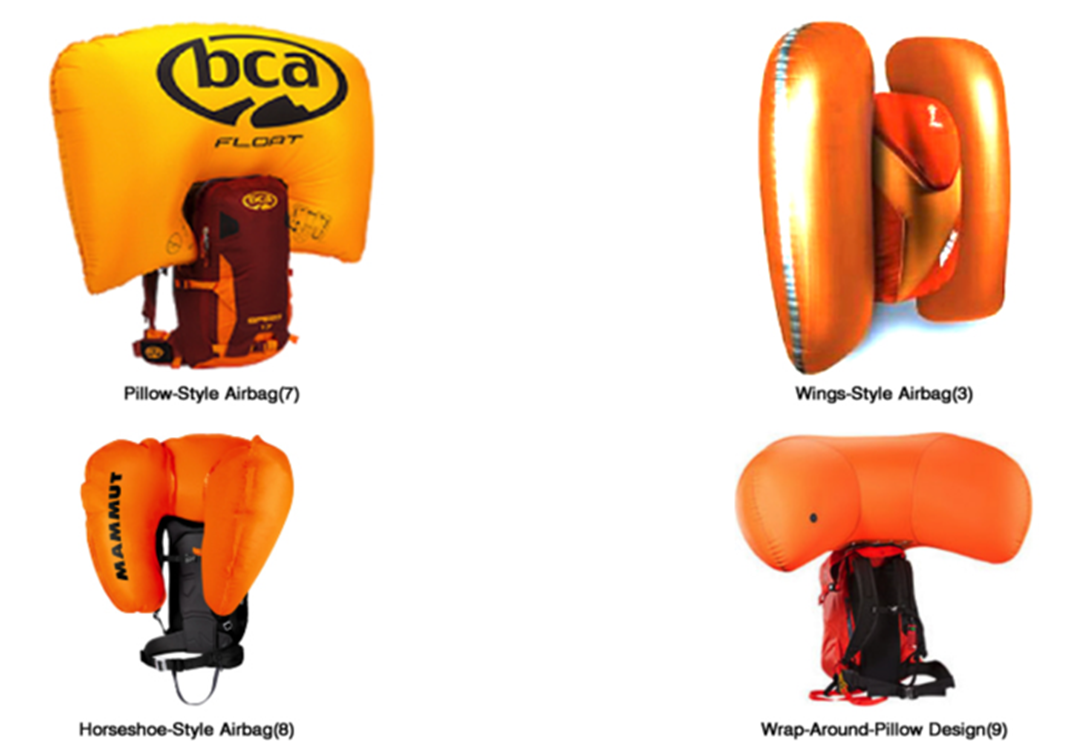
Various shapes of available avalanche airbags. Photo from wms.org.
The 1985 single bag, pull-string system was introduced by the company ABS, and the device saw a steady increase in use over the proceeding decades. A number of companies began creating airbags, with changes in design, shape, and technology. To date, there are over 10 companies that manufacture and sell some form of avalanche airbag as either a single or double bag (shaped as a pillow, horseshoe, wings, etc.), and with options for deployment mechanisms including compressed gas canisters (air, nitrogen, argon, carbon dioxide) and battery-powered fans. These differing components play into decision-making about what pack may work best in regards to cost, weight, and travel restrictions for compressed gases.
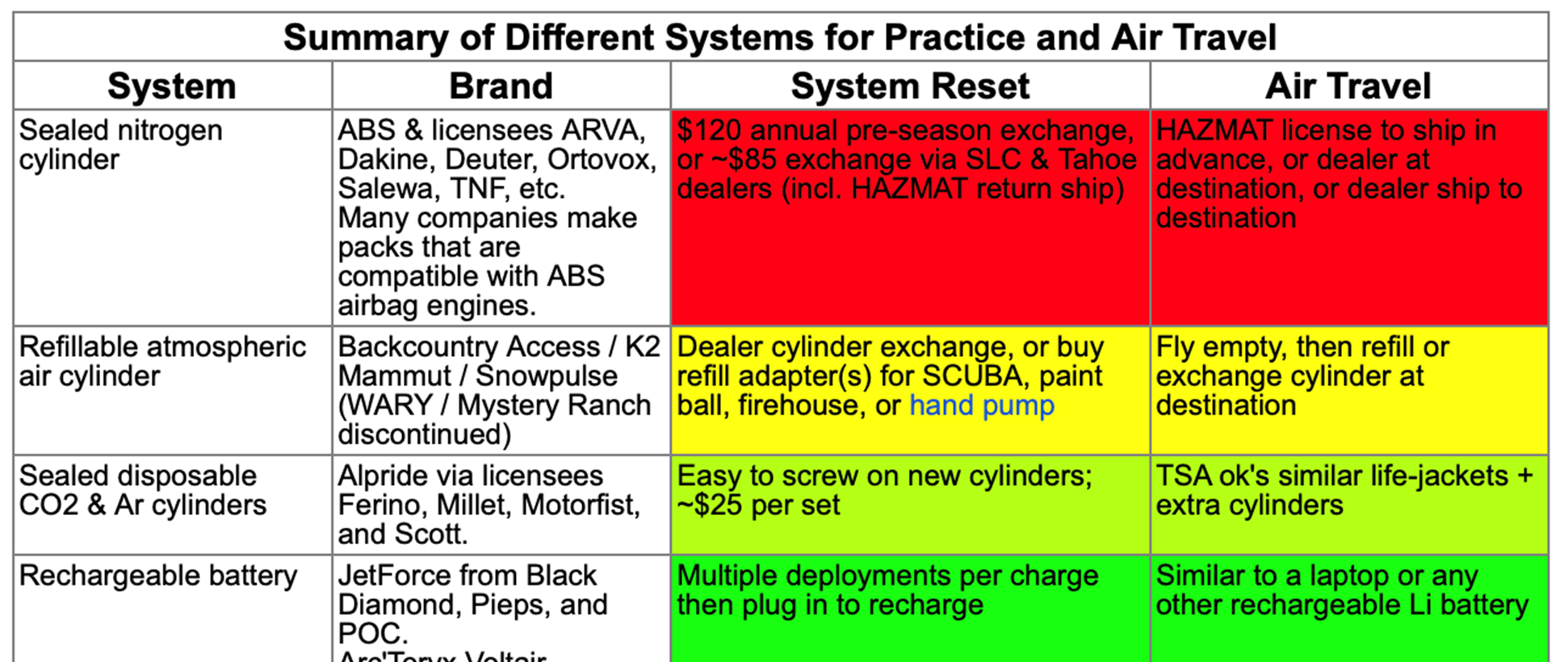
Table from BeaonReview.com.
A little over a decade ago, avalanche airbags grew substantially in popularity with the release of the oft-cited 2014 article from the journal Resuscitation, “The Effectiveness of Avalanche Airbags.” Though only a limited number of studies have been conducted regarding avalanche airbags, the general consensus is that they can increase survival of fatal avalanches by at least 50%, conservatively. Avalanche airbags are not without their faults as they are prone to user error (forgetting to deploy during an avalanche) and mechanical failures (failure to deploy, damage from debris, etc.).
Despite these flaws and criticisms, they have become a nearly-essential piece of backcountry equipment for snow-lovers, and are now recommended by the Wilderness Medical Society in their 2024 Update on Clinical Practice Guidelines for Avalanches. Market sales have grown significantly since the early 2010s and are projected to continue through 2033. For many, besides avoidance of an avalanche altogether, the next most important thing is to not experience burial during an avalanche. When airbags are deployed during an avalanche, deploy correctly, and the debris field does not pose a risk of major trauma to the victim or the airbag, they give the wearer a higher chance of not experiencing deep burial, and thus a higher chance of survival.
Avalanche airbags have also been considered to theoretically provide some level of protection from trauma to the head and neck, which is an added benefit. There are even some bags that auto-deflate after a short period of time from activation in order to create an air pocket for the wearer.
Air Diverters
Around the same time that airbags were growing in use, an avalanche “snorkel,” the Avalung by Black Diamond, was a product that promised to allow the wearer the ability to breathe fresher air while buried. The device, originally sold as stand-alone and later pack-integrated, was designed with a mouthpiece for the wearer to use in the event of burial. While breathing into the mouthpiece, a one-way valve would pull in air from the surrounding snowpack and exhale CO2 to the back of the pack, away from the user’s face. While useful in theory, it did not grow significantly in popularity or use in North America. After a recall in 2011 citing safety issues with the air intake tubing, which proved to be fragile in cold temperatures posing a suffocation hazard, the packs have since been quietly discontinued by Black Diamond and are largely only found on resale websites.
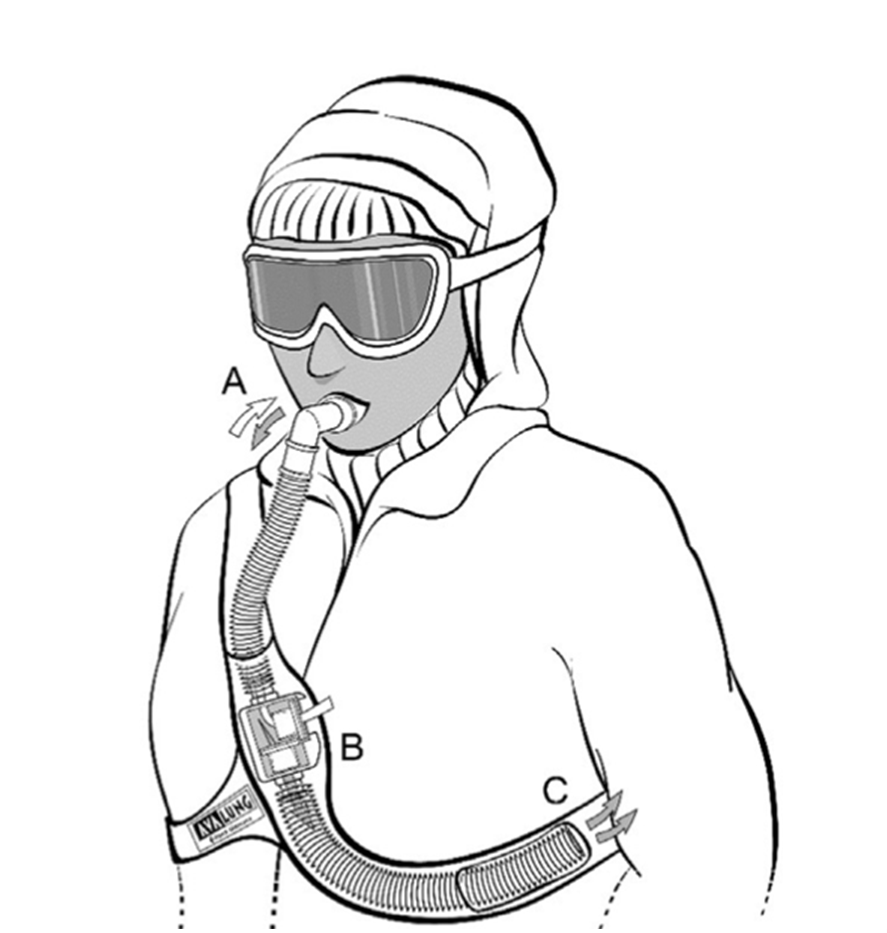
Illustration of an artificial air pocket device or "air diverter,' occasionally referred to as a "snorkel," branded as Avalung by Black Diamond. No lnoger commercially available in North America. White arrow indicates air flow during inhalation, gray arrow shows exhaled air.
The 2024 WMS Clinical Practice Guideline Update for Avalanches notes that similar devices remain available in Europe, though the consensus recommendation is only that their use should be considered and is based on low quality evidence.
Safeback SBX System
In a slight spin-off of the Avalung, a Norwegian company, Safeback, has created a product called the SBX system, designed to circulate breathable air to a critically buried victim without the use of a mouthpiece.
The SBX is a pack-integrated, battery-powered fan system that is user-activated via a pull-string mechanism. In the event of an avalanche, a user is to pull the T-shaped tab to activate the fan, which will begin circulating air from the straps near the rider’s face. With six AA batteries, the assembled unit weighs 560 g and boasts a run time of 90 minutes even at -30° C/-22°F.
Safeback has presented preliminary data on the success of the device in simulated burials, though real-life use and outcomes remain to be reported. While another pack device could be cumbersome in the backcountry, it does theoretically offer great benefit to burial victims and could potentially increase survivable time under snow, giving rescuers a window well beyond the 30 minutes that is currently fatal for most burial victims. As of now, the Safeback SBX system is only sold in packs that are specific to the fan system. This would require users to decide between a dedicated airbag pack or the SBX system.

This diagram, from the Safeback website, outlines the steps for use of the aeration pack in an avalanche scenario.
The pack still has much to prove before it may be considered the newest piece of “must-have” avalanche gear. It poses similar limitations to airbags, such as user error, mechanical error, fragility if banged up by debris, fan clogging, etc. Time will tell if the device will deliver all of what it promises, or if real-world scenarios will render it useless.
As one of the leading causes of death in winter sports, avalanches continue to pose a significant risk to outdoor enthusiasts, despite the fact that rescue times and survival have improved over the last several decades. Avalanche education remains the most important tool for anyone trekking into areas with high risk, whether on foot, skis, snowboards, or snowmobiles. For the highest chance of survival, backcountry winter travelers should also be carrying a functional transceiver, airbag, probe and shovel. In time, the Safeback SBX system could be added to that list.