When considering the success or failure of an avalanche burial rescue, time taken to locate the victim and depth of burial are the two most important factors at play. Before the introduction of the avalanche transceiver (commonly referred to as a “beacon”), search and rescue efforts were arduous. Early avalanche safety involved cords tied around the waists of trekkers that would float to the surface during an avalanche to help identify the location of a victim. Search and rescue was then conducted through the organization of probe lines – a line of searchers probing a debris field in a systematic fashion. These efforts could easily take over 30 minutes to perform, far longer than the cited 15 “golden minutes” a victim has prior to asphyxiation. Current data suggests that asphyxiation begins around 10 minutes after burial under snow, making the need for a rapid search pivotal to the success of a rescue.
With the introduction of transceivers, and other signal searching technologies such as RECCO reflectors, avalanche rescue times have decreased significantly over the last several decades. In this first part of our two part series on “avalanche technologies” we will review the tech behind these life-saving tools.
History and how they work
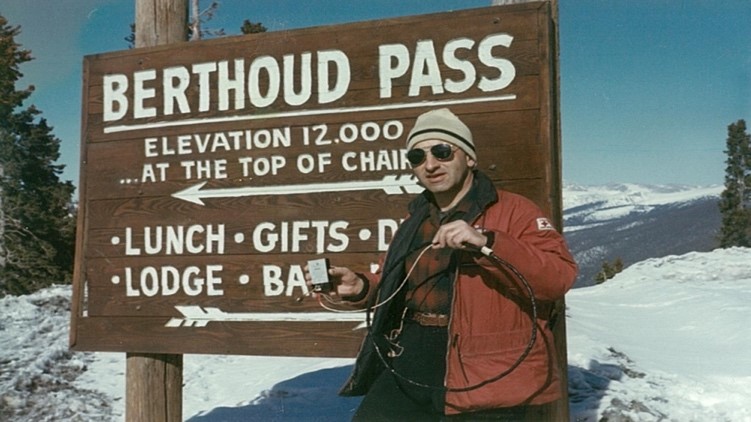
Dr. John Lawton pictured with the prototype avalanche transceiver. The large, copper loop was sewn into the back of a jacket.
Avalanche transceivers emerged as a key backcountry tool for winter sport enthusiasts in the 1970s. Invented by Dr. John Lawton, PhD in 1968, the principle was simple: use a transceiver attached to a copper antenna sewn into the back of a parka that constantly pulses an electromagnetic field – originally 2.275 kHz. While skiing, devices of all the skiers in the group remain on “transmit.” In the event of an avalanche burial, the search group switches their transceiver devices to “receive” to detect the signal of the missing person. The interactions of the radio frequencies between the devices created an audible cue that intensified as other devices approached the transmitting wire.
The first antenna loop was large, about a foot in diameter, making it cumbersome, but good for a large signal range. The 2.275 kHz frequency initially used for transmission was relatively free of interference, could penetrate large objects such as rocks and trees, and was audible to the human ear, allowing for a cue without the need for complex processors to convert the signal to sound.
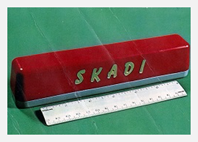
The "hot dog" - Dr. Lawton's first marketable avalanche transceiver nicknamed for its color and shape.
The first marketable avalanche transceiver, named “Skadi,” was a downsized, compact device that Lawton developed by using a looped ferrite antenna contained in plastic casing. These devices grew in usefulness in the backcountry, with multiple skiers sharing stories of successful rescues using the new “beacons."
In the 1980s, 457 kHz became the internationally-recognized standard frequency for avalanche transceivers. This frequency is ideal as it is highly directional and the long wavelength is able to penetrate even better through large objects without significant signal interference. Transceivers on the market today utilize crystal oscillators to create the standardized 457 kHz transmission and are not permitted to deviate by more or less than 80 kHz from this setpoint. Any drift away from 457 kHz can diminish the distance of signal transmission, or make the device altogether useless as receiving devices cannot detect the transmission.
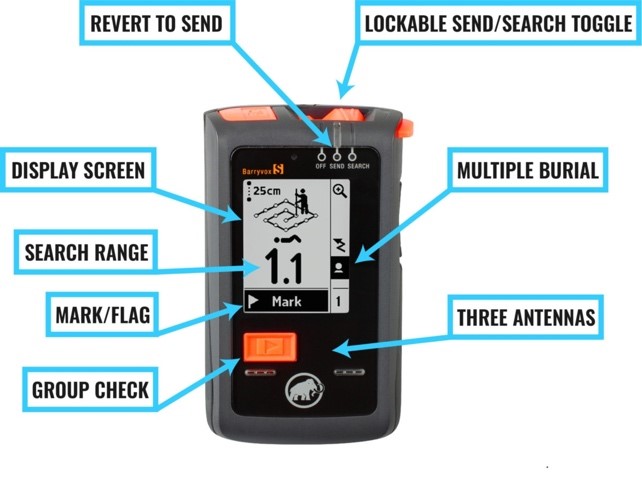
Highlighted features of some modern avalanche transceivers. A Mammut transceiver is pictured.
Most modern transceivers also use three antennas to offer more precise directional guidance and triangulation of a signal. Additionally, they contain microprocessors that speed up signal searching and offer several advanced features, such as screen displays, audible signals with voice command, distance-from-signal displays, multi-signal searching, signal masking, and more.

The electromagnetic field produced by avalanche transceivers creates arced flux lines. The third antenna within devices today helps to reduce the signal loss experienced when the transceiver approaches a device and becomes perpendicular with the electromagnetic field.
Use during an avalanche rescue
As previously described, avalanche transceivers function in two basic modes – send and search. When a party enters into the snowy backcountry – skiing, snowshoeing, splitboarding, or snowmobiling – in an area with avalanche risk, it is recommended for all parties to carry a transceiver on their person in a readily accessible location (eg on a chest harness). During the trek, all transceivers are set to “send.” In the event of an avalanche burial, all parties involved in the search and rescue attempt should switch their transceivers to “search” to locate the buried signal and eliminate interference from nearby transceivers.
Besides a transceiver remaining in “send” during a search, there are several things that can interfere with transceiver signals and thus the rescue attempt. You should be sure that the device has no physical damage, is not outdated or in need of software updates, and has adequate battery level (>40%). Nearby electronic devices, such as cell phones, watches, GPS devices, radios, or pacemakers, can also interfere with the signal. A general recommendation is for devices to be at least 20 cm away from transceivers in send mode, and 50 cm in search mode. Phones should be switched to airplane mode during a rescue. It is also important to be aware of any recalls that may be issued for a particular device.
As with any gadget intended for rescue use, the most important factors to success are familiarity and practice in simulated situations. There are many transceivers that offer a myriad of features, but the one that will be most useful to you is the one you practice using and with which you are intimately aware of its realistic capabilities and performance. Before heading into the backcountry, be sure to review all above recommendations, review manufacturer’s guidelines, and perform a group check of all transceivers to ensure adequate battery life and reliable functionality. No single device ever replaces the need for avalanche awareness, education, and rescue training.
Options and how to choose
There are several websites that go into great detail regarding features, pros, cons, and real world tests of devices that are on the market today (GearLab, BeaconReviews, and BackcountrySkiingCanada). Companies that sell avalanche transceivers include Black Diamond, Backcountry Access, Mammut, and Arva, among others. Some features will prove more useful to expert rescue personnel and may not be appropriate for use by a lay person. Consider your level of expertise in avalanche rescue, and choose a device that will allow you the most ease of use to avoid getting slowed down by unnecessary complexity.
About RECCO reflectors

RECCO reflectors can be placed on any piece of outdoor equipment and are searchable by handheld and helicopter detectors.
RECCO reflectors are devices that have grown in popularity and use since the 1990s. While they are often used by professionals in search and rescue scenarios, they are not sold as companion rescue devices. Unlike transceivers, a RECCO reflector is a small, lightweight, passive transponder that can be attached to any piece of clothing or equipment (winter coats, snow pants, boots, helmets, backpacks, etc). This reflector is searchable when a handheld or helicopter detector sends out a 900 MHz radar signal which is reflected back to the detector and converted to sound at double the frequency.
Increasingly, outdoor equipment is being sold with RECCO reflectors attached to aid in search and rescue during avalanches as well as non-winter backcountry searches. Many ski resorts today have detectors available, and searches are conducted with a combination of RECCO technology, transceivers, trained dogs, and probe lines.
Probes and shovels
Last, but not least, probes and shovels are key pieces of avalanche rescue tech. While transceivers and reflectors may lead you more quickly to the general location of a buried victim, the most important part of rescue is probing exactly to the person and digging! An ideal avalanche probe should be lightweight, compactable, and at least 240 cm in length, even up to 320 cm, if possible. A shovel should also be lightweight and compactable, but sturdy and reliable when assembled to ensure maximal snow movement.
Transceivers were ground-breaking technology at the time of their creation and ushered in significant change to the field of avalanche rescue. Check out the second part of this series in June for some additional tools and tech that have changed backcountry snow sports, including an up-and-coming invention with some promise in extending survivable burial time.