
Group of white-tailed deer (Hunter-ed)
In 2022, a fear in the backs of the minds of many hunters was realized when two men, exhibiting symptoms of seizures, confusion, and agitation, died after eating deer meat that came from a herd known to be infected with chronic wasting disease (CWD). Up until this point, while authorities recommended exercising caution when consuming possibly infected animals, the opinion was that animal-to-human transference was extremely unlikely. On postmortem examination, the men were confirmed to have Creutzfeldt-Jakob disease (CJD), and no causal relationship between the consumption of deer meat and disease development was identified. Rather, these men aligned with the typical patient age, disease progression, and physiologic changes in the brain seen in cases of sporadic CJD, and their diagnoses were within the expected number of cases identified by the CDC.
CJD and CWD are part of a family of disorders called prion diseases, with CJD affecting humans and CWD affecting ungulates, or hoofed animals, such as deer, elk, and moose. Also known as transmissible spongiform encephalopathies (TSE), prion diseases are marked by the misfolding of proteins within the brain. Avoiding the host’s immune response, accumulation of the disease-associated prions ultimately yields an irreversible, uniformly fatal disease progression.
CJD primarily occurs sporadically, but can also be inherited or develop secondary to iatrogenic transmission (from grafts, cadaveric hormones, and contaminated neurosurgical equipment). In 1996 presumed transmission of bovine spongiform encephalopathy (BSE) caused an outbreak of a variant form of CJD in humans. This precedent, with the cases of BSE, raises concerns about the possible transmission of CWD to humans.
Humans with CJD may present with psychological symptoms such as anxiety, depression, and withdrawal but will eventually develop neurological signs such as myoclonus, seizure, and extrapyramidal dysfunction. Deer infected with CWD may present as emaciated, with erratic behavior and neurological irregularity; however, due to the prolonged and progressing course of illness, these animals usually succumb to predators, vehicles, or the disease before their symptoms are witnessed by humans.
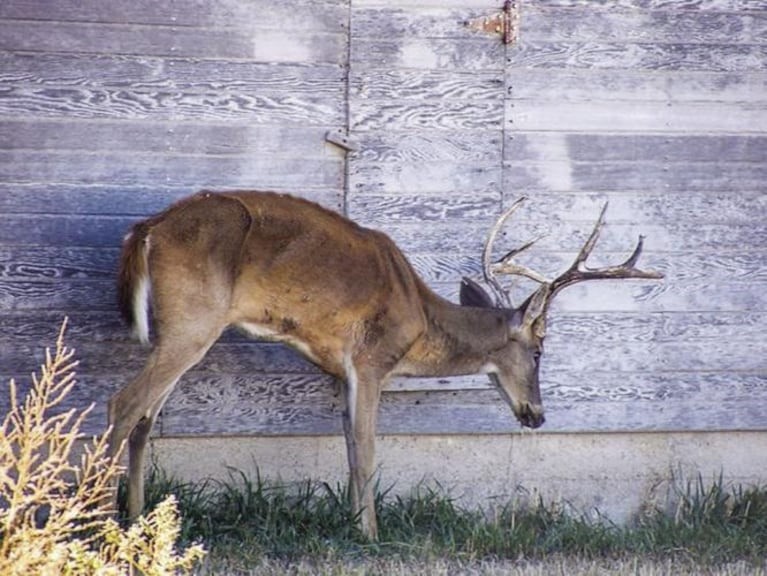
Deer exhibiting signs in final stages of CWD (OPB News)
CWD was first observed in the United States in 1967 when it was identified in a captive deer. It wasn’t until 1981 that the first wild animal, an elk in Rocky Mountain National Park, was confirmed to have the disease. Since its emergence on the landscape, CWD has spread to 35 states, with Indiana, California, and Washington all detecting cases within the last year. With its sharp uptick and seemingly ungovernable spread, it was aptly described in a Wildlife and Natural Resources conference excerpt as having “run the gamut from minor scientific curiosity to national crisis.” States’ efforts to manage disease spread are centered on epidemiologic surveillance with supplementary methods such as population culling programs, harvest-mediated population reduction, and harvest strategies biased towards male deer (male deer are more likely to be infected than females).
Several factors exist that render CWD presence an inevitability and confer incredible difficulty in management. CWD is spread through direct and indirect means. Being social animals, deer can transmit disease through their saliva simply by living and feeding in close proximity. Additionally, excreted CWD can persist for years on the landscape through saliva, blood, urine, or infected deer carcasses, contaminating the soil and the plants that grow there. The incubation period of CWD can be as long as two years. During that time, prion shedding can occur, resulting in otherwise asymptomatic deer serving as infectious sources for their social groups and nearby herds. Considering the natural movement and migration of animals and transportation required for commercial farming of deer and elk, CWD can even spread between distant locations. These incontrovertible challenges to mitigating disease spread have caused some jurisdictions to abandon their efforts entirely.
The case of hunter-related CJD in 2022 was not the first time such an incident took place. Between 1993 and 1999, the deaths of three men were investigated, having died of non-specific neurological disease in the context of participating in “wild game feasts.” Ultimately, only one of the men was confirmed to have had CJD, but it was deemed impossible to have been caused by CWD-infected meat as none of the meat served at these meals came from a CWD-endemic area. Between the years 1997-2000, three individuals, all of whom reported a history of venison consumption, were diagnosed with CJD. These patients were all relatively young, making a concerning case for CWD-related transmission as the typical presentation of sporadic CJD occurs later in life. These, too, were deemed coincidental rather than causal.
Conversely, in 2005 a fire company in New York fed deer meat contaminated with CWD to over 200 people. Surveillance of all potentially affected personnel took place over the course of six years. Ultimately, none experienced any significant changes in their health. Monitoring of those involved is still ongoing, but other than conditions attributed to old age, the only change reported was an overall lack of enthusiasm in consuming more deer meat.
To determine whether CWD transmission to humans was even possible, National Institutes of Health (NIH) scientists conducted a study using cerebral organoids, tiny spheres of human brain cells grown in the laboratory. After prolonged exposure to CWD prions from ungulate species and subsequent monitoring for up to six months, none of the organoid tissues became infected with CWD. Despite these findings, scientists are unwilling to say that the human contraction of CWD is impossible. Some individuals may have a genetic susceptibility or disease variants could emerge that offer a greater ease of transmission.
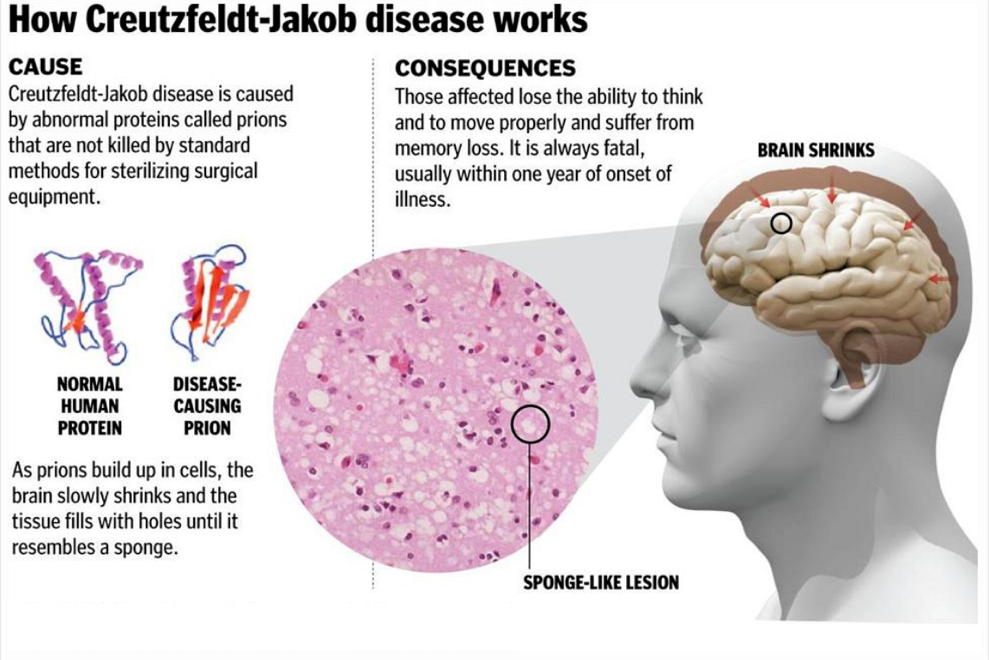
Creutzfeld-Jakob Disease (Microbe-Canvas)
As hunting season approaches, different localities produce their recommendations, or in some cases mandates, for how CWD will be monitored and mitigated. For example, Washington state requires hunters in specific game management units (GMUs) to submit the whole head or extracted lymph nodes to the Washington Department of Fish and Wildlife (WDFW). Hunters can watch videos on executing these surgical maneuvers and obtain information on appropriate and safe handling of wild game and directions to self-service kiosks for submission of samples for CWD testing.

CWD check station in Idaho (Idaho Fish and Game)
Even though no human has ever had a confirmed diagnosis of CWD, nor has a laboratory been able to produce a positive result, the possibility of CWD infecting a human remains enigmatic. While experts agree that it is improbable, the consensus still stands that it can’t be ruled out, and this has directly changed the way some hunters interact with their game. While hunters typically enjoy their venison throughout the year, maybe even on the day of harvest, growing concern over CWD has some waiting weeks until test results return to prep their first meal, or causing them to grimly dispose of the entire animal if the results are positive. Cooking, even at high temperatures, will not destroy the malformed prions, so the only true way to prevent exposure to the disease is through identification. Whether or not CWD will ever be a public health concern to humans is unclear, but this disease does pose a tremendous risk to conservation as it continues to ride roughshod through wild game populations in the US. Perhaps the mounting, almost national awareness, and research will lead to better and more successfully tailored ways for states to manage the disease. For now, however, it remains an equally elusive and ever-present concern for those who hunt and consume wild game.