In wilderness medicine, time is rarely neutral. Exposure, dehydration, injury, and hypothermia all progress while search teams move across terrain. Yet despite decades of refinement in search and rescue (SAR) strategy, the fundamental challenge remains unchanged: finding a missing person is often like searching for a needle in a haystack. There are well-documented cases of rescuers passing within meters of a subject without detecting them. The limitation is not always where we search, but whether we recognize what we are looking at.
Earlier this year, widely reported coverage described how a missing mountaineer was located after artificial intelligence (AI)-based image analysis identified a single anomalous pixel within a large dataset of images. This suggests a shift in how detection occurs, with new tools augmenting rescuers' capabilities.
Traditional SAR has long relied on a combination of systematic search patterns, resource allocation, and behavioral prediction. Texts such as “Lost Person Behavior” describe how different categories of missing persons, such as children, hikers, and individuals with cognitive impairment, tend to move in predictable ways. These models allow teams to assign probability to different areas and prioritize search efforts accordingly. Air assets expand visibility, and ground teams methodically sweep terrain.
And yet, even when search areas are well chosen, detection remains the weak link. Human perception is fallible, especially under fatigue, stress, and environmental complexity. Dense vegetation, variable lighting, and terrain can obscure even nearby subjects. This is compounded by attentional and perceptual biases. In many cases, the limiting factor in SAR is not access to terrain, but the ability to extract meaningful signals from it.
Over the past decade, advances in imaging have increased the amount of terrain that is observable. Drones, handheld cameras, and body-worn systems allow teams to capture high-resolution visual data across large areas. These tools improve coverage and create a record for review after the fact. Increasingly, these systems are also capable of operating beyond the visible spectrum, incorporating infrared, thermal, and other sensor modalities that detect heat signatures or material differences invisible to the human eye. But increasing the amount of data does not solve the detection problem.
AI offers a different approach. Rather than relying solely on human observers scanning terrain in real time, AI systems can analyze large collections of images across multiple spectral bands and identify subtle anomalies.
In Figure 1, the search subject is detected as a person with 53% confidence. In Figure 2, the model detects a rescuer in a red shirt with 84% confidence, but does not detect the original search subject.
The model used was YOLO, a general-purpose object detection model. Out of the box, YOLO looks for typical human features such as a head, arms, legs, and body shape. In Figure 2, the search subject is crouched among rocks, with much of their body outline hidden. Their neutral clothing also blends into the terrain.
This demonstrates both the potential and limitations of AI in wilderness search. Obvious subjects can be detected, while subtle or camouflaged subjects remain difficult to detect without search-and-rescue-specific model training.
These may include color contrasts, unusual shapes, or patterns of disturbance such as broken vegetation or compressed ground. Thermal and infrared data may reveal heat signatures that would otherwise go undetected. Beyond thermal imaging, these systems can detect subtle indicators, such as disturbed vegetation, exposed soil, moisture variations, and changes over time, which may be imperceptible to a human observer in the field. In some cases, the signal is not what is present, but what is absent: a disruption in an otherwise consistent environment.
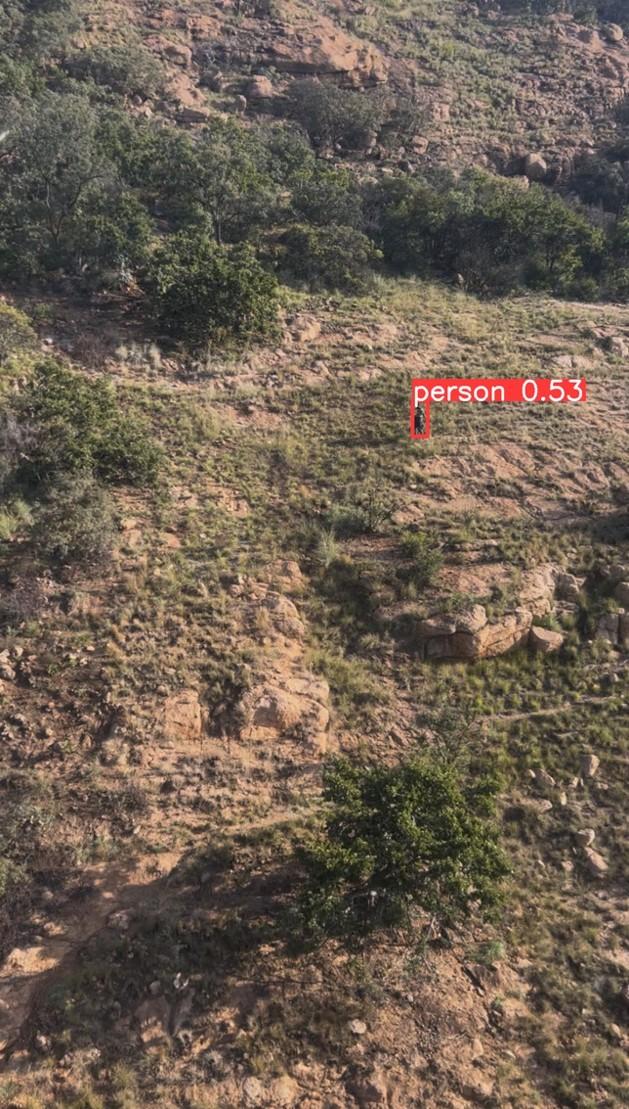
AI-assisted detection of a simulated search subject during a wilderness search exercise. The YOLO object detection model identified the subject as a person with 53% confidence. Photo Credit: Franco Houy from the Mountain Club of South Africa's Gauteng Province Search and Rescue Team. The object detection shown was performed by AI. The photos were taken during a search exercise.
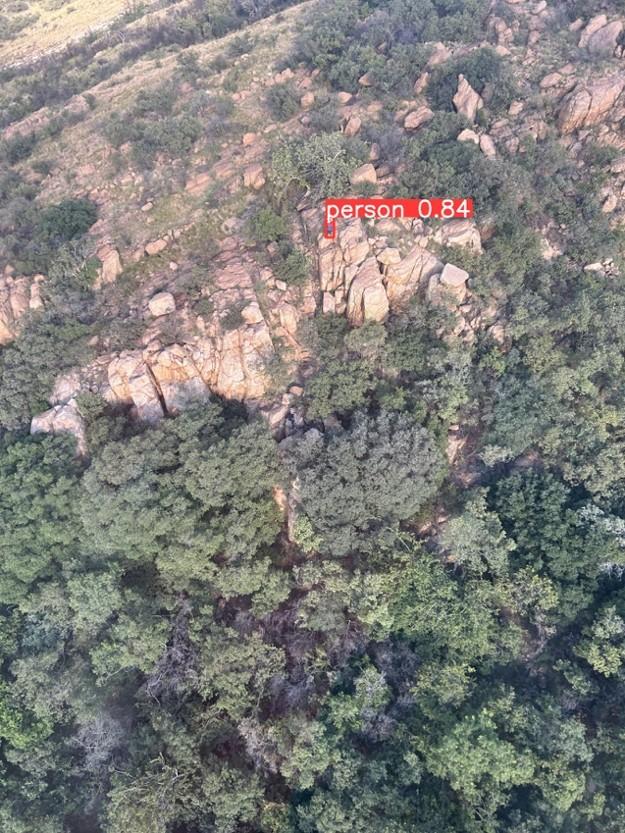
In the same environment, the YOLO model detects a rescuer in a red shirt with 84% confidence, but fails to identify the original search subject, whose crouched posture and terrain-colored clothing reduce detectability. Photo Credit: Franco Houy from the Mountain Club of South Africa's Gauteng Province Search and Rescue Team. The object detection shown was performed by AI. The photos were taken during a search exercise.
In practical terms, this shifts SAR from a process of continuous visual searching to one of signal detection. Searchers are no longer relying only on what they notice in the moment, but also on what can be identified later within captured data. A team may pass through an area without recognizing a clue, only for that clue to be identified retrospectively through image analysis.
This does not eliminate the rescuer's role. On the contrary, it reframes it. Field teams still rely on their eyes, ears, and intuition. They listen for calls, notice subtle environmental cues, and navigate difficult terrain. But they may increasingly operate in parallel with AI systems that flag areas of interest for follow-up. In this hybrid model, images captured from either drones or ground-based systems are paired with centralized or edge-based analysis. The output is not a definitive answer, but a set of probabilistic leads.
The integration of AI with established behavioral models may further refine this process. Predictions derived from lost-person behavior can indicate where a subject is likely to be, while AI helps determine where, within that space, meaningful signals are likely to be found. Search areas may become more dynamic, adapting in near real time as new data is collected and analyzed. Instead of linear progression through a search grid, teams may shift toward iterative, feedback-driven movement.
The potential operational impact is significant. More targeted searches could reduce the need for large numbers of personnel or prolonged deployment of expensive air assets. Faster subject localization may reduce morbidity associated with exposure and injury. In this sense, improvements in search efficiency are not merely logistical; they are directly tied to patient outcomes.
However, these technologies come with important limitations. AI systems are constrained by the quality of the data they receive. Poor lighting, dense canopy, weather conditions, and low-resolution imagery can all degrade performance, even across advanced sensor types. False positives, such as rocks, shadows, or debris misidentified as human, may divert resources, while false negatives may create false reassurance. Power limitations, data transmission challenges, and the need for trained operators further complicate deployment in remote environments.
There are also cognitive risks. Automation biases decision-making by increasing the tendency to over-trust machine outputs. An absence of AI-identified signals does not imply the absence of a subject. As with any tool in wilderness medicine, AI must be integrated carefully, with an understanding of both its capabilities and its failure modes.
The future of SAR is unlikely to be fully automated. Instead, it will be augmented. Teams equipped with imaging tools and supported by AI analysis may be able to search more efficiently, but success will still depend on human judgment, adaptability, and fieldcraft. The combination of behavioral science, improved data capture, and machine-assisted interpretation represents an evolution, not a replacement, of existing practice.
Search is an emergency. The faster a subject is found, the better the outcome is likely to be. As SAR continues to evolve, the challenge may no longer be defined solely by how much ground can be covered, but by how effectively we can recognize the signal hidden within it.
Additional Readings:
- Journal of Search & Rescue – Bayesian GIS analysis of the William Ewasko case
https://journalofsar.com/wp-content/uploads/2019/11/vol3iss2_rossmo_et_al.pdf
- Journal of Search & Rescue – Probability of detection models in missing-person search
https://journalofsar.com/wp-content/uploads/2023/01/jsar_v6i1-chiaccchia.pdf
- Journal of Search & Rescue – UAVs for wilderness SAR
https://journalofsar.com/wp-content/uploads/2019/04/JSAR3-1.pdf