On Wednesday, May 20th, seven gold prospectors in the mountainous province of Laos were trapped inside a cave after a monsoon triggered flash floodings, sealing the exit. This triggered a high stakes international rescue mission, after one local managed to wade through the flooded cave to alert authorities, leaving the seven remaining left. More than 100 responders responded, including a professional team of fifteen cave divers. Finnish diver Mikko Paasi and Thai diver Kengkad Bongkawong, veterans of the 2018 Tham Luang rescue in Thailand, are leading the mission.
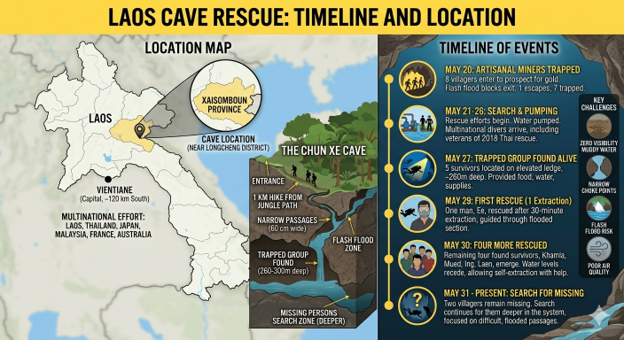
Laos Cave Rescue Timeline and Map. Infographic generated by the author using AI image-design software.
In order to reach the victims, the rescuers have to navigate through a 1150-foot tunnel that slopes downward at a 45 degree angleIn order to reach the victims, the rescuers will have to navigate through a 1150 feet tunnel that plunges downward at a 45 degree angle. Some parts of the pathway will be as narrow as 23 inches wide, requiring rescuers to crawl and tilt sideways to pass through.
Five out of the seven missing villagers were initially found by rescue divers a week after they were initially trapped. The mission is not over yet, with the search continuing for the two remaining victims and the operational challenge with extracting the five current rescuees. The environment is described as incredibly remote and hostile, entailing a 4 km jungle track, and once inside the cave, dark flooded areas stretching hundreds of meters, restricted spaces, collapsed structures, and very hazardous air quality.
Multi-day flooding introduces a succession of distinct pathoplogies that evolve over time. In the acute phase of a cave flash flood, the immediate threats are drowning and hypothermia. Drowning remains one of the primary causes of mortality in subterranean environments. Concurrently, environmental hypothermia develops rapidly because convective heat loss in moving water occurs 25 times faster than in still air of the same temperature, quickly depleting a victim's metabolic reserves.
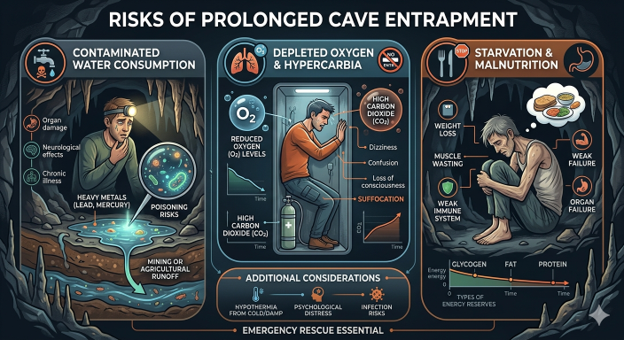
As the timeline extends into days, the clinical focus shifts to the highly toxic and infectious profile of the floodwater. In active mining regions, cave water becomes heavily laden with suspended silt, agricultural runoff, and dangerous heavy metal concentrations. Furthermore, stagnant subterranean pools serve as ideal breeding grounds for fecal-oral pathogens, including Escherichia coli and Campylobacter species, alongside fungal spores and protozoa.
Trapped individuals are ultimately forced into a critical survival dilemma: face dehydration, or consume the contaminated water and risk severe gastroenteritis and chemical toxicity. Ironically, choosing to hydrate with this water induces severe secretory diarrhea and emesis secondary to infectious enteritis. The resulting rapid fluid loss and profound electrolyte imbalances accelerate hemodynamic instability, shortening survival compared to simple dehydration alone. Lastly, the ingestion of water laden with toxic heavy metals, including arsenic, mercury, chromium, and lead, poses a severe risk of long-term organ toxicity and neurotoxicity.
As the survival timeline stretches into the late phase, we are now concerned for systemic metabolic exhaustion and atmospheric degradation. Even if trapped individuals manage to find clean water and avoid hypothermia, their bodies begin running on a finite metabolic clock. Without caloric intake, glycogen stores deplete within 24 hours, forcing a shift to lipolysis (breaking down fat) and ketogenesis. In a highly stressful, cold environment, this metabolic shift accelerates muscle wasting and induces profound lethargy.
Laos Cave Rescue Timeline and Map. Infographic generated by the author using AI image-design software.
At the same time, the micro-climate of a sealed or poorly ventilated cave pocket undergoes an insidious atmospheric decline. As the victims' respiration steadily consumes available oxygen (O2), carbon dioxide (CO2) climbs to toxic thresholds. However, when a cave is flooded, it offers a unique chemical buffer: carbon dioxide dissolves rapidly in water. In a flooded cavern, the turbulent, moving water actively functions as a natural gas scrubber, absorbing a significant portion of the exhaled CO2. This may be helpful temporarily but the water does not replenish the air pocket with oxygen. Oxygen levels steadily tick downward in isolation. Once the victims' constant respiration eventually overwhelms the water's localized absorption capacity, or if the water becomes stagnant, CO2 levels steadily increase. Initially this will cause cavers to increase their respiratory drive to dry to breathe out the CO2 but that paradoxically contributes to more CO2. This will then lead to high enough levels that can lead to CO2 narcosis which presents as progressive somnolence and confusion and decreased respiratory drive, worsening narcosis. Ultimately, the victims slip quietly into unconsciousness, before terminal hypoxia sets in.