Xenon (Xe) and Argon (Ar) were added to the World Anti-Doping Agency (WADA) prohibited list of banned substances in 2014 due to their purported positive effect regarding erythropoiesis and steroidogenesis. Athletes competing in the 2014 Winter Olympics in Sochi, Russia were suspected of using xenon inhalation as a performance-enhancing substance and to assist with recovery when inhaled before sleep. Upon conclusion of the 2014 Olympics, WADA investigated xenon and argon, ultimately leading to these two substances being added to the prohibited list. Any sport subject to WADA oversight, such as competitive ice climbing, prohibits the use of Xe for training and competition. However, high-altitude mountaineering is not subject to WADA governance. Like all noble gases, Xe is colorless, odorless, and tasteless. Xe makes up only about 0.0000087% of the Earth’s atmosphere. Natural xenon consists of isotopes, some of which can be radioactive. Xe-133 is used as a lung contrast agent and Xe-129 is used in MRI. Xe-132 is not radioactive and is used in Europe and Russia as an inhaled anesthetic. In contrast, Xe gas is not FDA-approved in the USA for anesthesia.
Traditional acclimatization techniques for mountain ascents and climbing involve spending 6-8 weeks in a hypobaric and hypoxic environment. Hypobaric hypoxia training (HHT) exposes an athlete to a low-pressure, low-oxygen environment to simulate high altitude physiology. Altitude tents and masks utilize controlled environments to encourage adaptive physiological responses. Increasing altitude is associated with a decrease in barometric pressure, a lower partial pressure of oxygen (pO2) and, consequently, lower inspired oxygen pressure. Altitude adaptations include increasing hematocrit and hemoglobin concentrations secondary to kidney production of erythropoietin (EPO).
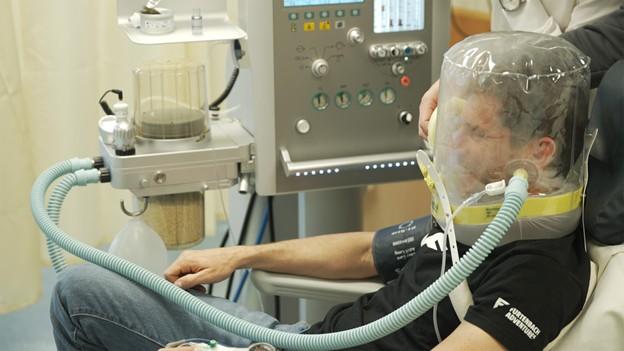
Xenon gas treatment. Source: Furtenbach Adventures
Xe gas is a hypoxia-inducible factor stabilizer and activator, meaning that exposure to xenon leads to the generation of erythropoietin (EPO). This was confirmed in humans after utilization of xenon as anesthetic agent. A later study of healthy, human volunteers concluded that any increase in erythropoietin was temporary - there were no significant lasting effects on EPO, hemoglobin mass, plasma volume, or maximal oxygen uptake. Most important, the increase in EPO does not seem to increase hemoglobin mass and/or aerobic exercise tolerance. As of 2026, xenon remains on the WADA Prohibited List (both in- and out-of- competition) as a HIF-activating agent despite the conflicting and few clinical outcome studies.
Doing drugs to help summit Everest is not new. Hermann Buhl summited Nanga Parba (Pakistan) in 1953 without the use of supplemental oxygen, but used pervitin - a stimulant similar to methamphetamine - to help stay awake for the descent. Other medicines have been tried to aid climbing and/or acclimatization, including amphetamines, Viagra, diamox, decadron, and the gold standard: oxygen. Purists maintain that taking any substance, whether by mouth, injection, or inhalation is a form of doping. Other climbers advocate that any substance that assists climbing and/or acclimatization of 8000m peaks makes the sport safer for all involved.
Regarding high-altitude mountaineering, it has been hypothesized that inhalation of Xe gas prior to departure may aid in acclimatization. In 2024, professional climbing guide Lukas Furtenbach used Xe to facilitate a quick climb of Mount Everest from the north side. In the spring of 2025, four clients (and 5 sherpas) of this guide underwent Xe inhalation as part of their preparation and were able to summit Everest in only 7 days (traveling from London). Notably, the International Climbing and Mountaineering Federation has issued a warning about the absence of scientific studies to prove the safety and efficacy of xenon at high altitude. The Federation position statement from 2025 recommends against the usage of Xe inhalation for preparation or execution of high altitude expeditions unless part of a controlled study with appropriate medical personnel, such as anesthesia.
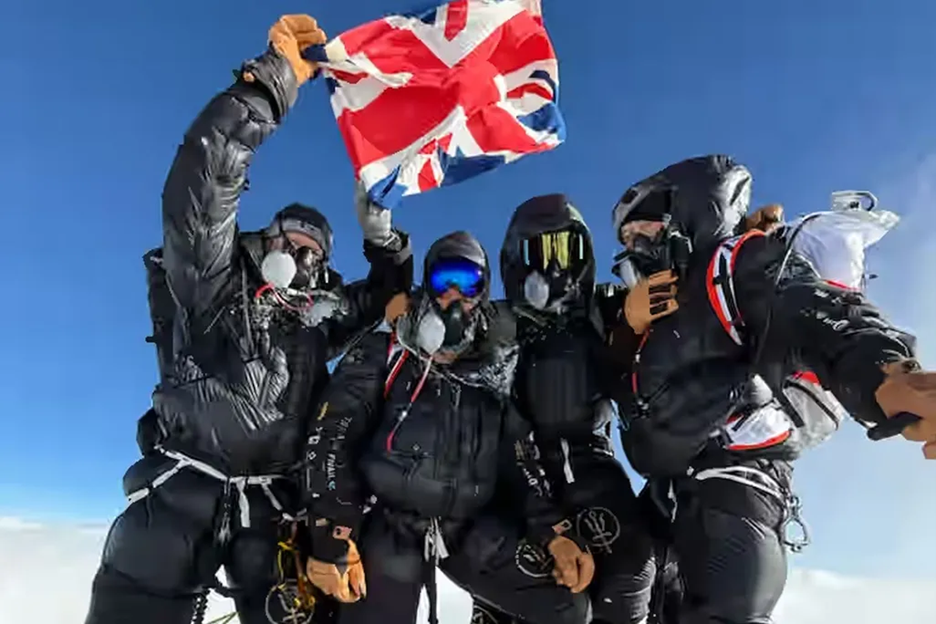
British climbers summit Mount Everest in 5 days with the aid of xenon gas. Source: Smithsonian Magazine.
Xenon was discovered in the late 1800’s, and was first used as an anesthetic in 1951. The advantages of Xe include low blood-gas and brain-blood coefficients, ensuring that Xe floods into and out of the central nervous system quickly. Narcotic effects are seen at 50% Xe concentration, and full anesthesia is achieved at 80%. Cardiovascular stability is a huge advantage, with both cardiac output and vascular resistance remaining unchanged. Mixed results in pig studies demonstrate that Xe may decrease pulmonary artery pressure, and could therefore help prevent high altitude pulmonary edema (HAPE).
German anesthesiologist Dr. Michael Fries tested Xe usage while climbing Aconcagua in 2020 and Mount Everest in 2022. Dr. Fries approached Lukas Furtenbach in 2019, positing that Xe could increase Everest safety and decrease garbage waste associated with longer expeditions. Furtenbach Adventures was formed, which facilitates climbs up Everest and other famous mountains. Dr. Fries and Furtenbach recruited 4 British clients, all of whom had both high-altitude climbing experience and military training. These clients completed 6-8 weeks of pre-acclimatization at home (normobaric hypoxia). The clients slept in hypoxic tents with increasing doses of hypoxia up to a simulated altitude of 6-7000m. Two weeks before departure, the clients received a low dose of inhaled xenon in a German hospital. They departed from London and were able to successfully summit Mount Everest 5 days later. Xenon is extremely expensive, and the cost of this expedition was about $150,000 USD per client.
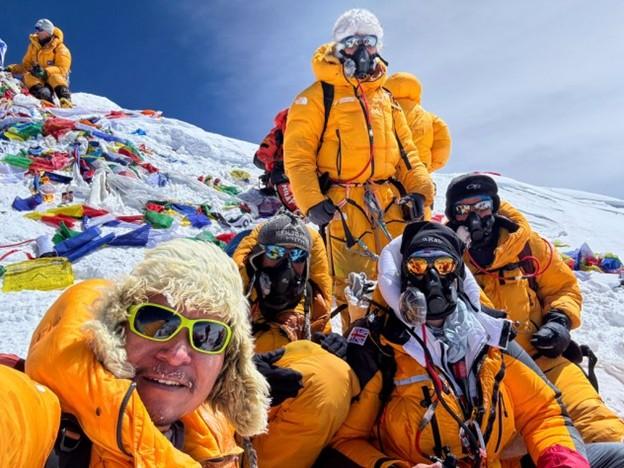
Everest climbers. Source: AccuWeather
Detractors of this approach point to xenon’s high cost and scarcity, arguing that the same physiological effects can be garnered by using a high enough flow of oxygen continuously 24/7. In May of 2025, a Ukrainian climber summitted Mount Everest 4 days after leaving NYC. This climber also utilized low oxygen training and sleeping conditions but started supplemental oxygen after leaving base camp (5364m). Concentrations started at 0.5L/min and slowly increased to 3-4L/min at the summit. In contrast, traditional Western guiding agencies typically have clients start oxygen as they move from camp II (6494m) to camp III (6800m).
Recent reviews of the 2025 Mount Everest ascent in the medical literature have explored the theory that the recent fast ascents were successful due to extensive pre-acclimatization with altitude tents. In addition, most of these expeditions were aided by Sherpa and helicopter support, good weather, and oxygen. Notably, all of the Xe-aided expeditions utilized supplemental oxygen. Due to of the lack of peer-reviewed studies and the existence of only a few case reports, it is difficult to conclude that xenon made a physiological and statistical difference. Xe inhalation does increase serum EPO concentrations, but there is little published evidence that it enhances acclimatization or prevents AMS/HAPE/HACE. Ideally, future scientific and clinical studies will evaluate the potential effect of xenon with regard to acclimatization and appropriate mountaineer utilization.