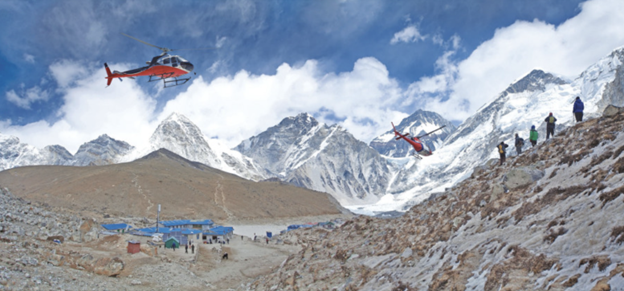
Helicopters fly over Everest Base Camp. Source: Kathmandu Post
The “Roof of the World” has been surrounded by scandal and intrigue since the first attempt at an ascent of Mount Everest in 1924, but a more modern criminal enterprise has recently come to light in the Himalayas. A new report alleges that trekking companies, helicopter operators and hospitals worked together to defraud travel insurance companies by fabricating emergencies and evacuating trekkers who had no medical need for urgent transport or treatment.
This scheme was first exposed by journalist Annabel Symington in 2018 after she learned that private helicopters in Nepal accumulated more flying hours per year than anywhere else in the world. While her reporting initially led to an official government inquiry and new regulations for trekking operators, attempts to curtail the practice over the last 8 years have been unsuccessful. In 2025, Nepal’s Central Investigation Bureau reopened the claim, with the new report showing this fraud garnered roughly $20 million dollars between 2023-2025 alone.
The organizations implicated in this scam provide trekking services throughout the Himalayas, primarily to Everest Base Camp. (This is distinctly separate from guiding companies engaged in high-altitude mountaineering such as to the summit of Everest, none of which appear to be caught up in this scam.) These locations can only be accessed on foot or by air, as there are no roads passable by vehicle in these regions, which necessitates helicopter evacuation in the event of a true emergency.
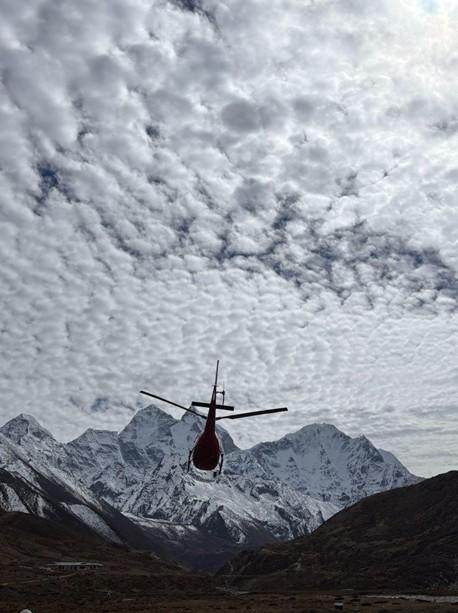
A helicopter flies over Everest Base Camp. Source: Jasmine Gale, MD, 2025 Everest ER physician
In most cases of acute mountain sickness (characterized by headaches, nausea and fatigue) or the unfortunately-common traveler’s diarrhea, supportive care and descent on foot is adequate. For many ill (or impatient) travelers, guides simply offered the option to take a helicopter ride back down after reaching Everest Base Camp to save them the 3-4 days usually required to make the return trek on foot, with the promise that their insurance company would pay for it.
In some situations, guides falsified oxygen saturations and exaggerated the risks of AMS in order to scare trekkers into complying with unnecessary helicopter rescue. Some trekking companies offer expedited tours, with patrons hiking in more quickly than the typical 8-10 days, increasing the likelihood of AMS without adequate time to acclimatize. The most eye-catching headlines claim trekking guides “poisoned” their clients by mixing baking soda in their food, with the resulting diarrhea providing adequate motivation for helicopter transport.
The guides would falsify records as needed to indicate medical necessity, and when patients arrived in Kathmandu (at 4500 feet) it was difficult to prove that they hadn’t been suffering from severe altitude illness as the mainstay of treatment for any sort of altitude illness is simple - descent. The helicopter rescue companies that were involved often evacuated multiple trekkers in a single flight, but would submit individual, full-price invoices to each trekkers insurance company as if they had been transported individually. Once in Kathmandu, hospital records were fabricated to show extensive medical care and testing that would then be submitted to the insurance companies for reimbursement. All along the chain the guides, outfitters and pilots would receive kickbacks, while the helicopter operators and hospitals would receive inflated reimbursement for services they hadn’t provided.
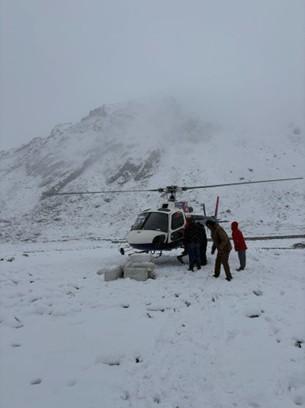
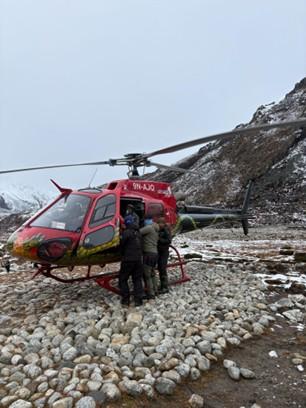
Poor visibility and snowy conditions complicates helicopter evacuation at altitude (left), loading a patient for evac from Everest ER (right). Source: Jasmine Gale, MD, 2025 Everest ER physician
Helicopter rescues are not without risk, particularly in high-altitude environments prone to extreme weather. Any time a helicopter rescue is initiated it should be with careful consideration of the risk versus benefit of extracting that patient as it puts not only the pilot and other helicopter crew members at risk, but the patient as well. Helicopter evacuations are typically undertaken only in the event of serious injury or illness when timely ground transport is impossible. In the case of Everest Base Camp the most common reasons for urgent evacuation would be high-altitude pulmonary or cerebral edema (HAPE/HACE), frostbite, hypothermia, severe dehydration or significant musculoskeletal injury.
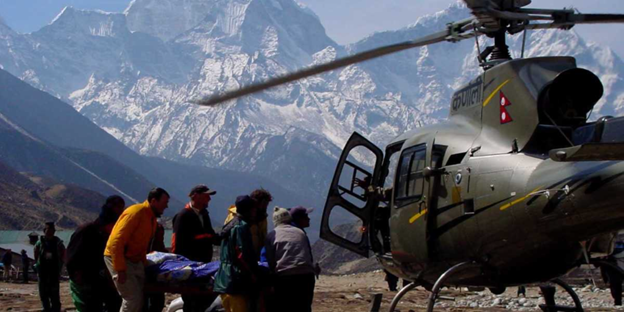
A patient is evacuated by the Nepalese Military. Source: Himalayan Rescue Association
In the case of Everest Base Camp, there is unique access to high-quality medical care available at 17,598 feet through the Himalayan Rescue Association. Since 2003 the HRA has staffed Everest ER with volunteer physicians, in order to provide care for mountaineers, trekkers and guides. This clinic allows patients to be evaluated and treated, and if urgent evacuation is indicated the providers at HRA will help coordinate evacuation via helicopter and discuss care with the receiving hospital.
When selecting travel insurance, most providers cover “evacuation to the nearest medical facility”, which typically includes helicopter transport if necessitated by the situation, although it is important to read the fine print as to what types of evacuation are covered. It may be necessary to purchase an add-on package for coverage above a certain altitude. For example, Global Rescue (which offers a discount to WMS members) has a High Altitude Evacuation Package you would need to add for coverage on trips over 15,000 feet.