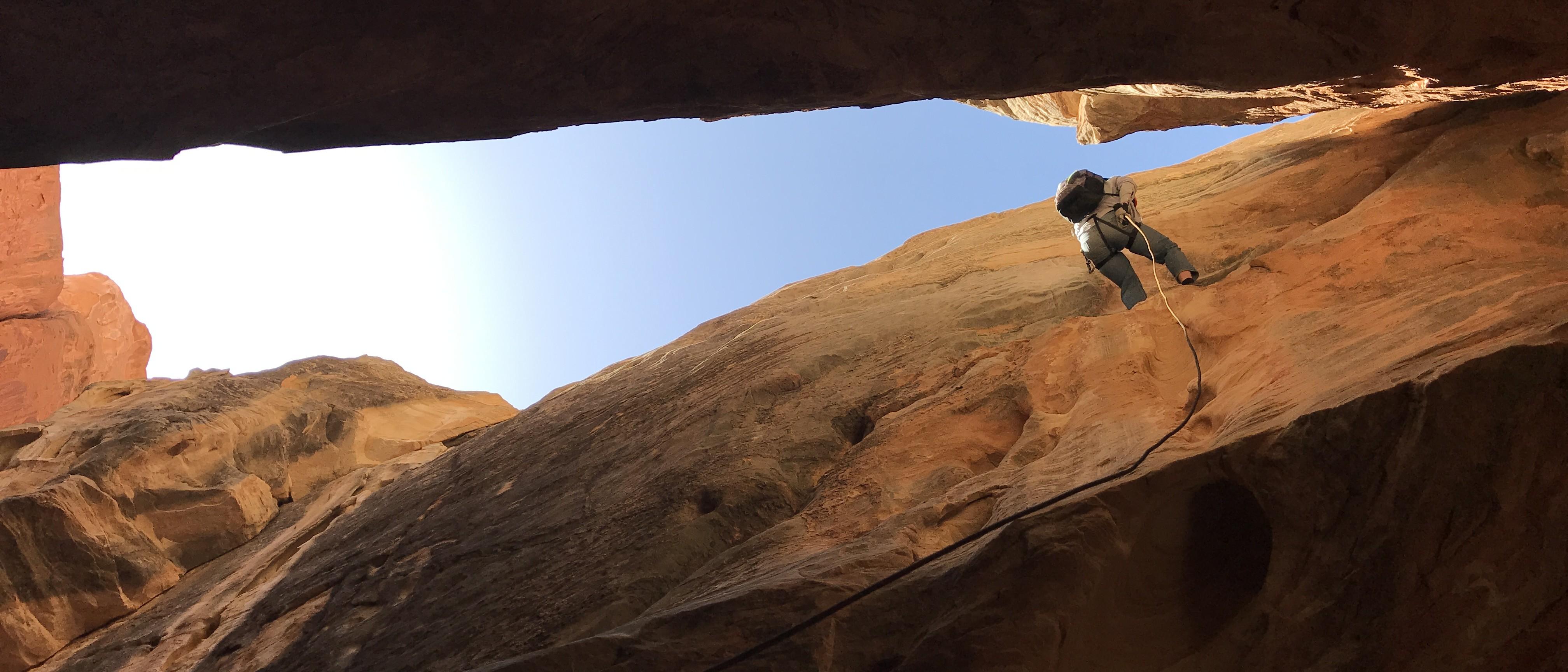
Cassidy Canyon, Rated 3A II Photo credit: Matthew McKinnon
Canyoneering, the exploration of slot canyons, occupies a unique space in wilderness medicine. To outsiders, it appears inherently dangerous: rappels into narrow stone chambers, swims through cold water, and long days spent far from roads or cell service. To experienced canyoneers, however, the risk feels manageable, provided conditions are favorable, and routes are chosen appropriately. The sport juxtaposes high perceived risk, perhaps accompanied by surges of adrenaline, with relatively low injury rates, largely due to the work of gear manufacturers and a strong culture of technical competence.
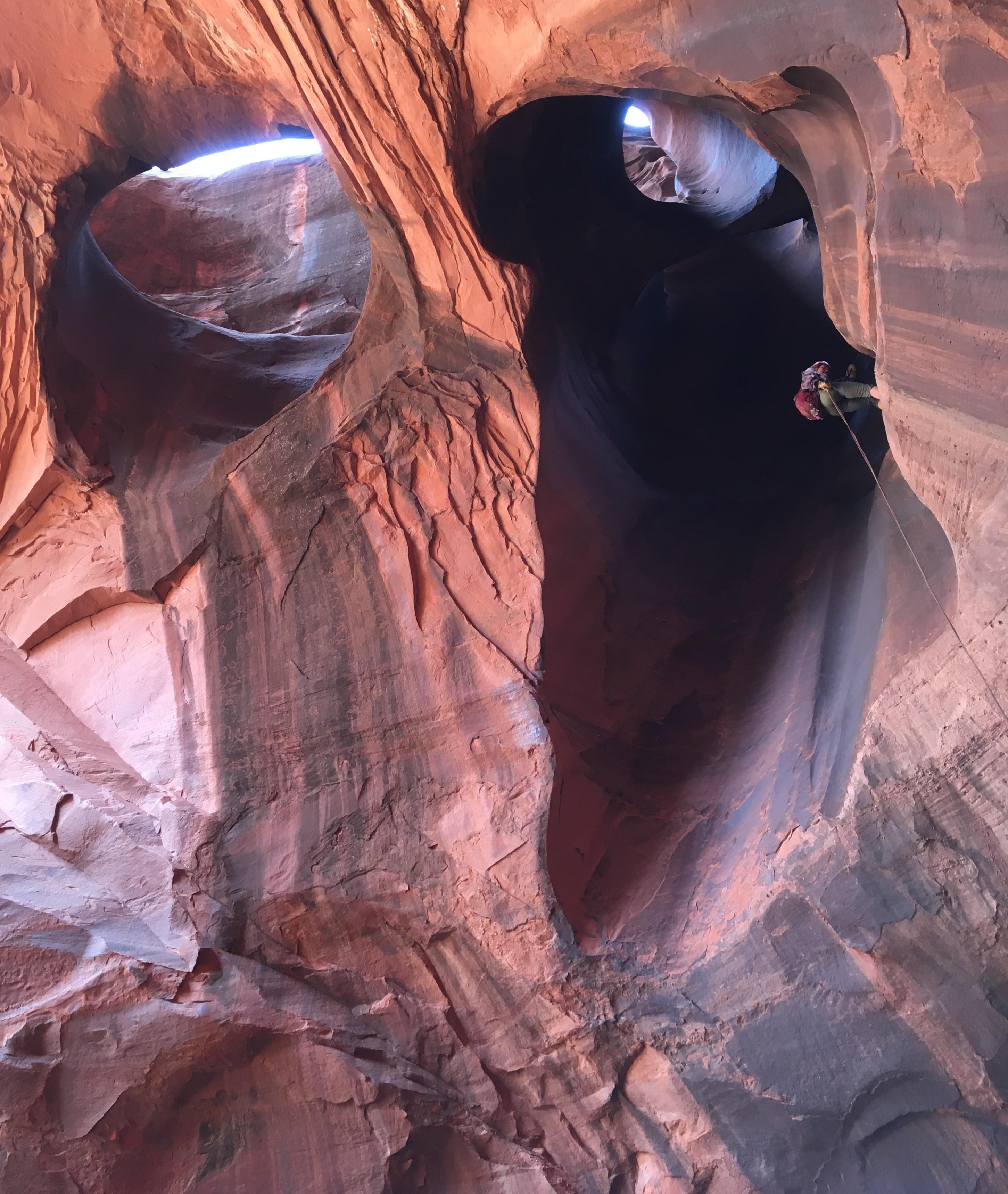
Golden Cathedral in Neon Canyon, Rated 3B IV Photo credit: Matthew McKinnon
Despite this complex relationship with risk, when serious injuries do occur, they frequently present logistical challenges for rescue teams. Remote terrain, technical rope systems, swiftwater hazards, and limited access can delay patient contact for hours or even days. Understanding how and why accidents happen in this environment is therefore highly relevant to wilderness medicine providers. Previous analyses suggest that canyoneers span a wide range of experience levels, and that experience alone is not significantly associated with incident severity. An intuitive alternative assumption is that harder canyons may result in worse injuries. After all, canyons are commonly rated by technical difficulty, water conditions, and overall risk. But is this assumption supported by accident data? And what might that data reveal about how people choose routes, assess risk, and ultimately get into trouble?
Canyon Difficulty and the ACA Rating System
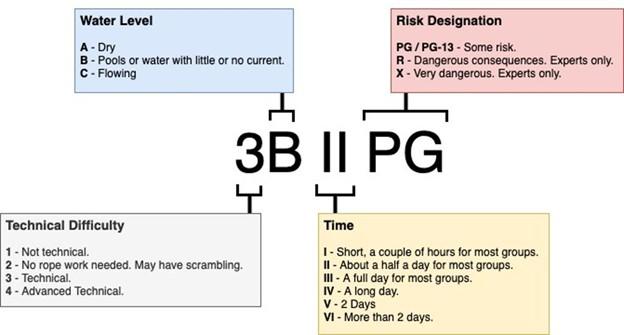
Breakdown of the ACA canyon difficulty rating system. (Image reproduced for publication with permission of Ryan Cornia at www.roadtripryan.com. See https://www.roadtripryan.com/go/c/getting-started/canyon-rating-system for more information.)
As the sport has matured, the canyoneering community has developed detailed route descriptions and difficulty ratings for many slot canyons. The most widely used framework in North America is the American Canyoneering Association (ACA) rating system, which characterizes canyons across technical difficulty, water conditions, time commitment, and risk (see Figure 1). These ratings help canyoneers select routes aligned with their skill and comfort level. A novice canyoneering group can experience a technical canyon without committing to the equivalent of a triple black diamond ski run. These ratings provide a shared language for communicating terrain, though their relationship to actual risk remains uncertain.
Exploring Accident Data
To explore whether canyon difficulty correlates with injury severity, we conducted a retrospective descriptive review of 179 accident reports from two community-maintained databases: the International Canyoneering Accident Database (ICAD) and the RopeWiki Accident Report Database.
Injuries were classified using a modified START triage framework, with outcomes ranging from minor injuries allowing self-extrication (Green), to non–life-threatening injuries preventing self-extrication (Yellow), life-threatening injuries requiring definitive care (Red), and fatalities (Black). The START triage model was selected as a foundation for injury categorization, given its simple algorithm and existing prehospital use; however, it is limited in its applicability outside mass-casualty incidents. Canyon difficulty was categorized using ACA technical grades and water ratings, which were analyzed both independently and in combination. Canyons without prior ratings were classified using established criteria.
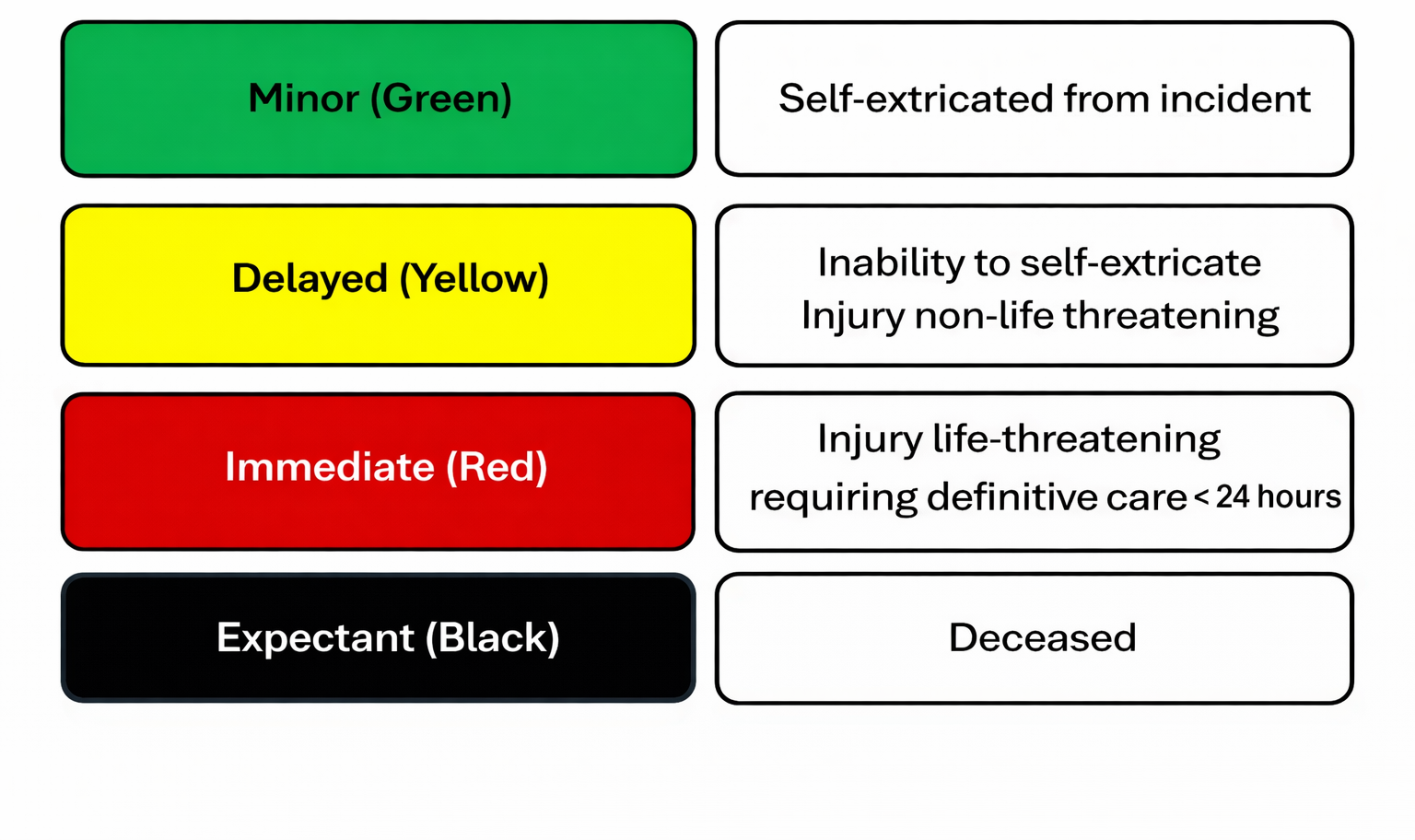
Modified START (Simple Triage and Rapid Treatment) Triage System
Statistical testing, including Fisher’s exact test, did not demonstrate a significant association between canyon difficulty and injury severity. However, closer examination revealed several notable patterns that merit discussion.
Of the 174 incidents with complete data, 94 occurred in beginner canyons, compared with 46 in intermediate and 34 in expert canyons. This distribution likely reflects exposure rather than intrinsic safety, as beginner canyons are attempted more frequently by participants with a broader range of experience. Proportionally, minor (Green) injuries decreased with increasing canyon difficulty, suggesting that accidents in more technical terrain may be less forgiving. Intermediate canyons demonstrated a relatively high proportion of non-life-threatening injuries preventing self-extrication (Yellow), possibly reflecting groups operating near the limits of their technical skill or decision-making errors that carry greater consequences in complex terrain.
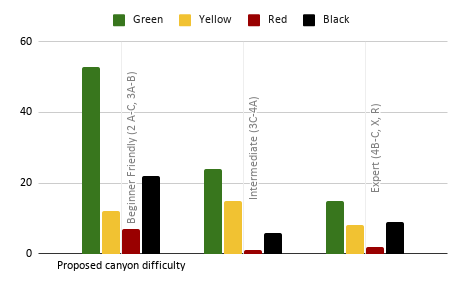
Number of Canyon Incidents by Canyon Rating and Injury Severity
Life-threatening but non-fatal (Red) were uncommon across all categories (2–7%), consistent with the austere nature of slot canyon environments, where severe injuries may progress to fatal outcomes during prolonged rescues. Fatality proportions (Black) were notably consistent across all difficulty levels, representing a substantial fraction of reported incidents regardless of rating. The consistency of fatalities across difficulty ratings suggests that catastrophic outcomes may be driven by failure modes, such as flash flooding or anchor failure, that can occur in any technical canyon. Importantly, serious injuries and fatalities occurred across all difficulty categories. Even beginner-friendly canyons accounted for 22 fatal outcomes among 94 reported incidents. This striking statistic should not be interpreted as an equal risk between beginner and advanced canyons, however, given the reporting bias and missing denominator data in the case reports.
While these accident databases are invaluable resources, they are also inherently incomplete and biased. They rely on voluntary reporting, disproportionately capture serious or unusual events, and likely miss many minor injuries and near misses. These limitations suggest that the true value of the dataset lies less in what it can definitively prove and more in what it reveals about the broader context in which canyoneering accidents occur.
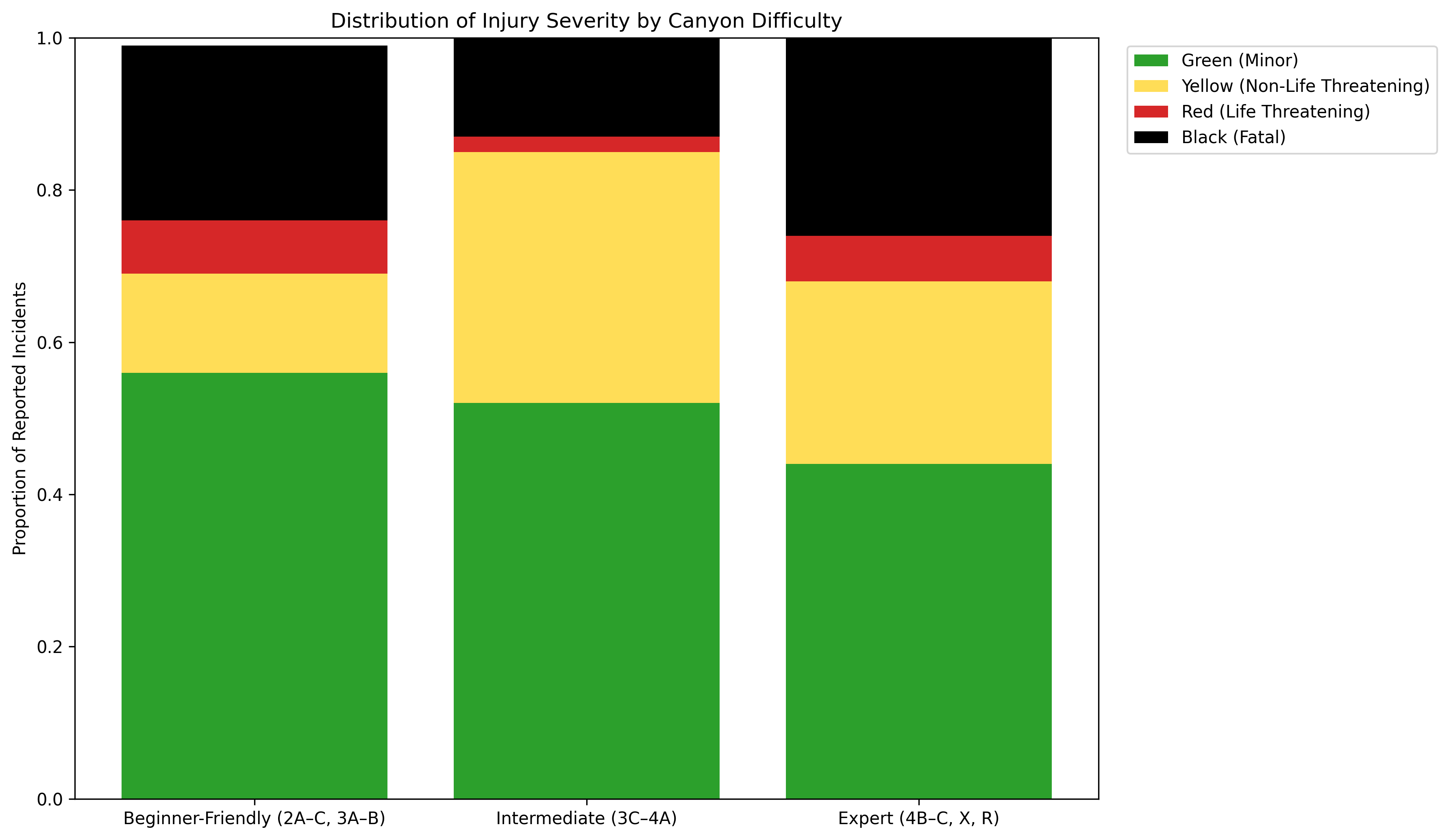
Distribution of Injury Severity by Canyon Difficulty
Beyond Terrain: Human Factors in Canyoneering Risk
One of the most compelling insights from this analysis is not what it proves, but how it can help shift our perspective. Canyon ratings describe terrain, but accidents occur within human systems.
Factors likely influencing canyon accidents include:
- Rapidly changing conditions, particularly water flow during or after storms
- Group dynamics, including leadership, communication, and teamwork
- Experience gradients within groups, where the least experienced member may drive risk
- Decision-making heuristics such as expert halo, sunk cost fallacy, and social facilitation
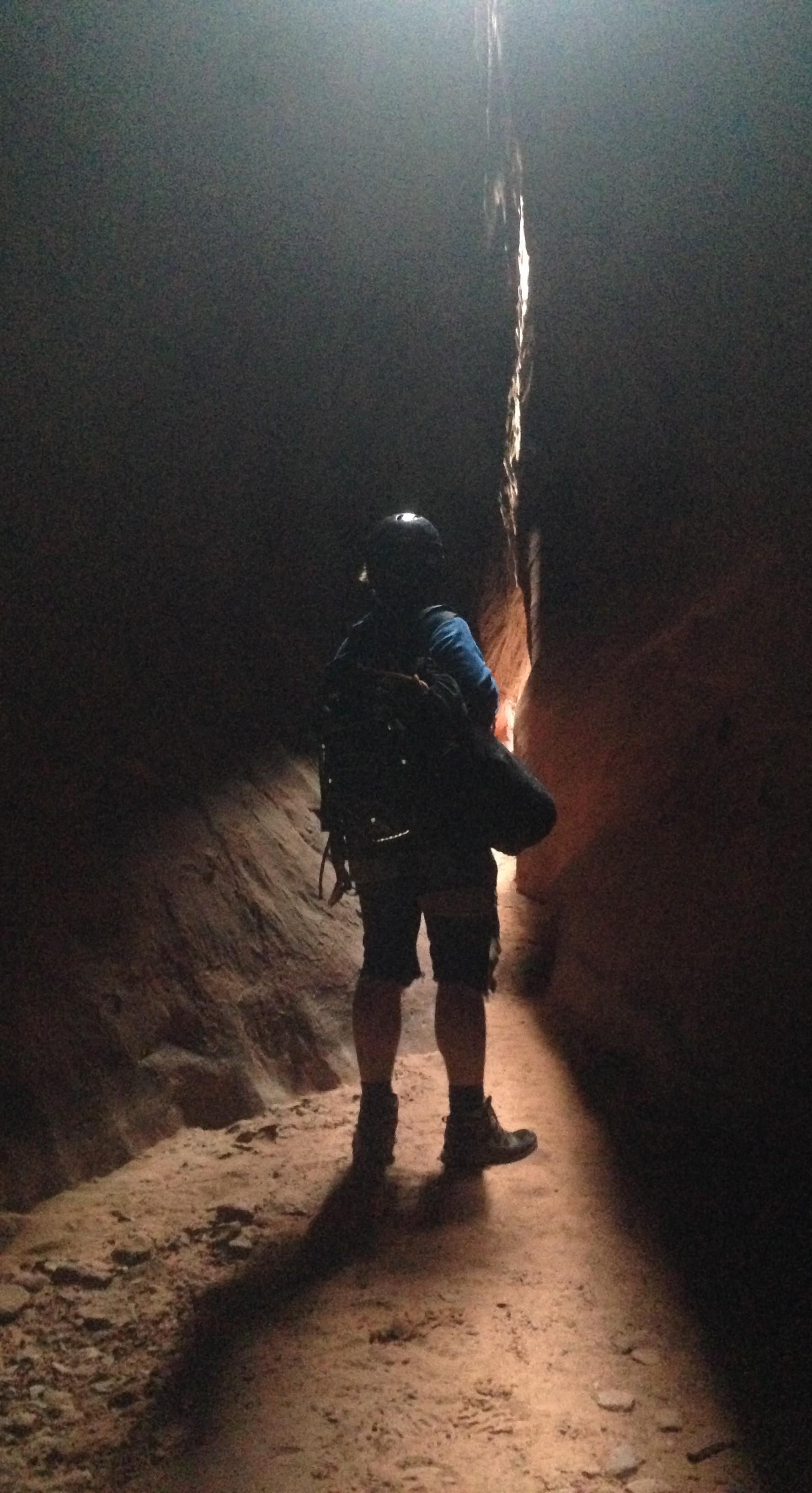
Leprechaun Canyon, Rated 3A II Photo credit: Matthew McKinnon
Prior studies suggest that most canyoneering incidents are more closely related to human factors than to environmental conditions. This pattern parallels findings in the avalanche literature, which show that accident risk is driven less by terrain gradient alone and more by human factors and cognitive traps. In his expertise, Ian McCammon found that familiarity, social proof, commitment, and scarcity are among the most prevalent heuristics that lead to avalanche accidents. Many of the same cognitive processes are almost certainly at play in canyoneering, yet they remain largely unstudied and under-addressed. With limited exit options and the potential for sudden flash floods, slot canyons are similarly wicked learning environments, in which feedback is delayed or incomplete. For wilderness medicine providers and educators, this perspective underscores the importance of addressing human factors alongside technical skills when considering prevention, training, and risk mitigation in slot canyon environments.
Conclusion
For wilderness medicine providers and rescue personnel, these findings reinforce a practical reality: serious injuries can occur in any canyon, not just those with intimidating ratings. Preparation, patient packaging, prolonged field care, and evacuation planning remain essential regardless of perceived difficulty.
For new or returning canyoneers, ensuring that all group members understand the basics of rope safety and wilderness dangers is key before attempting an expedition. In avalanche education, there is an educational computer simulation tool that equips adventurers with virtual experience to prevent real-life tragedies from occurring (especially from human error); perhaps this approach could be adapted for canyoneering.
From a prevention standpoint, the ACA rating system remains a useful tool for communicating terrain difficulty and guiding canyon selection. However, it should not be viewed as a standalone predictor of risk. Education efforts may benefit from emphasizing situational awareness, decision-making under uncertainty, and recognition of heuristic traps.
In a sport that blends technical skill, environmental uncertainty, and human judgment, understanding canyoneering accidents will require moving beyond ratings alone. The terrain (and the ropes) may be static, but people and their decisions are not.
Special thanks to the Coalition of American Canyoneers, for granting permission to utilize the International Canyon Accident Database (ICAD). Special recognition to the community of RopeWiki for maintaining their incident report database. Special thanks to the canyoneering community for their efforts in reporting canyoneering incidents.