My Story:
I am a third-year medical student who recently
completed the Wisconsin Full Ironman in 12 hours 30 minutes with
less-than-optimal training (15 hours a week for 3 months leading up to it). I
have been a relatively high-level athlete my whole life, but only during the
Ironman and after have I been thinking extensively about optimal fueling and
how that translates to best performance. One common theme I came across was
fueling with carbohydrates.
My training was unmeasured, random, and
sporadic, squeezing in workouts at lunch, extremely early, or at night when
gyms had closed. There were many instances when I planned to go 20 miles for a
run or 60 miles for a bike but had to cut it short. I tried to incorporate
these longer workouts early in the morning with no breakfast after long study
hours. I knew I had bonked because I did not eat well enough, but
I was stubborn, believing that this subpar consumption would make the race
easier.
On race day, after a (very distressingly cold)
swim session, I started my bike and took every opportunity to fuel during the
race by grabbing the snacks at the aidstations: Maurten GELs, Gatorade Endurance Formula, and prepackaged
Uncrustables. I felt great the entire 112 miles. During the run, I ran the
first half marathon in 90 minutes with no fuel but slowed down the second half,
drinking only Gatorade. Only in the last 800 meters did my legs lock up from
muscular fatigue. My mind, however, was clearer than it had ever been - I had
by some miracle avoided bonking despite my undiscipline.
The Science:
For endurance events, there have been two
different “movements” or philosophies: targeted carbohydrate consumption per
hour versus attaining metabolic flexibility. These also apply differently for
elite vs. amateur athletes like myself. A popular Norwegian runner discusses
both on his YouTube channel here.
1. Carbohydrate consumption: It was previously believed that the body could only absorb a maximum of 30-60 grams of carbohydrates per hour. This was a guideline set forth by the American College of Sports Medicine, independent of the type of activity or level of athlete. For many years, people were consuming this amount of fuel in the form of glucose (gels, chews electrolyte mix). For amateur athletes this is usually enough. Interestingly, many higher level endurance athletes have elevated fasting glucose A1cs up to 6.0%, but their post-prandial glucose is normal, as if the body had adapted to and prepared for the baseline muscular uptake of glucose from constant exercise. Blood sugar control for endurance athletes with diabetes merits its own discussion but entails continuous glucose monitoring and regular intake.
The unique glucose profiles shown in athletes is an evolving area of research. There may or may not be an increased risk for development of Type 2 diabetes even with high blood sugar levels.
A big development in carbohydrate consumption protocols came with the realization that the gut can use other receptors to absorb glucose equivalents like fructose. After many experiments, the optimal fructose:glucose ratio for most individuals (maximizing fuel absorption and minimizing GI upset) was discovered to be between 1:2 and .8:1g. The Maurten gels I took had a ratio of 8:1 with 25g of carbohydrates. Looking back, I was averaging around 25-50g of carbs per hour. Elite athletes use this ratio to increase the maximum amount of glucose their gut can absorb up to 120g of carbohydrate per hour or more. The best cyclist in the world, Tadej Podacar, consumes this much during the Tour de France or during key training sessions. To get to this level, it takes years of training the gut to be able tolerate such vast quantities of food.
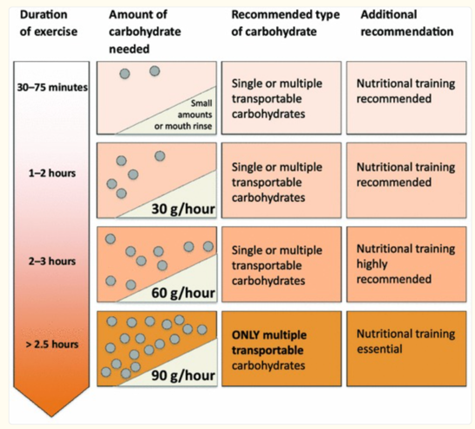
The importance of fuel consumption is not just for performance, but also for recovery. I realized I could have recovered quicker after workouts if I fueled well, allowing me to train more over time. However, I believe I was able to do well on race day because I was metabolically flexible from training so much without proper fueling.
2. Metabolic flexibility is the ability to best use whatever fuel is available. This is also something that must be trained. This concept will be different for each individual and may need to be drastically adjusted if they are for example pregnant, insulin resistant, or have a history of an eating disorder. The fundamental concept is that if you overfuel, your body may not use fat stores as efficiently.
How to improve your metabolic flexibility:
- Progressive overload and fuel cycling: Carbs are essential, but varying them intentionally can lead to better performance. This is done with cycling of muscle glycogen stores - doing some workouts without fuel, others with some consumption of carbs, and others with maximal carbs. I reiterate that carbs are essential and underconsumption can have devastating effects on performance and health. Overall, underfueling and expecting less performance in some sessions may improve the body’s ability to use different sources of fuel at hard moments in the future. This page goes into great detail citing experiments that used different training regiments (e.g. train low, recover high). However, more recent studies show that this may be nuanced, presenting data suggesting that carbohydrate cycling or restriction is less necessary to achieve metabolic flexibility.
- Intermittent fasting: Intermittent fasting (more so than caloric restriction), forces a metabolic stress that mandates the body to use different fuel sources and better toggle between what is available. For training purposes, this metabolic stress can translate to optimal use of fuel on race day, allowing subtle changes like using glucose for a short uphill segment but then settling back to ketones during a flat portion for the bike. Of note, this is NOT something you do on race day or for every training session. It is something you incorporate when you can, perhaps for easier workouts, once or twice a week e.g. doing a long run without breakfast. Elite athletes, who are adept at fat oxidation, may not need fuel for longer workouts and fuel more so to facilitate recovery or achieve harder workout goals. For an amateur athlete like me, the associated benefits are compelling enough to try. Note: There is a gender difference in response to fasting; women may need to use more caution and more research is needed on how hormonal profiles and performance change by gender during fasting.
- Incorporating different types of training that force different fuel profiles to be used: :Zone 2 exercise is critical but insufficient (per the 80-20 rule, where 80% of exercise should be Zone 2 and 20% more intense). For days when I was mentally fatigued, it was a lot easier to fit in a low intensity workout while studying with a podcast than doing something hard) We need to do sprints, lift, stretch, and cross train even with unrelated sports. I found myself doing a lot of this when - for example - trying to squeeze in a 10 minute but extremely hard bike workout before I had to leave for my medical rotation.
Conclusions:
Overall, I got lucky. I unintentionally cultivated a metabolic flexibility by the rigors of my schedule necessitating dynamic and variable types of food consumption and exercise intensities (due to just not having enough time!). My situation is unique and the information in this article should not be misconstrued as training or medical advice. I have my own South Asian genetic predisposition (I grew up often with large gaps between meals, inadvertently intermittent fasting for years) that allows me to better tolerate periods of starvation but which also increases my risk of metabolic syndrome. I have a good baseline from D1 collegiate sports and I had a wonderful support system throughout training and the race in my partner.
I plan to do another Ironman eventually, with a more measured training and nutritional approach. The most important aspect of an endurance race or any endeavor is to expose yourself to a variety of stressors in a gradual and controlled manner. As an aspiring ER doc hoping to work in austere, disaster, or global health settings, I think working to cultivate resilience and adaptability is invaluable. Food is a stressor we can modulate. Embrace curated discomfort. You will be surprised by how much your body - and your mind - will adapt.