Can a seed be dangerous? For anyone who has gotten to the bottom of a popcorn bag, recklessly gnashing until that odd kernel meets tooth, the answer is likely an emphatic yes. Honestly, there are an uncomfortable number of ways this is true. Some are choking hazards, others are poisonous, and others still are manufactured to be dangerous. How do you make a seed dangerous? A group of Coloradans have answered that question and organized to mitigate the risk to their communities. Their mission will soon lead them to the state capitol to give testimony in support of a bill. The SEED Act SB26-065, proposes to improve lives and reduce harm to wildlife, soil, and water by addressing an agricultural threat which many people are not even aware of.

Photo by Derious Oliver
What Makes These Seeds Dangerous
Neonicotinoids or neonics are a group of chemical compounds sometimes used to coat seeds as insecticides. Clothianidin, Dinotefuran, Thiamethoxam, Acetamiprid, and Thiamethoxam are all examples of neonics. You may recognize some of these chemicals from the active ingredients of bed bug sprays as well as animal flea and tick preventatives. Neonics are neurotoxic by design. They irreversibly attach to nicotinic acetylcholine receptors in the central nervous system of insects, causing paralysis and death -which would be fine and good if that was all they did. More on this to come. Coating these seeds is akin to pre-exposure prophylaxis in medicine. Like many other places, in Colorado, the practice has gone on for years. These chemicals protect crops from potential insect harm. For example, potato aphids are tiny bugs with big appetites that can devastate crops. They are known to reduce crop yields, stunt new growth, and spread rapidly if not stopped. The World Health Organization defines One Health as a “unifying approach that aims to balance and optimize the health of people, animals and ecosystems.” The One Health framework allows us to better understand the tradeoffs of neonicotinoid insecticide use. Like many communities, Colorado now reckons with what has been traded away.

Normal seeds (left) vs .coated corn seeds (right). (National Institutes of Health)
Human Impacts
The mechanism of action of neonics does not discriminate between insect and mammalian receptors, so it is not surprising that acute neonic toxicity has been reported in humans. Reported symptoms in humans range from headaches, dizziness, seizures, tremors, muscle weakness, irregular heartbeat, respiratory failure, and death in certain circumstances (see Table 1).

In particular, exposure to neonics during pregnancy and the impact on developing fetuses is a major concern. There is evidence to support that they can cross the maternal placental barrier. Furthermore, links to congenital heart defects, developmental delay, and other neurologic issues have been demonstrated.
Chronic exposure has implications on metabolic and reproductive health as well. Males exposed to neonics have shown decreased sperm motility, low sperm count, and reduced testosterone levels. Animal models in mice have demonstrated that females exposed may have reduced primary follicles in the ovary. Lastly, evidence shows a link between exposures and altered insulin regulation secondary to pancreatic dysfunction.
Animal and Environmental Impacts
When neonic coated seeds are planted, they leech into the soil and contaminate surroundings including waterways and adjacent crops. Research shows that the soil itself is stripped of nutrition and beneficial bacteria. Ground water and private well surveillance studies confirm the widespread contamination of waterways by neonics in agriculture and urban sites. Studies in Colorado have found evidence of contamination of some of its iconic water ways such as Cherry Creek. Water treatment plants that use conventional approaches struggle to remove all traces of these chemicals. Produce like spinach, strawberries, potatoes, and kale have been shown to have neonic contaminates. As can be expected, due to the ubiquity of these chemicals’, their effects impact ecosystems.
Further effects can be seen in pollinators and animals. The loss of honeybees is an ongoing problem exacerbated by neonic contamination of colonies. In a study of rodents prenatally exposed to neonics, cortical shrinking of the brain was noted. Exposed deer developed thyroid dysfunction and higher rates of birth defects. These findings are worrisome with respect to their impact on the ecosystem we live in as well as the potential human health implications. Neonics exert their effects across entire biomes.
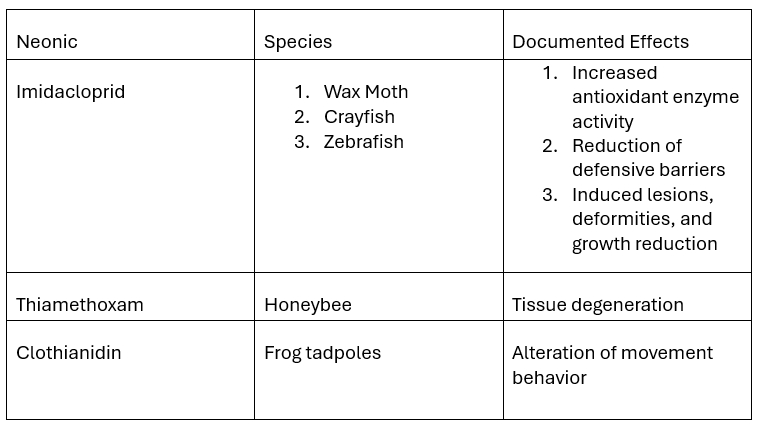
Animal Exposures and documented impact (extrapolated from Rezende-Teixeira et al)
What is the SEED Act, SB26-065?
With the knowledge of all the potential harms to human, animal, and the environmental health, Coloradans have taken a stand. These efforts stand on the shoulders of successfully passed regulations on neonicotinoids use in New York, Vermont, and Canada. The Strengthening Economic and Environmental Decisions Act, or SEED Act, is Colorado’s effort to better regulate the chemicals used in agriculture. The bill empowers Colorado farmers to opt out of the automatic coating of crop seeds with neonics but does not completely ban it. It strikes a compromise between the need to protect crops while also recognizing that much neonicotinoid insecticide use may be unnecessary. Interestingly, findings from an economic metanalysis suggest that making neonicotinoid seed treatment optional could actually reduce costs to farmers in addition to protecting their local ecosystems and human health. Lastly, this bill acknowledges that farmers would not knowingly put their neighbors’ health in danger, giving them the choice to act, considering the growing evidence of potential harm.
A Call to Action: Lessons Learned and Next Steps
Unfortunately, we now know the SEED Act has not passed the Colorado state legislature. Feeling discouraged in a moment like this is natural, but movements are more than a single success or failure and their impact can stretch across lifetimes. Do not give up on what matters to you. If you are in Colorado, you can contact your local policymakers and express your concerns about this topic to encourage ongoing discussion and future legislative efforts. If you are outside of Colorado, you can investigate what local neonicotinoid legislation may be impacting your own communities and the food you eat.
The story around the Colorado SEED Act is exemplary of modern-day cooperation. A team of legislators, lawyers, farmers, scientists, and local physicians were able to come together and discuss the downstream effects of a long-held practice with local community members and policy makers. This collaboration between professions is a reminder that people from diverse backgrounds can share common goals. Specifically, it is a reminder of three key points to both future and current health care providers of all kinds. First, your voice matters. Second, your contributions to the community do not have to be directly medical. Lastly, allow yourself to align with causes that matter to your patients, and the benefits may be plentiful.
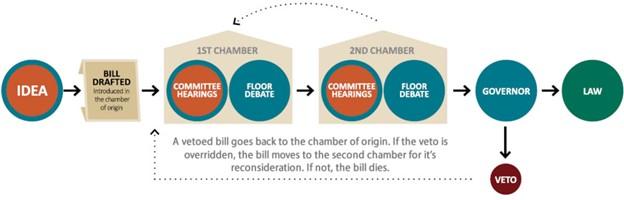
How state bills become law. (National Conference of State Legislatures)