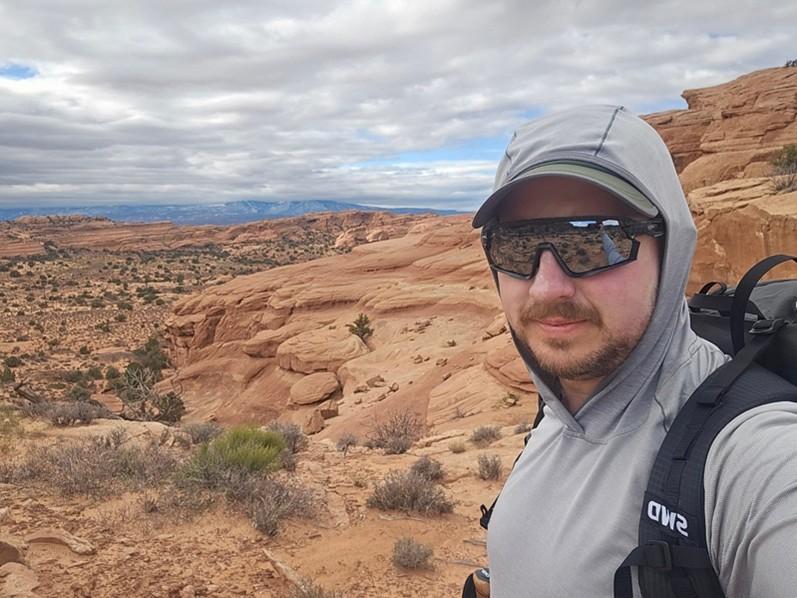
Austin Dirks, the day before the quicksand incident (Photo: Austin Dirks/Reddit)
Over the past two decades, quicksand rescues in the United States have surfaced sporadically in news headlines, capturing public fascination and revealing a misunderstood and potentially dangerous natural hazard. Though true quicksand incidents are rare, when they do occur, they frequently involve hikers, beachgoers, hunters, or motorists who inadvertently step into water-saturated sand or silt and become trapped. Most recently, two Florida teenagers suffocated under water and sand that collapsed as they dug a deep hole on a beach. Not exactly quicksand, but a testament to the insurmountable power of sand and water.
Three quicksand rescues in Utah offer important lessons about terrain awareness, satellite personal location beacons, emergency response, and the realities of survival in unstable ground. These rescues range from prolonged, hours-long extrications to complex operations requiring helicopters, ropes, and specialized search and rescue teams.
A cold December morning in Arches National Park turned unexpectedly dangerous for veteran backpacker Austin Dirks, whose solo trip along Courthouse Wash in Moab, Utah became a real-time demonstration of how wilderness hazards rarely behave the way people expect. Dirks, a highly experienced hiker with thousands of trail miles behind him, set out before sunrise. He had hiked for some time when the ground beneath him suddenly gave way. “Before this trip, I honestly thought quicksand was more of a folklore or a legend,” Dirks said in a Reddit post. That belief evaporated when his left leg punched through what looked like solid ground. After pulling it free, he shifted his weight—and instantly found his right leg sinking even deeper. “I was able to pull it out, and then I shifted all my weight to my right foot. And I sunk up to the knee,” he recalled. “It felt like I had stepped into concrete, and then it hardened around my leg. I couldn't even move it a millimeter.”
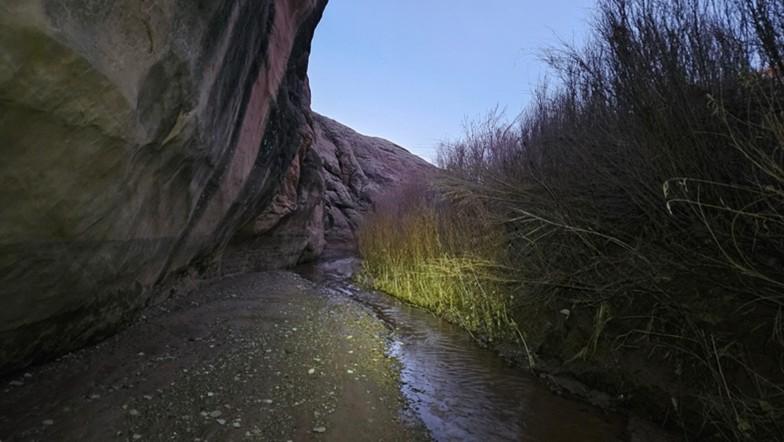
The area near where Dirks became trapped (Photo: Courtesy Austin Dirks)
Contrary to the dramatic sinking scenes portrayed in older adventure films, real quicksand behaves more like dense, viscous mud than a bottomless pit. “I tried my trekking poles. They sank to the handles the moment I leaned on them. I dug with them, anyway, hoping to carve out space around the trapped leg. The stream filled every hole instantly with sand and tiny stones. My knee bent to a painful forty-degrees.” The awkward angle of his trapped leg added another layer of concern. Dirks worried that maintaining such an extreme position for too long could result in ligament damage, dislocation, or vascular compromise. Hypothermia remained a pressing threat as well. The mud’s temperature hovered just above freezing, and the recommended survival technique of leaning backward to increase surface area and float was impossible because of his position.
With no cell signal in the canyon, Dirks turned to the tool he hoped he would never need to use: his Garmin satellite messenger. His SOS signal allowed search and rescue to pinpoint his exact location, a critical advantage in terrain where visibility, access, and navigation can be extraordinarily difficult. Grand County Search and Rescue’s Scott Sollee emphasized in Backpacker Magazine the seriousness of the desert conditions: “It's cold at night, and to spend it in cold water for a long period of time, that has serious consequences.” Sollee emphasized that satellite communication devices save lives only when used promptly. “We've had some people have those in-reach devices and not use them and then go somewhere to call 911 and then leave that area,” he said. “If you need to call 911, hit the SOS button on your satellite device if you have it, because that will tell us exactly where you're at.”
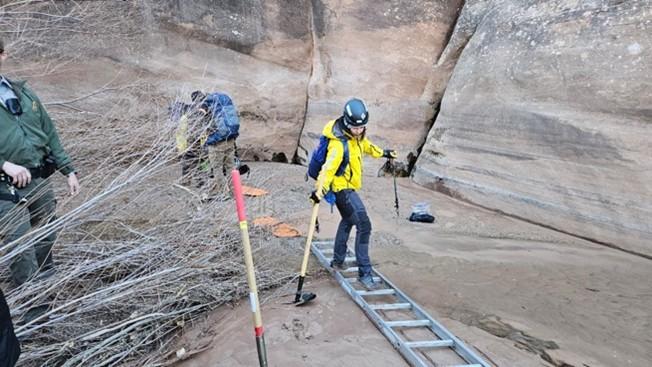
Rescuers used ladders and boards to create a safe path to Dirks. (Photo: Courtesy Austin Dirks)
Dirks is not the only person to become trapped in quicksand in recent history. In July 2014, a 78-year-old woman was rescued after becoming trapped in quicksand on the same trail as Dirks - Courthouse Wash - in the Moab area of Utah. She had gone out for a walk and failed to return home, prompting concern when she missed a scheduled book club meeting. Friends later found her car at a nearby trailhead, triggering a search by local authorities and rescue teams. She was found alive with one leg sunk into quicksand up to her knee, unable to free herself due to the strong suction created by the water-saturated sand. Despite the long ordeal, she remained conscious and in relatively good condition when rescuers reached her.
The incident drew attention because of both the woman’s age and the rarity of quicksand rescues in the region. Officials later used the site to demonstrate how deceptively stable the terrain appeared, emphasizing that even experienced hikers can encounter dangerous conditions in desert washes under the right environmental circumstances. Her rescue underscores the secondary safety importance of telling people the estimated time of return and planned path.
In February 2019, a man visiting Zion National Park became trapped in quicksand. Though quicksand incidents are uncommon in Zion, the environment’s mix of sand, water, and narrow canyons can occasionally create these dangerous conditions. Despite being immobilized, the man was able to call 911 to contact emergency services, alerting authorities to his situation and location within the park. Park rangers responded to the scene and were joined by a Utah Department of Public Safety helicopter, which assisted in the rescue operation. Using coordinated ground and air resources, rescuers were able to safely extract the man from the quicksand without serious injury. The incident underscored both the importance of rapid communication in wilderness emergencies and the need for advanced rescue capabilities, even in popular, heavily visited national parks like Zion.
Scientific studies support what rescuers and wilderness medicine specialists already know: sinking isn’t the problem. A 2005 study published in Nature by physicist Daniel Bonn demonstrated that objects with the density of the human body, as represented by aluminum beads in his experiment, float upward when quicksand is disturbed. The beads “never became more than halfway submerged” because quicksand’s viscosity increases after initial liquefaction.
The real threat lies in being immobilized in cold, wet sediment long enough for circulation to drop or hypothermia to develop.
For wilderness travelers, the message is clear: carry reliable communication devices, understand local terrain risks, travel with partners when possible, notify others of the plan and estimated time of return, and always treat cold exposure and immobilization as serious medical emergencies.
Four safety practices can save lives:
- Do not dig deep holes or tunnels in sand.
- Use the SOS function on your cell phone immediately. That is why it is there.
- A Garmin or SPOT personal location beacon can be lifesaving.
- Alert family and friends to your plan and estimated return before you go.