Multiple recent shark bites have drawn renewed attention to the risks of swimming, surfing, and recreating in the ocean. In the past 48 hours, 4 people in Australia have suffered shark bites. All have survived. A 39-year-old surfer was bitten on the chest by a suspected bull shark, with his board taking the brunt of the attack. This follows a 12-year-old boy losing both his legs after cliff-jumping into murky waters after recent heavy rains, which attracts bull sharks closer to shore. Two other surfers survived attacks in recent days, prompting widespread beach closures despite presence of shark netting.
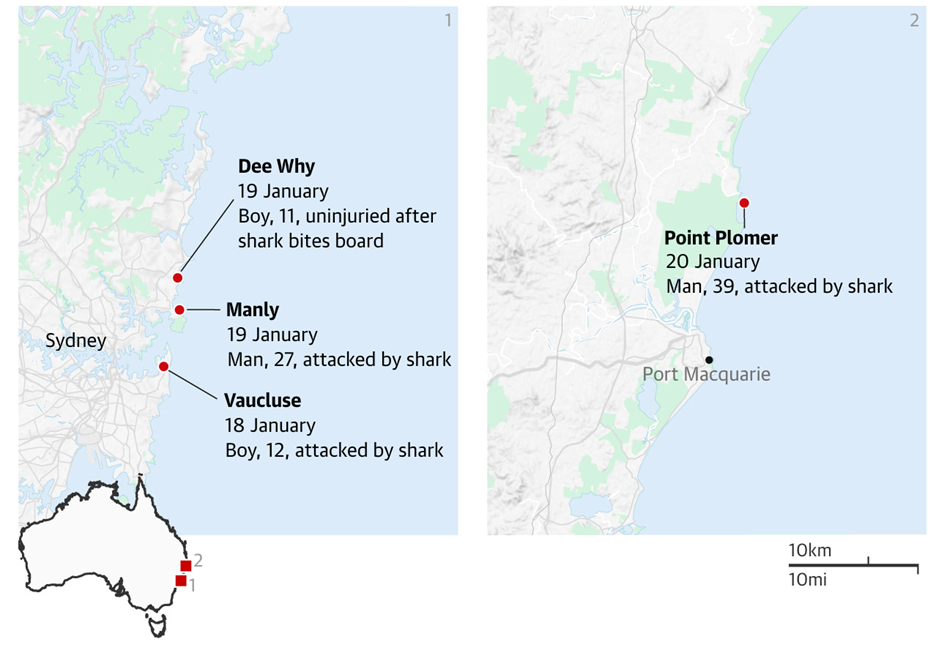
Map of recent shark attacks in Australia. Source: The Guardian.
Erica Fox, a 55-year-old experienced open-water swimmer, went missing on December 21, 2025, while swimming in the ocean near a Pacific Grove beach. Her body was found 6 days later in the sea at Davenport Beach. Curiously, she was wearing a “shark band” around her ankle. According to the coroner’s report, her death was the result of “sharp and blunt force injuries and submersion in water due to a shark attack.”
On January 8, 2026, Arlene Lillis, 56, sustained a severe upper-extremity trauma with loss of the distal portion of the left arm after a shark bite at Dorsch Beach in St. Croix, U.S. Virgin Islands. She was pulled alive from the water, and despite rescue efforts and subsequent transport to Juan F. Luis Hospital, she later died from her injuries.
These fatalities contrast with other human-shark encounters that happened on January 9 in Brazil’s Fernando de Noronha archipelago, where Tayane Dalazen, 36, was bitten on the thigh by a shark species normally not considered dangerous. She walked away with minor wounds and shared her experience on social media. A brief reminder that not all encounters lead to tragedy.
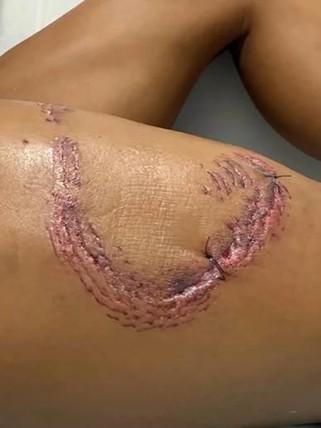
Dalazen’s wound. Source: The Sun
The most common immediate cause of death following a shark bite is uncontrolled hemorrhage. Exsanguination can occur within minutes, especially with injuries involving arterial vasculature. Survival is often dependent on hemorrhage control before evacuation. Drowning also represents a significant risk, as trauma and panic may incapacitate a swimmer from being able to protect their airway.
Immediate priorities include safely removing the victim from the water, rapidly assessing for life-threatening bleeding, and initiating hemorrhage control. Firm direct pressure remains the first-line intervention. When bleeding cannot be controlled with pressure alone and the injury involves an extremity, early tourniquet application may be lifesaving. Following bleeding control, patients should be kept warm and evacuated as rapidly as possible to definitive care. In remote settings, outcomes frequently depend on timely bystander response, emphasizing the importance of first aid training and Stop the Bleed skills among watersport enthusiasts. Those with survivable injuries should be treated with tetanus prophylaxis and antibiotics that cover marine flora such as fluoroquinolones or doxycycline in combination with third generation cephalosporins. Rabies is not of concern after a shark bite as they are not mammals.
Commercially available shark bands and magnetic bracelets are often marketed as effective personal deterrents, however a comparison study of devices used on a surfboard showed only one device generated a moderate reduction in shark interest in and distance to a board in Australian waters. Two brands of electrical shark deterrent devices reduced but did not completely mitigate bites from bull, tiger, and white sharks.
Risk reduction strategies include avoiding swimming at dawn or dusk, staying in groups, steering clear of areas with active fishing or high prey density, avoiding excessive splashing, and following local advisories or closures.