Commonly overhead conversation at the start of the WMS Student Elective:
FRED: Why are you here today?
STUDENT: I am being made to be here.
FRED (to himself): I’m gonna make this guy - and the rest of the class - love to be here.
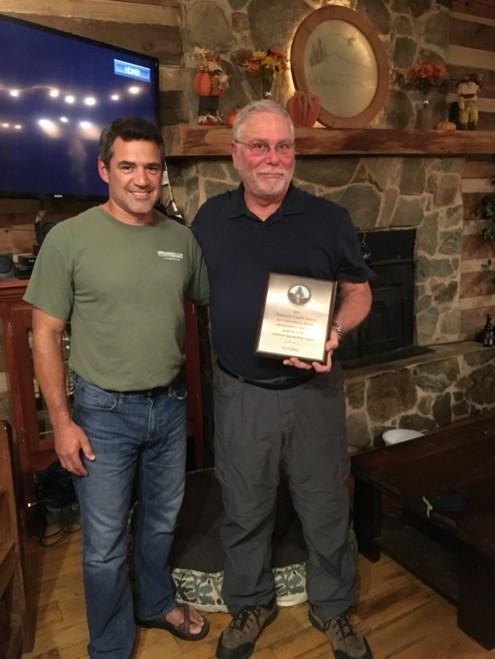
Fred Baty (right), with Mike Caudell, receiving the 2016 Mountain Laurel Award from Appalachian Center for Wilderness Medicine. (credit: Stephanie Lareau)
“The best rotation in medical school,” is how many senior medical students described the WMS Elective on their end-of-rotation evals. For most of the WMS elective students and faculty, from its inception in the early 2000’s to 2016, Fred Baty is a name recalled with admiration, warmth, and pride that you made him proud. Fred, along with Kirk Harris, was half of the Dream Team that provided the leadership for the most memorable part of the elective: a Wilderness First Responder (WFR) Course on steroids. Former students still beam with pride decades later when recalling to me their sense of sleepy-eyed accomplishment after completing this WFR bootcamp - usually culminating at 2am after an intense multi-victim mock scenario in the Appalachian wilderness.
Fred Baty spent nearly 40 years in the fire service including nine years as Assistant Fire Chief for the City of Knoxville, TN. Other career roles included search and rescue technician, paramedic, and hazmat/DMAT specialist. What elevated Fred beyond patient care in his career was his commitment to wilderness medicine education and training. Fred taught as an Adjunct Professor for Roane State from 1994-2015. What elevated Fred in the field of wilderness medical education and training was his unique ability and energy to engage every last student, even those, or especially those, who sat timidly at the back.
When I recently asked Fred his reasons for teaching, many of his answers will resonate with other lovers of medical education. Teaching kept information fresh, allowed him to keep up on new developments in the medical field, and he quickly realized that teaching helps all of us learn. Beyond that, Fred noted a high burnout rate in first responders - especially in remote areas. Working in austere environments meant “you had to know more,” because it was often going to take a lot longer than the “Golden Hour” to definitive care. Fred started in wilderness medicine education before “Wilderness First Responder” was an established certification. Recognized as a good ACLS/PALS instructor, through Wilderness Medicine Associates (WMA) in the mid 90’s, Fred had the opportunity to take and then teach a 54-hour course over five days to achieve Wilderness EMT status.
Developing a wilderness medicine curriculum locally in eastern Tennessee began with writing lessons that morphed into a semester long course. Fred had the support of University of Tennessee Emergency Physician Director of the Air Ambulance Service, Dr. Chris Brooks. What ultimately emerged was a Wilderness First Responder (WFR) course; an 80-hour / 8-day comprehensive curriculum, stocked with outdoor hands-on scenarios, that included three stages:
- Education
- Training
- Experience
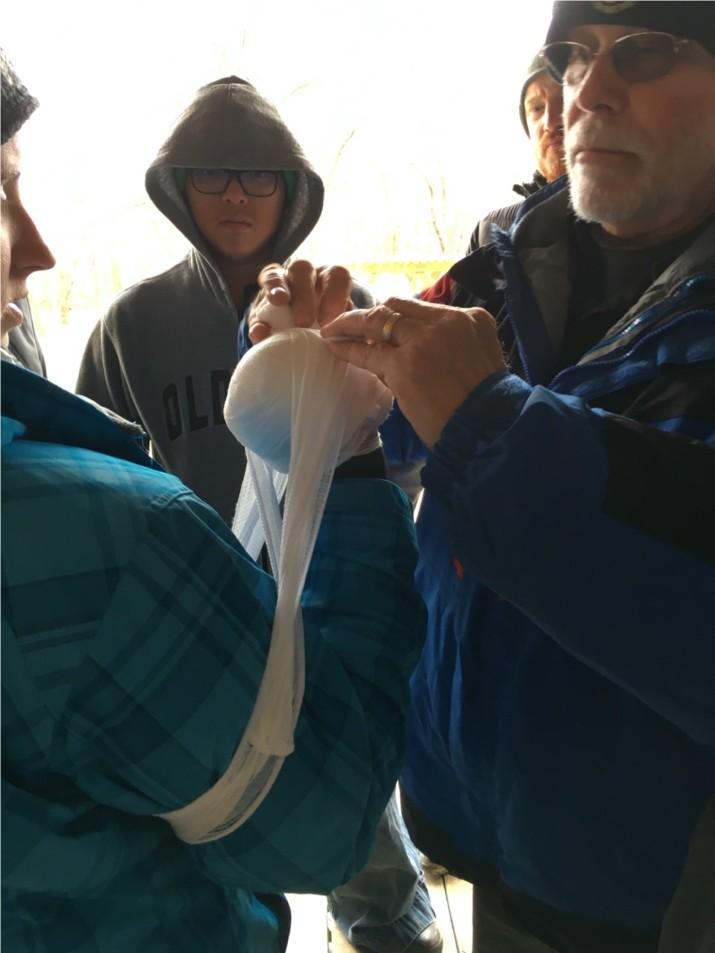
Fred demonstrating hands-on wound dressing techniques with some of his students. (credit: Liz Edelstein)
“Everyone gets a shot at being a leader.” Reflecting on this course, originally put on by Maryville College, now held every January at the Great Smoky Mountains Institute at Tremont (or “Tremont” as the locals say) as recently as 2025, Fred said, “Everybody listens through a filter. You see the light turn on when you repeat skills over and over.”
Students arrived for all different reasons: some were lifeguards, some ski patrol, volunteer firefighters, park rangers, and fully trained physicians to name a few. The WFR at Tremont ultimately became the basis for the WFR component of the WMS Student Elective. Fred went on to be part of a team to develop similar curricula for different groups:
- Wilderness First Aid: designed as a first responder course for the wilderness
- camp counselors at Camp Wesley Woods - the location where the original WMS Elective was housed
- commercial outdoor guides
- WFR: designed for various medical providers
- AWLS: an advanced outdoor medical course for medical professionals interested in wilderness medicine
Fred went on, “Decent ACLS/PALS instructors love WFR and love teaching WFR. When we get off subject that’s when I’m really having a good time!” Fred loved teaching at all levels, students with no medical experience, students with underdeveloped communication skills, people with no prior leadership experience. “You cannot teach every student the same way. Find a method to reach each person.” Fred has a special talent in reaching out to people, which made him a great resource for any educator looking to improve their teaching style. Part of his own learning process was to understand there is almost always more than one way to do something, so learn as many ways as possible. “If there is room in your brain,” take every opportunity to learn something new or learn to do something a new way. That enables you as an instructor to reach more learners at all levels. Fred’s great theory included giving students an opportunity to show their skills or use their expertise, not micro-manage and then get out of the way. One particular joy Fred describes from the instructor vantage point was watching people begin to rely on one another and work as a team.
At the height of Fred’s teaching career, he instructed four WFRs/year not including the WFR Fred and Kirk brought to the WMS Student Elective. Fred’s group attracted good people to teach and volunteer. “We always had more instructors than needed,” so they filled the classes with any learners eager to take part. Fred’s team built a roster of “patients” for the scenario-based portion of the course from grateful alumni returning as volunteer instructors. Fred notes “9/11” changed the scenarios significantly from managing two patients (one of whom would always quickly be identified as “deceased”) to managing 3-7 patients, incorporating MCI logistics. Throughout his career, Fred estimates teaching thousands of students in wilderness medicine - not counting those he taught in his other roles. It is no surprise that Fred Baty was the first ever non-physician recipient of the Mountain Laurel Lifetime Achievement Award from the Appalachian Center for Wilderness Medicine.
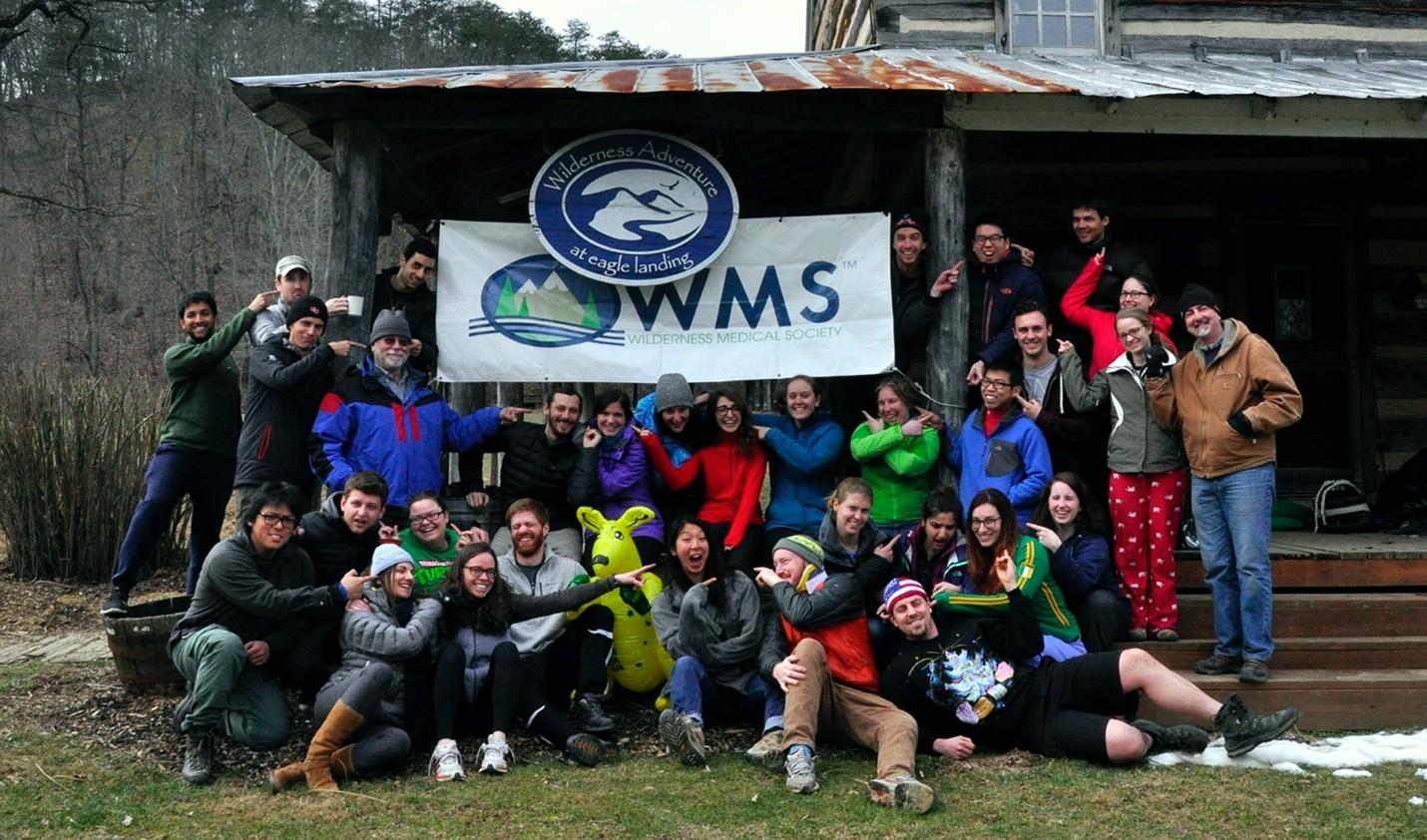
Fred surrounded by students and staff at the 2016 Student Wilderness Medicine Elective. (credit: Liz Edelstein)
At the WMS Student Elective, students can spend almost 24/7 with their instructors. That included the WFR instructors Fred and Kirk. For years the students shared housing with instructors, bunk beds at an overnight camp called Camp Wesley Woods in East Townsend, TN. That is where I met Fred Baty when I showed up as a new course director for the WMS in 2010. Boy, did I have a lot of ideas. Wow, was Fred kind as he listened and nodded. And then we got to work – a bit of didactics, a ton of skills stations, mini scenarios building to longer scenarios with debriefs and lots and lots of creative moulage. I had the privilege of teaching WFR with Fred through 2016, his last year teaching WFR for the elective, by then in New Castle, VA. I’m sure Fred still thinks about that last night-time scenario on his knees in a ravine teaching in below freezing temps at 11pm and the epic celebration of his last hurrah in the debriefs after. A testament to his connection to learners, Fred has a way of keeping in touch with many of his students - even decades later. In addition to watching an educator wizard at work, Fred taught me several life lessons:
- The importance of not judging a book by its cover and being open-minded
- The value of vocabulary and medical terminology, and when not to use them
- Memorizing students’ names
- Treating humans with dignity
- Finding ways to teach EVERYONE, from the most challenging students to the teacher’s pets. He was all in for everyone.
- Powered by giving – improving other’s careers and lives drove Fred’s commitment
Fred’s personal interests and background set him up well for success as a wilderness medicine educator. Fred had a background in public speaking, working for the Census Agency training 300 people at a time. Fred’s resume also includes being the front man in a rock-rhythm & blues band, “The Ponees”, playing electric guitar.
The content of Fred’s curriculum was top notch. Fred’s teaching style and his WFR alumni are what knocked his courses out of the park and perpetuate even now as the alumni of those courses go on to shape another generation of wilderness medicine enthusiasts.
I’ll conclude with “Great Memories about Fred” from a variety of people he worked with or taught, collated by Fred’s partner in crime and co-educator for many years, Kirk Harris.
- When trying to teach that one can get tunnel vision, he always said “to a man with a hammer, everything is a nail”.
- He always strived to make everything as real as possible so that when a real situation happened, you felt like you had already experienced it.
- He said he will not be able to save everyone, but the “wilderness is a great place to die”.
- He emphasized teamwork and helped everyone become a leader and their best selves.
- When the weather is at its worst, he’s most excited...snow, rain, ice - all “look like a scenario”.
- He can remember everyone’s names and email addresses and what year they took the class. Amazing.
- Students would often complain about him using big words. One person wrote, “the one that got me was cryotherapy, why not just say ice pack!”
- And another student said to him in class, “Fred can you say that a little more stupider?”
Parting vignette from Lisa Burchfield (former student and co-instructor):
“Fred would sacrifice himself for the sake of scenarios, the best example being when he was teaching an advanced wilderness class that I was taking before becoming a co-instructor for WFR. He set up a final scenario for us at Big South Fork State Park. It took place from late afternoon in winter till the next morning. Fred was a patient along with several others. We had to find him in the most undesirable terrain - mountains with cliffs, rock walls, and thick vegetation. After locating him, we fed him and started an IV. We packaged him and started the evacuation. We dragged him through underbrush, over rocks and up hills for hours, sometimes scooting him on the ground while crawling. After hours we let him out to relieve himself, then started again.
We did everything we could to get him out. Ultimately, we failed. He let us. What we put him through could not have been comfortable. By morning we were forced to give up. We failed to take care of ourselves.
We didn’t rest, eat, or drink. The next day we critiqued ourselves. He let us. We knew what we did wrong , A LOT. And he never criticized us but when we begged for a second chance, he allowed us to have it. He set up a second scenario at Camp Wesley Woods, at night again. We recruited additional resources, set up a headquarters, had better communications and repeated a scenario in tough terrain. Fred again volunteered to be a patient. This time we took care of ourselves and the patients. We successfully got them all out by morning. We were ecstatic. We felt successful and empowered that we could do this in real life. We learned valuable lessons about wilderness and life. He let us and led us. Fred IS wilderness medicine. He made great instructors out of myself and Kirk (Harris) and Tom (Kessler, MD) so that we had the most awesome team and adventures and helped many people gain wilderness medicine skills over the years. Fred brought us much laughter, learning, and love , for which so many of us are grateful.”
~ Lisa Burchfield
Fred - in true form is still keeping busy despite retirement. He is a traveler, motorcyclist, and photographer. Fred adores his family. He and wife Jaymi have three children and now seven grandchildren. He still welcomes any of his former students and co-instructors to reach out, catch up, and share some great wilderness medicine stories - either real or scenario-based.
The interview that inspired this article took place moments before the start of the 2020 COVID pandemic.