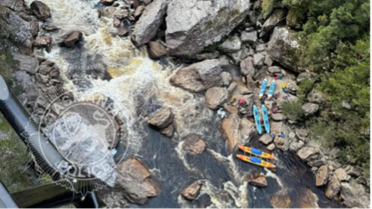
Franklin River Rescue (BBC news)
A Brief Case Summary
A 65-year-old Lithuanian man became trapped in a rock crevice while on a group kayaking expedition in southwest Tasmania in November 2024. The group of ten had stopped kayaking and was on the shore of the Franklin River. Valdas Bieliauskas, a seasoned adventurer and kayaker, slipped into the Franklin River while scouting an area near the rapids around 2:30 p.m. on November 21. He was submerged chest-deep in the 10°C rapids and his left leg became entrapped between large boulders. He and his friends were unable to free his leg, so they activated EMS using a satellite phone. Multiple rescue attempts were made throughout the day and into the night, involving two helicopters, 500 kg of gear, and 57 winches. The rescue team attempted to create space between the rocks using equipment such as spreaders and airbags. They also attempted to create a pulley system to reposition Valdas and haul him out. All of these attempts were unsuccessful. A medical team stayed with Valdas overnight to monitor his condition and treat his pain while he remained submerged waist-deep in the rapids. As the kayaker became increasingly hypothermic overnight with limited means of rewarming in the moving current, the medical team determined that he was in a life-or-limb situation. The rescue team communicated to Valdas, with the assistance of his friend, Dr. Arvydas Rudokas, a Lithuanian speaking medical doctor, that a leg amputation was the best remaining option.
The initial physician on the rescue team, Dr. Nick Scott, accidentally slipped and fractured his wrist in the same area where Valdas had fallen, requiring another physician, Dr. Jorian Kippax, to be flown in. He was tasked with performing an underwater limb amputation with a Gigli saw. Like much of the rescue team, he battled with this decision but knew it was the best choice. After Valdas was sedated with ketamine, it took Dr. Kippax less than two minutes to amputate the leg.
After he was extricated from the river, Valdas was found to be unresponsive and pulseless. He was presumed to be in hypothermic cardiac arrest, requiring mechanical cardiopulmonary resuscitation while being flown to the Royal Hobart Hospital. After spending four days in intensive care, where he was rewarmed with extracorporeal membrane oxygenation (ECMO), he awoke and made a remarkable recovery. He returned to Lithuania in January 2025 and is now continuing his recovery by learning to walk with a prosthesis. He plans to return to the Franklin River in 2026 to complete the original paddling trip.
Case Highlights and Clinical Pearls
A Cold Start
Defined as a core temperature of <35°C, hypothermia is categorized by severity based on temperature and clinical features to aid detection in resource-limited settings. The management of accidental hypothermia resulting from cold exposure mainly focuses on rewarming and preventing further heat loss. In the out-of-hospital setting, minimizing movement of a patient with moderate or severe hypothermia is particularly important to prevent fatal cardiac arrythmias. Patients should be rapidly, and carefully, extricated, but rewarming should not delay extrication.
In this case, insulating and rewarming Valdas was nearly impossible, given he was submerged in cold water. Immersion in 1-2° C water can lower core temperature as fast as 5-10°C per minute. Cardiac arrest can occur in just 30 minutes in <15° C water. Although Valdas had the insulation of a thick wetsuit and life jacket, he was submerged chest-deep in 10°C water. Valdas’ friends rotated in shifts, bringing him food and warm drinks every thirty minutes. Their efforts likely slowed the onset of hypothermia; however, with the convection of the rushing water, eventual progression into severe hypothermia was inevitable. The rescuers noted that he was “doing remarkably well”, remaining stoic and participating actively in his care for the majority of this ordeal. Over time, he became much less conversational, and it became clear that he was progressing from mild to moderate, and eventually, severe hypothermia.
Breaking Free
Field amputation is a rarely performed prehospital intervention. Indications for performing a prehospital amputation include: an immediate threat to life due to scene safety; risk of death from medical deterioration if rapid extrication by other means is not possible; a nonsurvivable or severely mutilated limb with minimal attachment that delays extrication or evacuation; and a deceased patient obstructing access to potentially viable casualties.
Like any procedure, field amputation begins with optimizing oxygenation, ventilation, hemostasis, analgesia, and securing vascular access, if possible. The medical team appropriately chose ketamine for procedural sedation, as it provides analgesia and sedation, without respiratory depression. A proximal tourniquet should be applied to minimize major bleeding and the limb should be amputated as distally as possible in a guillotine fashion – cutting through the bone using a sliding blade. All layers of skin should be first incised using shears or a similar tool, and hemostats may be applied to occlude large vessels. A Gigli saw—a lightweight surgical instrument consisting of a flexible, toothed wire—can be used, if available, to divide the bone smoothly. Some sources report that a hacksaw, reciprocating saw, or Holmatro device can be used, though they are not recommended as first-line, given risks such as additional blood loss or accidentally extending the cut beyond the minimally intended area.

Gigli Saw (Olek Remesz, WikiMedia)
In this case, submersion under water made performing the procedure especially challenging. Due to poor visibility, Dr. Kippax performed the amputation with bare hands for tactile feedback while he himself was partially submerged in spread eagle position. Rachet straps were implemented as torniquets out of concern that the hook and loop fastener of a conventional tourniquet – such as a Combat Application Tourniquet (CAT) – would not function underwater. Dr. Kippax cut through thigh musculature and began dividing the femur using a Gigli saw, which broke partway through the procedure. Despite this, he was able to cut through the rest of the femur and complete the amputation.
Afterdrop, Rescue Collapse, and Resurrection
After he was freed, Valdas likely suffered from "afterdrop” and rescue collapse. In afterdrop, core cooling continues even after removal from the cold environment. This occurs as cold peripheral blood returns to the core during rewarming, and through conductive heat transfer from warmer central tissues to colder extremities. The resulting drop in core temperature can precipitate cardiac instability, and rescue collapse during extrication or transfer often manifests as sudden cardiac arrest. Sudden movement and exercising patients should be avoided as this is known to cause rescue collapse even in those who are conscious. For this same reason, gentle and horizontal transport is recommended.
A key distinction in managing a pulseless hypothermic patient is the prolonged duration of CPR, which should continue until the patient is “warm and dead,” defined as having a core temperature >32°C. Severely hypothermic patients may qualify for venous-arterial ECMO, which supports organ perfusion but can also be used to warm the patient quickly.
Indications for hypothermia transfer to extracorporeal life support (ECLS) center include ventricular dysrhythmias, systolic BP <90 mmHg, and hypothermic patients already in cardiac arrest. Compared to other etiologies of cardiac arrest, survivability is much higher in hypothermic cardiac arrest.
After extrication, Valdas was found to be apneic and pulseless. Positional change during the extraction from vertical to horizontal may have triggered his collapse. He was winched from the crevice and placed on a mechanical CPR device before being airlifted to a tertiary care center.
A Job Well Done
Throughout this case, rescuers demonstrated exceptional preparedness and adaptability, anticipating potential outcomes and planning corresponding next steps. Friends and rescuers helped slow the progression of hypothermia through simple but effective interventions, buying valuable time to determine a means of extrication. Valdas’ determination and composure under extreme physical and psychological stress were remarkable. The team remained vigilant during the critical period following extrication, enabling immediate intervention when he lost pulses. They arrived well-prepared, equipped not only with appropriate gear but also with specialized tools such as a Gigli saw. Owing to the skill and coordination of the rescue team, Valdas ultimately survived—and was able to return home to his friends and family.