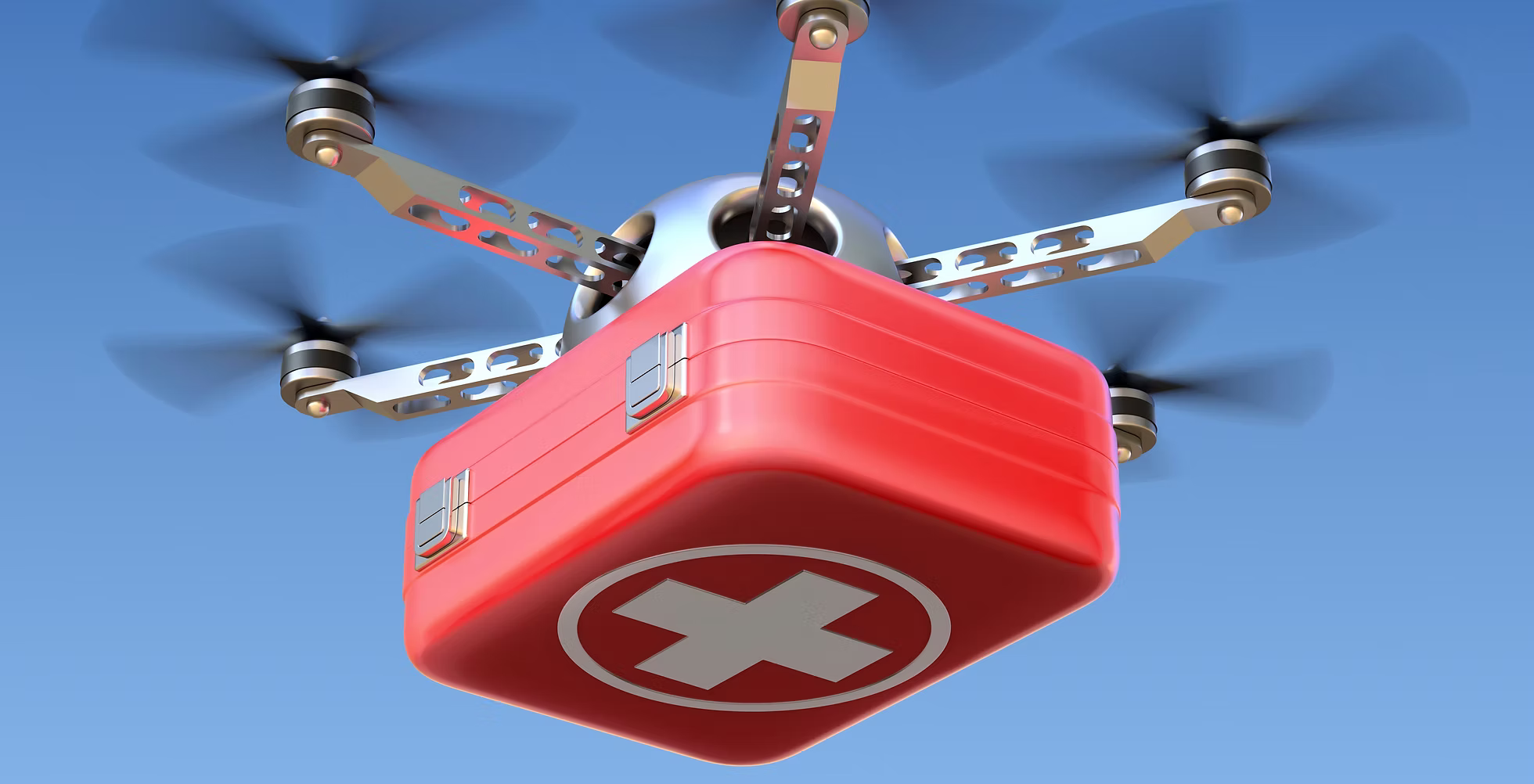
Photo credit: Jeremy Tucker
Introduction
The utilization of Unmanned Aerial Vehicles (UAVs) or Unmanned Aerial Systems (UAS), commonly referred to as drones, has transcended their military origins and has evolved into versatile commercial tools. Today, drones have diverse applications, including the delivery of small packages, conducting industrial site inspections, monitoring infrastructure, mapping, crop monitoring, emergency response, and security surveillance. Early generation UAVs have their roots in the United States military and date back to the 1800s. Currently, with extensive commercial applications of UAVs, it is indisputable that this technology will undergo further expansion for healthcare delivery in both military and civilian contexts. Our objective is to provide an overview of UAVs and UAS, emphasizing their military applications and prominent commercial uses with a focus on the UAVs healthcare delivery in challenging and remote environments.
Background
The word “drone” refers to UAVs, an aircraft that does not require an onboard pilot in order to operate. The use of UAVs for warfare is responsible for paving the way for the drone technologies we have today. Military units across the globe were among the first to recognize the benefits drones could provide to wartime strategies. Current military drones are often associated with sleek, advanced planes and quadcopters. However, the world’s militaries first developed drone technology as balloons, torpedoes, and aerial targets, and have used drones since the mid-19th century for intelligence, surveillance, reconnaissance, precision strikes, and electronic warfare. They’ve advanced from basic reconnaissance to sophisticated, sometimes autonomous weapons capable of identifying targets, relaying communications, and disrupting adversary networks.
Top Commercial UAV Uses
Even though military drones have been used for over 150 years, civilian drone ventures began in 2005 when the FAA issued its first certificate for use. Drones have proven invaluable in sectors like agriculture, industry, utilities, renewable energy, mining, drone deliveries, and ports, enhancing efficiency and reducing risks. See Table 1 for an overview of the primary commercial applications for drones, with a specific focus on the following sectors: government applications, public safety including law enforcement, firefighting, lifeguarding, inspections applications, and more.
| UAV Application |
Comments |
| Infrastructure Inspection and Maintenance
|
- Popular for infrastructure inspection and maintenance, enabling timely repairs
- In energy sector, inspecting solar panels, wind turbines, and power lines, enable detection of faults to prevent accidents and downtime
|
|
Search and Rescue Operations
|
- Significantly speed up locating of missing persons as they quickly cover vast areas, scanning for heat signatures or other signs of human presence
- Rapid response capability saves lives and ensures stranded individuals’ safety until rescue teams arrive
|
|
Agriculture and Precision Farming
|
- Revolutionize agriculture by improving crop health and yield while reducing resource consumption
- Enable early issue identification in soil, irrigation, and plant health
- Multispectral cameras detect nutrient deficiencies, pest infestations, and diseases
|
| Public Safety, Law Enforcement, Life Guarding and Firefighting |
|
| Aerial Photography and Light Detection and Ranging (LiDAR) |
- Aerial footage and LiDAR highlights features not visible from ground
- Drones capture difficult or costly LiDAR surveys
|
| Mapping and Surveying |
- Drones cover large areas quickly and capture high-resolution imagery, making them valuable tools in construction, mining, and environmental management
|
| Environmental Monitoring and Conservation |
- Drones monitor deforestation, supporting conservation efforts
- They track wildlife populations, identify breeding sites, and monitor climate change impacts
- Combat illegal activities like poaching and logging by providing surveillance
|
| Emergency Response and Disaster Management |
- Provide rapid deployment, real-time data collection, and enhanced situational awareness.
- After a natural disaster, quickly assess damage, locate victims, and deliver supplies
|
| Telecommunications and Power Line Inspection |
- Safely inspect and maintain telecommunications infrastructure and power lines, enabling efficient maintenance and reducing service disruptions
|
| Medical and Cargo Delivery |
|
Table 1. Top UAV commercial applications.
UAVs and Healthcare Delivery in the Military and Civilian Sectors
UAVs are rapidly integrating into military healthcare to expedite medical supply delivery, facilitate casualty evacuation, and minimize personnel risk in combat zones. This technology addresses logistical challenges in austere environments, supporting critical functions like point-of-injury care and prolonged field care. See Table 2 for an overview of UAVs use in military healthcare delivery.
| UAV Healthcare Application |
Comments |
| Medical supply and resupply |
|
| Casualty evacuation |
|
| Enhanced medical support and triage |
- Assist military healthcare by providing remote support and surveillance, offering medics real-time video feeds for initial assessments and remote guidance, as well as in mass casualty situations
|
Table 2. Uses of UAVs in military healthcare delivery.
In addition to their military applications, civilian drones are transforming healthcare by expediting the delivery of vital supplies and medications to underserved and remote areas in the US and worldwide. For further insights into medical drone applications, refer to Figure 1. These advanced aerial lifelines bridge emergency care gaps, ensuring vital resources reach patients in need, regardless of location. Capable of navigating challenging terrains and traffic patterns, medical drones improve life-saving outcomes and reshape healthcare logistics, making rapid response and care more accessible.
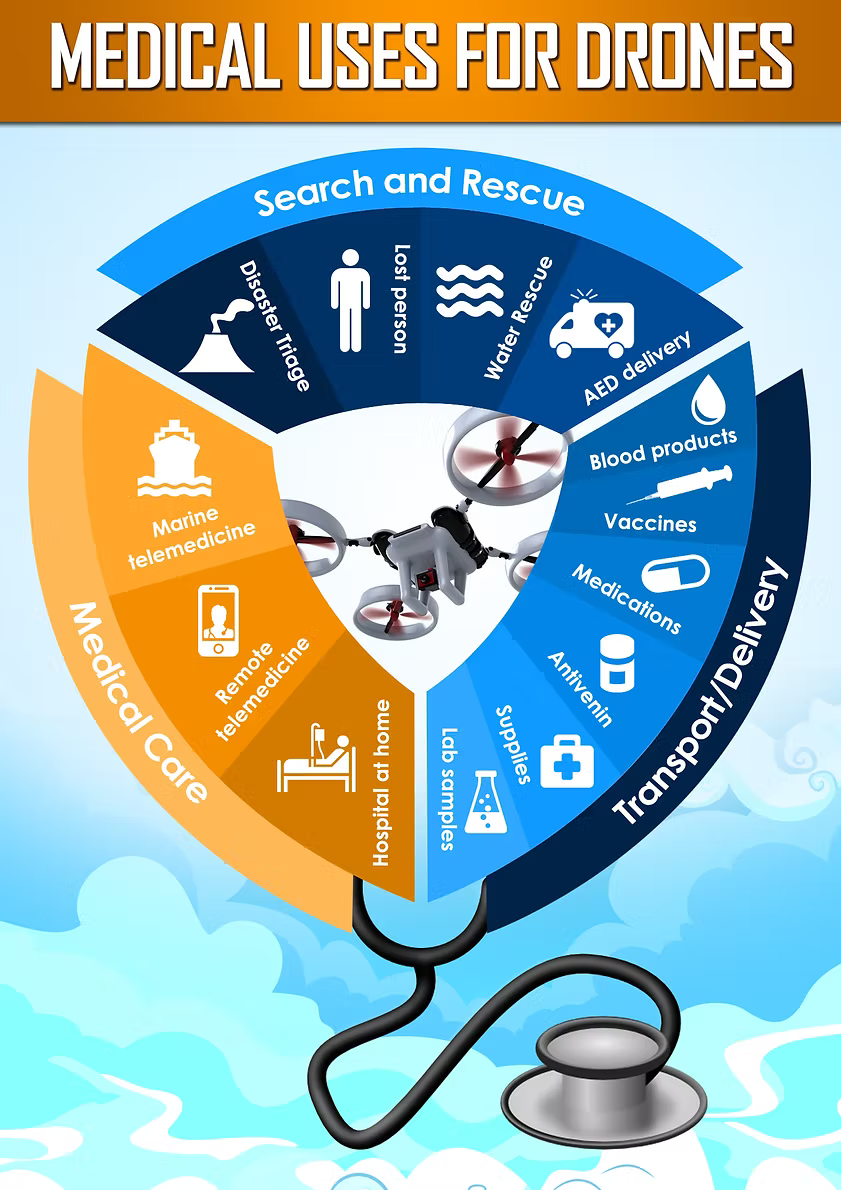
Figure 1. The medical application of UAVs. Graphic credit Jeremy Tucker.
The use of drones is fairly established during natural disaster recovery, and during search and rescue operations. This technology presents significant potential for healthcare delivery in other domains of wilderness medicine. Advancements in drone technology, as exemplified by Zipline, a pioneering company in drone delivery, enable the utilization of UAVs in developing countries. Zipline’s drones, known as Zips, have transformed logistics by facilitating rapid and efficient delivery of medical supplies, vaccines, and blood products, particularly in remote and inaccessible areas. Commencing in Rwanda and expanding across Africa to Ghana, Nigeria, and Côte d’Ivoire. Zipline’s mission underscores the transformative power of technology and innovation. See Table 3 for key areas that use of UAVs for civilian healthcare delivery.
| UAV Healthcare Application |
Comments |
| Emergency Medical Supply Delivery |
- Deliver life-saving supplies directly to remote locations and disaster-stricken areas with impassable roads
- Beyond disasters, drones supply medical supplies to underserved rural areas.
|
| Transporting Organs for Transplantation |
- Enable rapid, safe, secure, and direct organ transportation between hospitals, bypassing road congestion and reaching remote
- Maintain a controlled environment with temperature regulation to minimize deterioration
|
| Telemedicine and Remote Consultation |
- Enhance telemedicine by transporting diagnostic equipment and supplies to underserved regions, facilitating virtual consultations, remote patient monitoring, and timely diagnoses and treatments
|
| Rapid Diagnostic Testing |
- Rapidly deliver testing kits for COVID-19, malaria, or HIV to rural areas, reducing sample transport time and accelerating diagnostics
- Collect samples from patients and transport them to urban labs for quick analysis and timely results, crucial for initiating treatment and disease prevention
|
| Vaccine Distribution |
- Deliver vaccines quickly to regions where conventional transportation fails, crucial in global health emergencies, preventing widespread outbreaks
- Preserve vaccines during transit, minimizing spoilage or reduced efficacy, especially for temperature-sensitive vaccines
|
| Patient Monitoring and Transport |
- Equipped with advanced sensors and patient monitoring devices revolutionize patient transport
- Being explored as potential transport vehicles for patients, carrying lightweight medical devices like defibrillators and ventilators
|
| Aerial Ambulance Services |
- Aerial ambulance services powered by drones bypass traffic congestion, reaching emergency situations faster than traditional ambulances
- Can transport injured patients to medical facilities equipped with real-time monitoring devices
|
| Medical Research and Vaccine Trails |
- Streamline logistics and enhance clinical trial efficiency by rapidly transporting medical samples, research materials, and biological specimens between facilities, ensuring timely delivery of critical samples like blood, tissue biopsies, or experimental drugs
|
Table 3. Key areas for the use of UAVs in civilian healthcare delivery.
Conclusion
Unmanned Aerial Vehicles are transforming their applications across military, commercial, industrial, and healthcare sectors. They provide substantial benefits, including enhanced efficiency and cost reduction, as well as improved safety protocols. As drone technology progresses, it is highly probable that we will witness further innovative applications of UAVs in the majority of wilderness medicine domains. Based on all available indicators of risks and challenges, the only limitations appear to be creativity and logistics for implementing these technologies in the majority of challenging and remote environments.