From Cleopatra’s asp to whip cracking Hollywood icons, venomous snakes have long captured the imagination of humanity. Featuring in endless tales of exploration and discovery, venomous snakes have become synonymous with the hazards of wilderness adventure. This fascination extends beyond the world of healthcare with countless folk remedies, old wives' tales, and superstitions about snake bites permeating popular culture. But this celebrity status belies an incredibly serious condition affecting nearly 3 million people annually (WHO).

Venomous snake bites permeate popular culture (Image credit Disney/Lucasfilm imdb.com)
Perhaps in response to this celebrity treatment of a dangerous medical condition, medical education regarding snakebites has traditionally been rigid and pedantic with a focus on the rote memorization of individual snake species and their minutiae. From venom proteins to anal scales, trainees have been taught to master an exhaustive list of details about specific snakes. This methodology unfortunately leaves trainees completely unprepared to deal with unfamiliar snakes.
In an increasingly globalized world where practitioners are exploring wilderness spaces far from home, they are encountering snakes with which they have no familiarity. What use is a detailed understanding of the color patters of snakes of the American Southwest to a traveler encountering a venomous snake along the banks of the Nile?
This article attempts to address this problem by focusing on the anatomy, distribution, and behavior of snakes. This article provides a framework for understanding snake envenomation around the world. This is not an exhaustive guide meant to prepare providers to definitively manage all snake bites (that would require volumes) but instead is an attempt to build a conceptual understanding of snake venom to help practitioners make educated decisions when faced with a bite from an unfamiliar snake.
Much information about envenomation can be gained simply by looking at a snake. What shape is its head, what kind of fangs does it have, and what can that tell us about its bite. Geography also provides clues. Evolution is efficient and snake biology is conserved in regions often bound by geographic barriers. Lastly, we can examine snake behavior. How the snake acts provides useful information about the identity of the snake and the likely effects of its bite. Using these characteristics, we will build a frame of reference for travelling providers below.
The first major division in grouping venomous snakes is dichotomous and based on fang location. Rear-fanged snakes (Figure 1) have unsophisticated venom systems, deliver small doses of venom over time, and almost never generate medically significant bites. For the purposes of this article, they can be ignored.
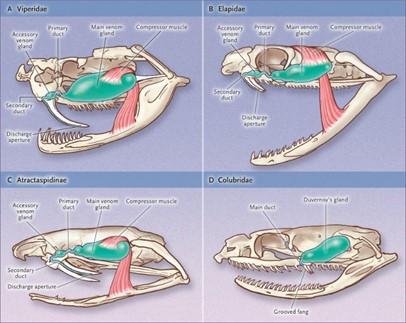
Rear fanged snake skull (bottom right) as compared to front fanged skulls; (“Snake Envenomation” NEJM 2022)
Much more important and clinically relevant are the front-fanged snakes. These are the snakes with highly developed venom mechanisms (including reservoirs and specialized fangs) responsible for clinically significant envenomation. Front-fanged snakes can be subdivided into the families Viperidae, Elapidae, and Atractaspididae.
Viperidae
Likely the group most familiar to North American readers, Viperidae are characterized by large retractable fangs with extensive venom reservoirs designed to deliver substantial doses of venom to deep tissues. To accommodate large venom systems, Viperidae skulls are widened at the base creating a characteristic arrowhead shaped head. The sophistication of their venom system allows modulation, with some bites occurring without any venom delivery. Viperidae are ambush predators, often featuring heavy camouflage and slit-pupils. Rarely aggressive, Viperidae bites often occur due to accidental treading upon these snakes. They are distributed across the Americas, Eurasia, and Africa. Well-known examples include rattlesnakes, adders, and asps.

Head shapes of common Viperidae compared to an Elapidae species (coral snake) (Drawing by Cadmus Cornfoot)
Functionally intramuscular needles, the elongated fangs of Viperidae snakes deliver large volumes of venom to deep tissues. Their venom is predominantly proteases and hemotoxins that dissolve local tissues gradually. Because of their local effects, venom-delivering bites are immediately painful but rarely cause systemic toxicities. As such, when dealing with these bites, pain control will be the primary challenge in a resource limited situation.
Toxins are relatively conserved across Viperidae species which allows for common antivenoms to be developed. In the Americas, CroFab is the antivenom for Viperidae bites, while outside the Americas there are regional variants of InoSerp (e.g. InoSerp-PanAfrica for sub-Saharan Africa, Ino-Serp MENA for Middle East and North Africa, InoSerp Europe etc.)
Elapidae
Elapidae species have fine fangs and less sophisticated venom delivery systems that do not require excess skull space. Elapidae have long thin bodies that continue seamlessly into the head without flaring. These snakes are active and often display elaborate threat behavior before striking. Elapidae are often brightly colored, are the only aquatic snakes, and are distributed throughout the tropics. Well-known Elapidae include cobras, coral snakes, mambas, and kraits.
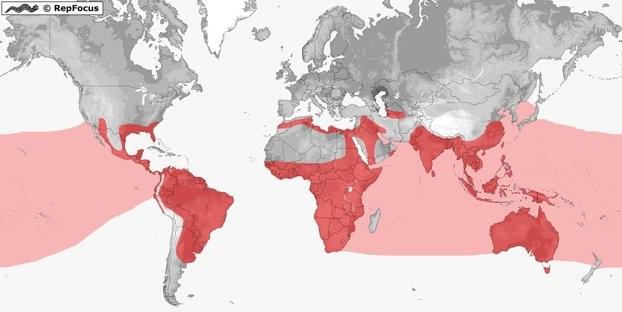
Geographic distribution of Elapidae Species (RepFocus.DK)
Elapidae fangs are similar to subcutaneous needles, only able to deliver small amounts of venom. Consequently, Elapidae toxins are more potent. They are extremely diverse and individual species often produce a cocktail of different toxins. These potent toxins are systemically active. Bites are often painless, and they may go unnoticed. In the Americas all Elapidae are coral snakes, which led to the development of North American Coral Snake Antivenin (NACSA). Outside of the Americas the diversity of Elapidae and toxins means that there is no unifying antivenom (each antivenom is species specific). As such, in resource poor environments treating Elapidae envenomation is focused on supportive care and rapid evacuation.
Atractaspididae
Atractaspididae fangs characteristically protrude laterally from the snake’s jaw. The fangs are exposed even when the snake’s mouth is closed. They are burrowing snakes and are often mistaken for worms because of their size and underground dwellings. They envenomate their prey with a characteristic swiping motion of the head, striking with their exposed fangs as opposed to truly biting. These snakes are distributed across Sub-Saharan Africa and the Red Sea coast and are poorly studied.


A Stiletto snake (Atractaspididae) next to a coin (left); Stiletto snake’s laterally protruding fangs (right). (African Snakebite Institute)
Atractaspididae venom is dominated by sarafotoxins and endothelin that promote localized vasoconstriction. Bites can lead to digital necrosis, which is the primary clinical concern with Atractaspidinae envenomation. There are no antivenoms for these toxins so supportive care and pain control are the mainstays of treatment.
The table below summarizes characteristics of front-fanged snakes.

In summary, snakebites loom large in the public consciousness and represent a serious medical threat. Medical education has traditionally focused on rote details of individual snake species and their venom, but this approach is less efficient for rapid identification of an unfamiliar snake. By using morphologic and behavioral characteristics, snakes can be divided into three clinically significant groups (Viperidae, Elapidae, and Atractaspididae). Toxins are conserved within these groups allowing for the estimation of clinical course and care requirements based on the morphologic and behavioral characteristics of a snake.