On March 7th, several Saint Louis University (SLU) Emergency Medicine residents and medical students participated in a search and rescue training exercise in the western part of St. Louis County. The exercise was part of the wilderness medicine elective rotation at SLU. This rotation is designed for medical students interested in learning how to manage trauma and illness in settings with limited resources, personnel, and access to definitive care.
We arrived at a cabin surrounded by a hardwood forest, where the search and rescue (SAR) coordinators informed us that a mother and child had gone missing during a hike. We were introduced to some common search tactics and formulated a plan for this SAR mission.
A search plan is developed with the goal of increasing the probability of finding the lost individual. First, a search area is defined by dividing a map into a grid of search zones. Next, the lost person’s Point Last Seen (PLS) is identified. This allows the search party to designate a starting point. The search area can be further narrowed by combining the PLS with knowledge of how far the person could have traveled in the time they have been missing. The person’s Last Known Position (LKP) can be updated continuously with clues, such as shoe prints or personal belongings.
The probability of detection can be further increased using a variety of land field search types. A hasty search involves assigning a team to search all the places where the person is likely to go before a significant amount of time elapses. Search members should possess diversified skills, such as emergency medical training, knowledge of the area, and search dog handling.
A loose grid search can also be used, which involves a small team of searchers who are allowed to meander along their search path.
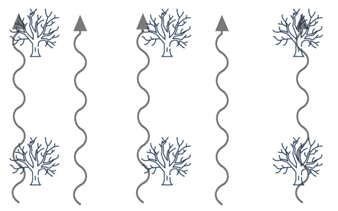
Loose grid search pattern.
Finally, a tight grid search which is more resource intensive and requires large teams to walk closely spaced and in straight lines. A tight grid search is often a last resort because it can be an inefficient use of man hours.
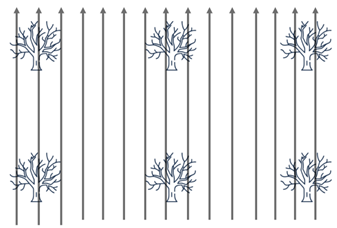
Tight grid search pattern.
Our search began at the PLS for the mother and son. Hank, a bloodhound, who is field-certified to identify and track human scents, was presented with an article of clothing from the "missing" mother and child.
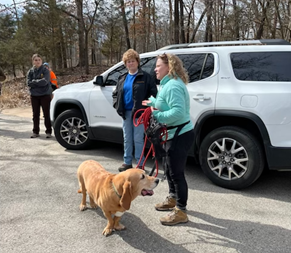
Hank the Search and Rescue dog and Jan his handler (Source: Dr. Prajwal Keranalli).
The medical students and residents split into two teams: one following Hank and his handler and the second performing a loose grid search. We observed as Hank tracked the victims’ individual scent trail through dense grass and shrubs. During the search, the teams identified articles of clothing that were presumably left behind by the victims. Hank’s training, combined with the handler’s understanding of wind dynamics, ultimately guided our search team to the location of the missing individuals.
In the demanding realm of wilderness SAR, time is critical—and canines have repeatedly proven to be vital tools for locating missing persons. Their superior olfactory capabilities and mobility across rugged terrains make them indispensable in SAR operations.
Recent studies have provided empirical evidence to support the widespread use of canines in SAR operations. A landmark study by Greatbatch et al. (2015) examined the effectiveness of trained SAR dog teams in wilderness scenarios. Across 25 simulated searches, dogs successfully located 76.4% of hidden human targets, with an operational effectiveness rate of 62.9% when factoring in false positives. This clearly surpasses what unassisted human teams typically achieve over similar terrain and timeframes.
Moreover, SAR dogs can cover approximately 2.4 times the distance of their human handlers during a search, increasing search coverage and reducing time to target. Their ability to work in low-visibility environments—such as at night or in dense forest—further enhances their utility, especially when aerial searches or technological aids like drones are limited by environmental factors.
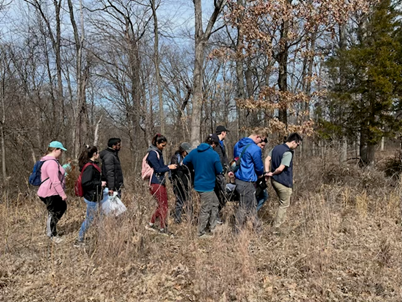
Search team with medical students and residents (Source: Dr. Cindy Bitter)
After sighting the injured mother and child both teams worked to ensure scene and personal safety. We checked for dangerous terrain and cleared the area of tree debris. Next, teams of medical students and residents evaluated each individual. The mother was conscious and had unlabored respirations. Moulage had been applied to make her appear to have forehead lacerations and obvious head trauma. She also appeared pale and cold. A primary and secondary trauma assessment was completed and no additional injuries were identified. The wounds were wrapped with gauze, and she was wrapped with a thermal blanket.
The boy was evaluated similarly and was found to have an open right tibial fracture. After confirming that he had palpable posterior tibial and dorsalis pedis pulses, his leg was reduced and splinted. He was then transferred to a litter and carried back to the cabin.
After transporting the patients to safety, we held a debriefing session where we discussed what went well and identified areas for improvement. The group felt that we addressed the patients' injuries appropriately, though we could have improved our organization by designating a team leader to communicate with the command center.
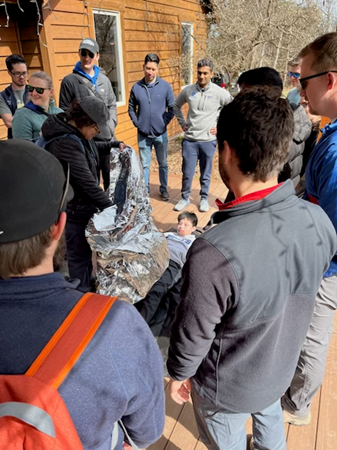
Debriefing session (Source: Dr. Cindy Bitter)
This exercise simulated a real search and rescue operation, where a SAR team is tasked by a government agency to assist with a mission. Since SAR missions are often time-sensitive, seamless teamwork is critical to efficiently locating and caring for victims. This exercise emphasized the value of integrating our medical knowledge with the expertise of other disciplines—such as canine handlers, ground search teams, and communication centers. We learned that understanding logistics, terrain, search planning, and the unique capabilities of trained animals is just as essential as clinical skills when providing care in remote, non-hospital environments.