According to the Oxford English Dictionary, the term wilderness dates to around 1200 and has at least ten different meanings. In contemporary American culture, “wilderness” often evokes images of remote, pristine landscapes untouched by human influence—a place where we can challenge ourselves and commune with nature.
This modern perception is largely shaped by the Wilderness Act of 1964, which defines wilderness as “an area where the earth and its community of life are untrammeled by man, where man himself is a visitor who does not remain” (Wilderness Act, 1964, §2(c)). The Act established the National Wilderness Preservation System and gave Congress the authority to designate land as part of this system. It originally encompassed 9 million acres; since then, more than 100 million additional acres have been added, totaling approximately 4.8% of the United States’ land (National Park Service, 2024).
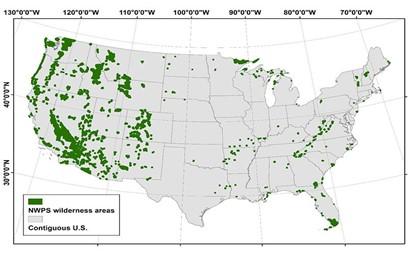
Current Wilderness Areas in the United States (International Journal of Wilderness)
But labeling these lands as “untrammeled” by humans codifies a myth: that these places were untouched and uninhabited. In reality, the land comprising the United States was inhabited and actively managed by Indigenous peoples for thousands of years before European settlers arrived.
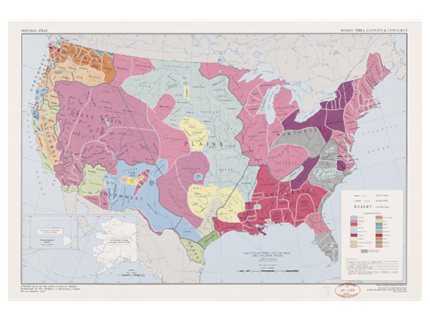
Indian Tribes of the United States (Library of Congress)
Reciprocity and Indigenous Land Stewardship
Indigenous relationships with the land are rooted in a foundational principle of reciprocity. Humans are seen not as separate from the ecosystem, but as participants in a mutual exchange with it. Land was actively managed to maintain ecological balance and productivity. This included practices like rotational agriculture, slash-and-burn techniques to reduce wildfire risk and promote regrowth, and sustainable harvesting to prevent depletion of local plant and animal species (National Geographic, n.d.). Rather than being static or “untouched,” these lands were dynamic cultural landscapes shaped by generations of Indigenous stewardship.
Indigenous stewardship continues to shape and revitalize landscapes across North America. The Tulalip Tribes relocate beavers to restore watershed function; the Jamestown S’Klallam Tribe removes invasive plant species; and the Confederated Salish and Kootenai Tribes plant disease-resistant trees to sustain forest health. The Karuk Tribe’s Wildland Fire Program implements prescribed burns “under cultural objectives to return the seasonal low-intensity fires” that historically maintained ecological balance (Karuk Tribe, n.d.). In 2005, the Southern Sierra Miwuk Nation and the Tuolumne Band of Me-Wuk partnered with Yosemite National Park firefighters to conduct a controlled burn benefiting resources in Yosemite Valley (National Park Service, n.d.). Following the removal of four lower dams—part of seven constructed in the early 20th century—the Klamath Tribe is restoring a marsh 30 miles northeast of Upper Klamath Lake to improve ecosystem health and enhance water availability along the river (Indian Country Today, 2024). The Yurok Tribe employs Traditional Ecological Knowledge to assess the impacts of climate change on culturally significant species, including the California condor, and has partnered with the National Park Service and U.S. Fish and Wildlife Service to reintroduce condors to ancestral territory. The Confederated Tribes of Coos, Lower Umpqua, and Siuslaw lead a wetland restoration project that will “improve salmon and shorebird habitat, (and) contribute to regional climate resilience” (Partners Break Ground on Tidal Wetland Restoration Project, n.d.). The Navajo Parks & Recreation Department—whose mission is “to protect, conserve, restore and manage the Nation’s natural and cultural resources”—oversees all Tribal Parks within the Navajo Nation Reservation (Navajo Nation Parks & Recreation, n.d.). Together, these initiatives demonstrate the depth and diversity of Indigenous land management and represent only a fraction of the stewardship actively shaping these landscapes today.
The Wilderness Act and the Suppression of Native Rights
The Wilderness Act, while intended to protect land from development, has often interfered with Native peoples’ ability to continue traditional land-use practices. One example is the Boundary Waters Canoe Area Wilderness (BWCAW), where the 1854 Treaty with the Chippewa granted continued rights to hunt and fish. However, these activities often require access to remote areas, and tribal members used motorized vehicles to reach them.
The Wilderness Act prohibits motorized access, and in United States v. Gotchnik (1999), the court ruled that the treaty did not account for the use of modern transportation. As a result, tribal members must rely on traditional methods of travel, effectively discouraging the exercise of subsistence rights.
These restrictions reflect a broader erasure of Native land practices, cultural traditions, and spiritual beliefs. For many tribes, religious ceremonies are inseparable from the land where they are performed. The American Indian Religious Freedom Act (1978) and Religious Freedom Restoration Act (1993) have often fallen short in protecting Native sacred sites. Executive Order 13007 narrowly defines a sacred site as a “specific, discrete, narrowly delineated location,”, whereas Indigenous traditions view sacred sites more holistically encompassing landscapes, plants, animals, and can include the gathering process in preparation of ceremonies itself.
A poignant example is Devils Tower National Monument, a site sacred to the Lakota, Arapaho, Cheyenne, Shoshone, Crow, and Kiowa. While the area is protected under the Wilderness Act, it is also a popular spot for hiking and rock climbing. The recreational use of such places can desecrate sacred sites and disrupt ceremonial practices, despite their spiritual importance to Native communities.
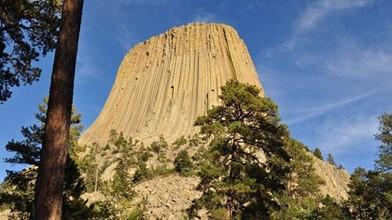
Devils Tower National Monument Wyoming (National Park Service)
The Structure of Federal Power and Land Seizure
The federal government’s structure also contributes to the systemic seizure of Indigenous lands. Although federally recognized tribes are designated as sovereign nations, the Bureau of Indian Affairs and National Park Service are both housed within the Department of the Interior. This administrative setup has made it easier for the government to appropriate Native lands under the guise of conservation or recreation.
Consider Yosemite National Park, whose “untouched” meadows were described by early white settlers as appearing like a well-maintained garden: “a prairie planted with fruit trees” or “a well-kept park” (UU World, n.d.). In truth, these landscapes were shaped by the land management practices of the Ahwahneechee (Southern Sierra Miwuk), Sierra Mono, Paiute, and other local tribes, who used controlled burns and cleared underbrush to maintain ecological balance and prevent catastrophic wildfires.
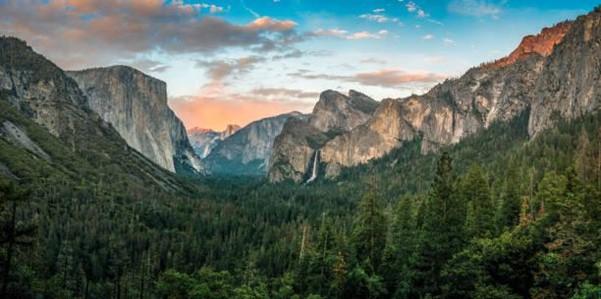
Panorama of Yosemite Valley at sunset (Getty Images)
An unsuccessful attempt was made to forcibly remove Native people from Yosemite during the Mariposa Indian War of 1851. When Yosemite was designated as a national park in 1890, their continued presence was not viewed as a right but a spectacle. Some Indigenous residents were allowed to stay but were showcased to tourists as “authentic” Indians. By the mid-20th century, employment and housing policies forced out the remaining Native residents. The final Native employee retired—and was required to leave—in 1996 (Intermountain Histories, n.d.).
Toward a More Honest Understanding of Wilderness
The idea of “pristine” wilderness erases the deep cultural, spiritual, and ecological connections that Indigenous peoples have to these lands. It also enables a collective denial of the colonial dispossession that made wilderness protection possible in the first place. As Chief Luther Standing Bear of the Oglala Sioux once said:
“We did not think of the great open plains, the beautiful rolling hills, and winding streams with tangled growth, as ‘wild.’ Only to the white man was nature a ‘wilderness.’” (Standing Bear, as cited in Wolf Action, 2011)
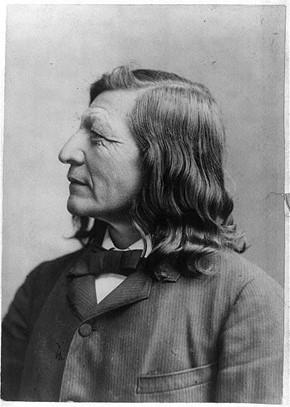
Chief Luther Standing Bear (Library of Congress)
To use the term wilderness without acknowledging its colonial implications is to reinforce a false narrative—one that minimizes the histories, cultural identities, and land management contributions of Native peoples. As we explore these federally protected spaces, we should do so with awareness of the lands’ deeper histories and with respect for the communities who have long called them home.