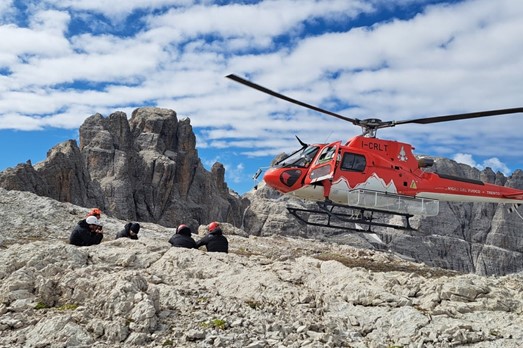
Helicopter in the Dolomites. Source: The Independent
A 60-year-old British hiker is facing more than $16,000 USD (14,000 euros) in fines after requiring a helicopter rescue from a closed via ferrata route in Italy’s Dolomites. According to a Facebook statement by Veneto’s regional search and rescue authority, the man ventured onto Ferrata Berti, a challenging, protected climbing route near San Vito di Cadore, on July 31, despite repeated warnings and signage indicating the route was closed due to dangerous rockfall. The route had been officially closed since June, after weeks of severe rockfall triggered by unstable terrain and extreme heat waves affecting the region.
At approximately 3:30 p.m., the hiker called emergency services, reporting that he was trapped by falling rocks and unable to move to safety. Veneto’s mountain rescue teams, unable to immediately dispatch due to low clouds, waited for weather to clear before launching a helicopter reconnaissance mission. When visibility improved, rescuers found the man directly in the middle of an active rockfall zone, surrounded by unstable terrain. By 5:30 p.m., a highly technical helicopter extraction was executed: a technician was lowered via winch to secure the man and hoist him to safety. Miraculously, he was uninjured, but officials emphasized that the rescue team risked their lives to recover someone who had deliberately violated safety protocols.
A spokesperson for Veneto’s regional health service confirmed that the hiker was being billed 14,000 euros (over $16,000 USD) to cover the full cost of the rescue. The charge was significantly higher than what an EU citizen with proper insurance might face—often just a few hundred euros—because the man was from outside the European Union and lacked any form of rescue coverage.
The incident comes amid what is shaping up to be an unusually deadly summer in northeastern Italy’s Dolomites, with at least 83 people dying in the mountains since June 21, largely due to heat, fatigue, poor planning, and underestimating alpine risks. Rescue teams have been stretched thin. Maurizio Dellantonio, head of Italy’s national search and rescue organization, told Il Corriere della Sera that operations are up 20 percent compared to the same period last year, with hikers making up 60 percent of all calls. Dellantonio also highlighted another challenge: payment compliance. Of those billed for their rescues, nearly half never pay, straining regional budgets and leaving Italian taxpayers to absorb the cost of avoidable emergencies.
Around the world, policies differ: Italy typically does not charge for mountain rescue unless laws are violated, or gross negligence is involved. Switzerland routinely charges for helicopter rescue unless a person carries alpine rescue insurance. In the United States, most SAR operations are free, but several states charge individuals deemed to have acted irresponsibly (California, Idaho, Maine, New Hampshire, Oregon, and Utah - although they rarely do). Japan and New Zealand have introduced permit and insurance requirements on popular trails to offset rescue costs.
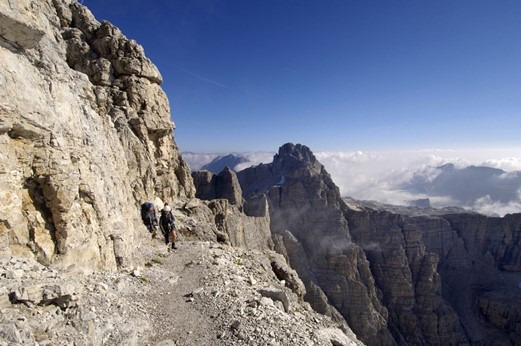
Via delle Bocchette Alte. Dolomiti di Brenta. Trentino Alto Adige. Italy. (Photo by: Stefano Beccio/REDA/Universal Images Group via Getty Images).
The surge in rescues this summer highlights a deeper issue: an increasing number of tourists are underprepared or misinformed, relying on social media for trail recommendations without understanding terrain, elevation, or seasonal risks. Via ferratas—routes that combine hiking and vertical climbing using fixed cables and ladders—have become popular with Instagram-era adventurers. But these routes require specialized gear such as helmets and harnesses, route knowledge, and respect for closures. When those elements are ignored, the margin for error vanishes.
“Mountains are not amusement parks,” said one regional safety official. “They are wild and unforgiving. And if you walk past a sign in three languages and climb anyway, you’re responsible for the outcome.” The region’s SAR agency has since replaced the warning signs at Ferrata Berti with larger, multilingual placards in English, Italian, and German, and physically blocked both trail entrances using ropes and steel rebar to prevent future incidents.
As alpine regions grapple with climate change, crowding, and increasing rescue demands, governments are tightening rules and increasing penalties for risky behavior. The British hiker rescued from Ferrata Berti is not the first person to face a fine—and likely won’t be the last. Whether these financial penalties act as a deterrent, or simply another ignored warning, remains to be seen. What’s clear is that search and rescue resources are not infinite, and the cost of poor decisions—in both lives and money—is climbing higher every season. The solution is simple: adventure with appropriate knowledge, gear, and trailhead rescue insurance.