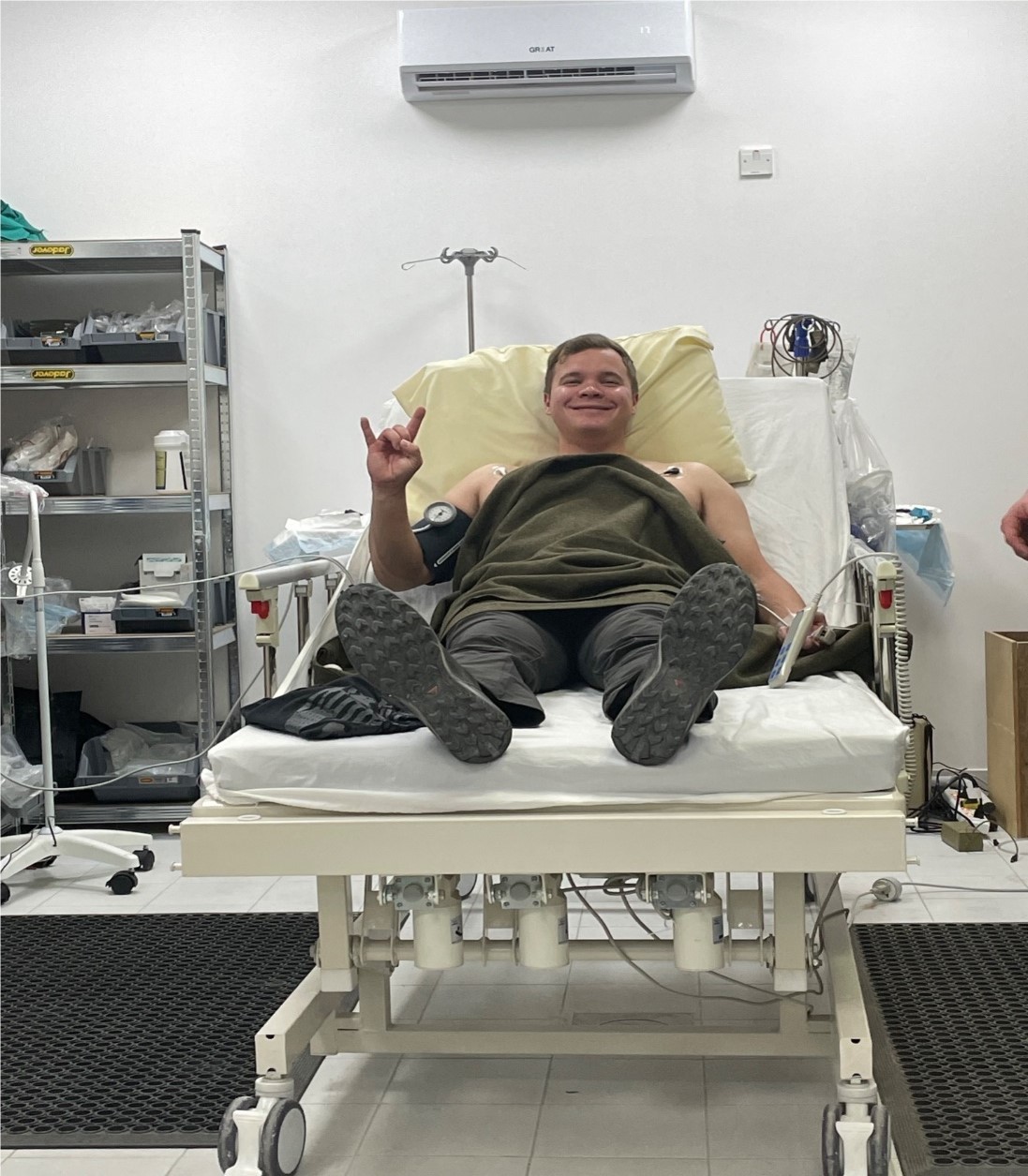
Patient mid-way through ketamine infusion for his migraine. (source: Tyler Harrell)
Introduction
Status migrainosus is a debilitating complication of migraine, defined as a persistent attack lasting 72 hours or more, with or without aura. In a forward-deployed setting, managing this condition poses a significant challenge to already resource-limited healthcare systems. For this reason, soldiers with chronic, uncontrolled migraines are typically disqualified from deploying. However, screening systems are not foolproof and such cases can still arise in theater.
Most forward-deployed Role 1 medical facilities are stocked with a basic set of medications, similar to those found in stateside urgent care clinics. These include IV fluids, ketorolac, acetaminophen, metoclopramide or ondansetron, and dexamethasone—these are often combined into a “migraine cocktail.” While this first-line treatment is often effective, supply availability may vary depending on location, resupply schedules, and operational tempo. When these treatments fail, options are extremely limited. Second-line medications like dopamine receptor agonists, antiepileptics, or dihydroergotamine are rarely available in Role 1 settings and typically inaccessible through the local economy. These constraints make it difficult to manage prolonged or severe migraine episodes and may even require medical evacuation or restricted duty of a soldier.
A Role 1 is unit level care or battalion level care that can provide initial trauma care and forward resuscitation. Minor procedures are conducted, and basic primary care complaints are seen as well. Generally, no surgical is rendered at a Role 1. This consists of at least one PA-C and several medics. In a forward deployed setting, austere places are currently still deploying soldiers. In most cases medical supplies are constrained and evac times are delayed.
Ketamine has gained attention as an alternative treatment for chronic pain and refractory conditions, including migraines, showing particular promise when standard treatments fail. In military medicine, it has become a frontline option for managing moderate to severe pain in austere environments. Its versatility—administered via IV, IM, or intranasally—makes it especially useful in the field. Ketamine provides rapid pain relief, has a favorable safety profile, and doesn’t suppress respiratory drive, which distinguishes it from opioids and makes it a strong candidate for field use by properly trained providers.
Clinical History
A 32-year-old active-duty male with no significant past medical history aside from chronic migraines presented with status migrainosus lasting more than 72 hours. He had failed multiple abortive treatments, including triptans and a migraine cocktail, and was also on a daily preventative medication. He described the headache as a constant, throbbing pain affecting his entire head, accompanied by nausea and photophobia. His ability to function was significantly impaired throughout the episode.
Due to the failure of standard therapies and the severity of symptoms, the medical team decided to initiate a ketamine infusion to attempt to break the migraine. The patient was continuously monitored with a Zoll Propaq system, and the infusion was titrated from 0.1 mg/kg/hr to 0.3 mg/kg/hr, based on the patient’s weight of 90 kg (equating to 9–27 mg per hour).
Treatment Protocol
The infusion was administered under the following conditions:
- Ketamine Dose: 100 mg diluted in 500 mL of 0.9% normal saline
- Additional Medications: 4 mg IV Zofran given prior to infusion; midazolam was readily available if needed
- Infusion Rate: Titrated from 0.1 mg/kg/hr to 0.3 mg/kg/hr over 90 minutes
- Monitoring: Conducted in a forward-deployed treatment center using a Zoll Propaq to monitor heart rate, blood pressure, respirations, and a 3-lead ECG
- Emergency Protocols: ACLS capability on site; ground evacuation available to a local facility 45 minutes away
The patient was monitored continuously throughout the infusion for adverse effects.
Outcome
Within 20 minutes of initiating the infusion, the patient reported significant pain relief, with near-complete resolution by the 30-minute mark. His pain level had dropped from a 7/10 to almost 0/10. He remarked that his nausea and photophobia had also resolved. No serious adverse effects occurred, though mild hypertension was observed—an expected response to ketamine. His blood pressure returned to baseline after the infusion.
Post-infusion, and after 60 minutes of observation, the patient was medically cleared. He returned to shared quarters with his team medic, who provided follow-up support. He was placed on limited duty for 24 hours, during which he was restricted from operating vehicles or handling weapons. He was also required to check in with his medic prior to resuming full duties to ensure no lingering cognitive effects remained.
Application for Providers in Austere Environments
Ketamine is an NMDA receptor antagonist that produces rapid analgesia by blocking excitatory neurotransmission. Its role in managing status migrainosus has gained traction in recent years, particularly in cases where other medications have failed. This case is notable because ketamine was safely and effectively administered in an austere, forward-deployed setting with minimal equipment.
The infusion protocol used in this case (0.1–0.3 mg/kg/hr) falls on the lower end of the recommended range (0.1–0.5 mg/kg/hr), yet was still highly effective. This case supports the potential use of ketamine as a low-dose, resource-conscious option for managing migraines in the field. Additionally, the absence of serious side effects reinforces its potential safety when properly dosed and monitored.
Despite the successful outcome of this treatment, operational considerations remain. Providers must weigh the soldier’s temporary loss of mission capability during and after treatment. In this case, a 24-hour recovery period was enforced, with follow-up care to ensure full cognitive recovery prior to returning to duty.
Final Thoughts
This case demonstrates that ketamine infusion is a viable and effective treatment for status migrainosus in austere environments. It offers rapid pain relief, requires minimal resources, and carries a favorable safety profile, however, providers should be properly educated on safe use. As more cases are studied, ketamine could be considered a practical treatment option when conventional therapies and infrastructure are unavailable in the deployed setting.