A healthy 17-year-old boy from Chapel Hill was bitten by a timber rattlesnake
while fishing near Lost Cove Creek in Pisgah National Forest on
June 2nd. The bite occurred as the teen, identified as Zain Shah,
stepped over a log and felt a sharp “prick” on his right ankle. Upon
inspection, he immediately identified “two red dots and blood,” a tell-tale sign of
envenomation. At first, Zain described the bite as “painless”; then the venom
coursed through him, leading to a tingling sensation throughout his body.
Zain’s
companion called 911, and the North Carolina Emergency Management (NCEM) system
mobilized the National Guard, NC Helo-Aquatic Rescue Team (NCHART), and
Charlotte Fire personnel. Approximately two hours after the bite, a Black Hawk
helicopter hoisted the teenager from the remote creek side to a medical staging
area. Zain was flown to Johnson City Medical Center in Tennessee, where he
received 12 vials of antivenom over a three-day stay.
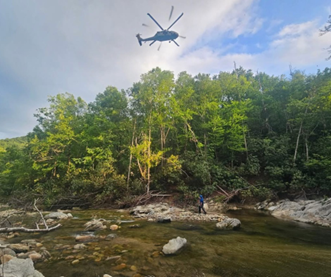
Black Hawk helicopter arriving to retrieve Zain. Source: NC Emergency Management
Recognition of envenomation is critical for guiding timely and appropriate management. The presence of two fang marks accompanied by local bleeding and swelling suggests envenomation and warrants prompt emergency intervention. Right after a snake bite, it is important to remove any constrictive items such as jewelry or tight clothing in anticipation of swelling. To monitor the progression of envenomation, marking the bite marks and edges of erythema helps track the spread of affected tissue over time. Time and date of the bite should be noted. Capturing a photograph of the snake from afar, if it can be done safely, can assist healthcare providers in identifying the species to determine the best course of treatment. This approach is preferred over attempting to capture or kill the snake, which can be dangerous. In the event of an envenomation, emergency rescue services should be activated immediately, unless a safe and practical self-evacuation can be confidently carried out without compromising the patient’s condition.
In wilderness medicine, rapid stabilization and coordinated evacuation are crucial to prevent deterioration. The multidisciplinary response enabled successful collaboration among NCEM, the National Guard, NCHART, and Charlotte Fire. This showcases vital interagency cooperation in rural rescue operations. Zain’s experience underscores the life-saving value of early recognition, integrated rescue systems, and swift access to antivenom.
In the United States venomous snakes include rattlesnakes, copperheads, cottonmouth/water moccasin (Viperidae/pit vipers), sea snake and coral snakes (Elapidae). In the US between 7,000-8,000 people are bitten by all venomous snakes annually per the CDC. This results in about five deaths each year. Pit viper antivenom options include CroFab and ANAVIP. Coral snakes bites are more rare, and access to antivenom is more limited. North American Coral Snake Antivenin (NACSA) was initially discontinued in 2010, with the FDA providing extensions to the expiration date. Production resumed in 2019, though it is still difficult to obtain. Immediate consultation with poison control or toxicology to assist in finding antivenom resources is imperative. In certain areas, zoos may need to be contacted for supplies.
In addition to antivenom, analgesics may be administered to mitigate pain. Intravenous opioids are recommended for analgesia. NSAIDs may pose hematologic risks and are therefore not considered first-line agents in this context. Additionally, the use of tourniquets is not recommended as it can restrict blood flow to the affected area.
To prevent snake bites, hikers and outdoor enthusiasts are encouraged to wear high leather boots, long pants, and protective chaps or gaiters. Leather boots and thick denim pants alone may decrease the venom transfer by two thirds. Prevention should also include education. Accidental pit viper bites are generally defensive and on lower extremities. Understanding these creatures hide motionless to attack prey is key. Therefore, stepping over tree stumps or rock overhangs may put the outdoor enthusiast at risk of a pit viper hiding in the crevice as they step over Additionally, recreators should be advised to travel in pairs, carry first-aid supplies, and learn to recognize venomous species endemic to the area of travel.