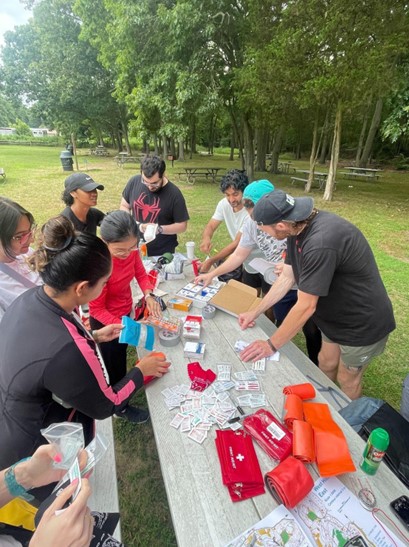
Participants preparing their medical kits for their big day ahead. (Lifan Fan)
It was a balmy overcast day on Long Island, New York when a group of emergency medicine residents, transitional year residents, rotating medical students, and PA students from South Shore University Hospital gathered in a local park for an educational romp through the woods. The day was July 17th, 2024, and it was the annual Suffolk County Wilderness Medicine Day.
In years prior, Wilderness Medicine Day has been held in a small picnic pavilion with different wilderness medicine topic stations all within sight of each other and the parking lot. Despite being outside, this set up never did seem to convey the nature of wilderness medicine. This year, in a MedWar-style competition, residents and students were broken up into groups of 7-8 and given maps to stations spread out on the trails over a 2.4 mile (3.9km) loop course.
At the beginning of the race, participants were presented with a table full of first aid kit supplies and challenged to create kits that could be used to take care of the medical emergencies and injury scenarios that they would encounter along the way. By making groups choose their own supplies instead of providing them presorted, participants were able to put into practice the power of foresight (and at the end of the race, gain all the benefits of hindsight without the consequences of being unprepared in the backcountry). Materials on the table included the usual first aid wound care supplies and medications, but also items such as paracord, duct tape, small tubes of super glue, and bandanas for improvisation.
At Station 1, before setting off on their adventure, racers got a crash course in orienteering - navigating with a compass and other map skills from Dr. Gupta, the Department Chair of South Shore and a FAWM graduate himself. For many this was their first experience in navigation with anything besides a phone or GPS. Luckily, the map had clearly marked trails, including the location of all the stations, so taking bearings and bushwhacking to each point was not on the agenda for the day.
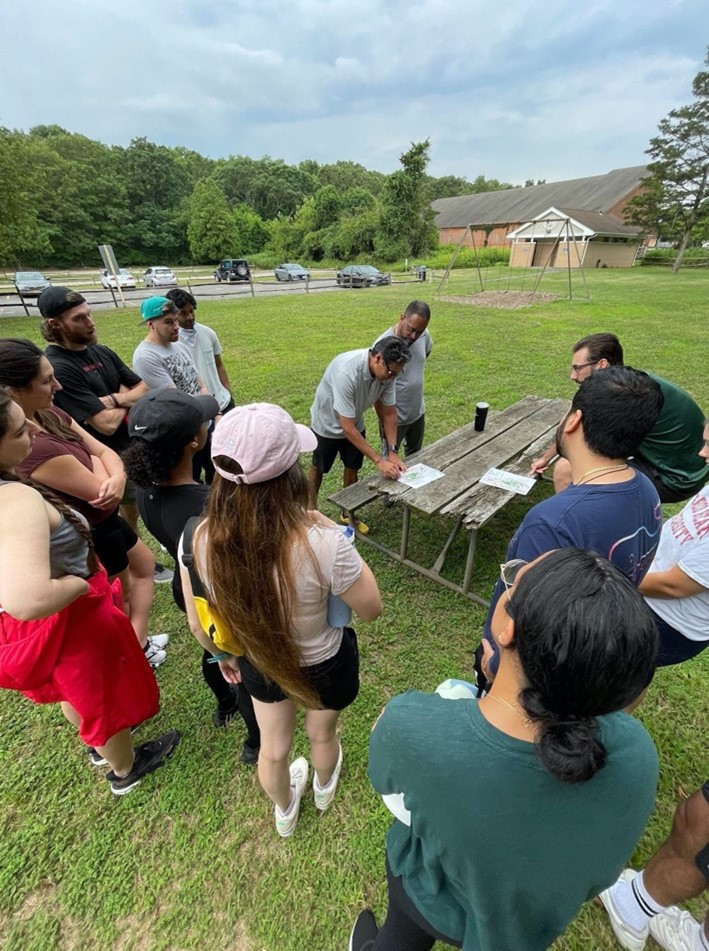
Participants learning map and compass skills from Dr. Gupta. (Lifan Fan)
At Station 2, participants were presented with a quiz on plant-associated dermatologic findings and were faced with their first challenge: did they bring either oral or topical steroids for a nasty poison ivy rash in their first aid kit? If yes, they received a bonus point.
Moving onto Station 3, racers came across another one of our ED attendings: Dr. Urmaza’s smiling face welcomed one lucky participant to take a break and lay down on a tarp with a sleeping bag draped across it. The rest of their teammates then tied them up in an improvised rope litter and carried them down the trail to Station 4.
Station 4, a lecture on hyperthermia and heat injury led by our program director, Dr. Frank, felt truly applicable as the last of the cool morning burned off, and the shade was the only relief from the oppressive, humid heat of the day. Compounded by hiking up and down some of the only hills in Eastern Long Island, racers wondered if they were going to become true patients. Perhaps they wished there was actually water in the tarps they rolled around in to practice the TACO method of cold water immersion.
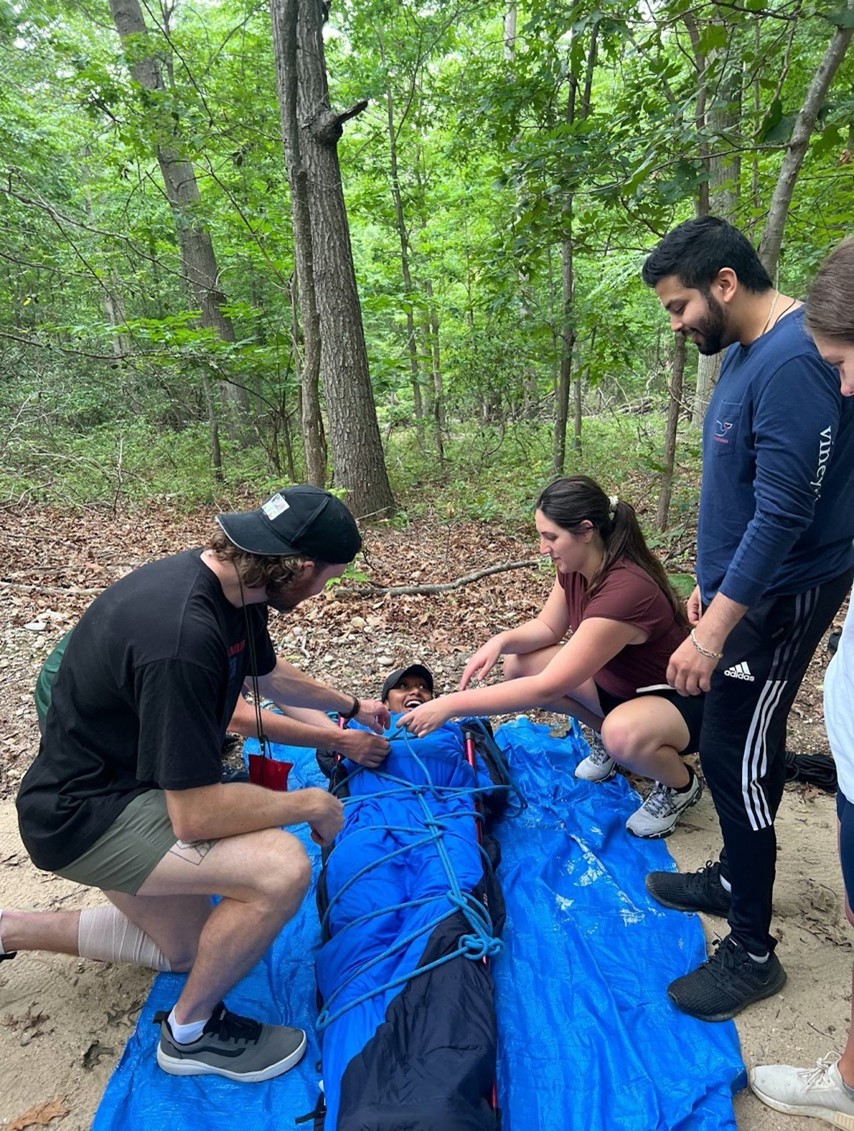
Getting warm (despite a balmy day!) in a TACO wrap. (Lifan Fan)
At Station 5, yours truly put on her best impression of a scout troop leader to teach these city slickers how to tie some knots. Imagine if one of your teammates fell down a steep hole and the rest of your team has to haul them up with a rope. You want to make a loop that doesn’t tighten and is easy to untie? Well, let me show you how to tie a bowline. Oh no, your rope doesn’t reach all the way down? Let’s put two different ropes together with a double sheet bend! Need a break from hauling? Secure your rope with a clove hitch to a post or carabiner! One by one, people started to get it and then turned around and taught their teammates these three essential knots.
Next up, Station 6! Assistant program director Dr. Yanes posed a rather gnarly injury to our groups: an open tibia-fibula fracture. Even in the trauma bay, a mangled extremity can turn a stomach. In the wilderness, you may not have a prefabricated tourniquet readily available, and you definitely don’t have a blood bank asking you if you need a massive transfusion protocol. Dr. Yanes showed residents and students how to use a bandana to tie an improvised tourniquet with a stick as a windlass. Then, using either the SAM splints provided at the table in the beginning, or sticks from the forest floor, teams splinted and wrapped the injured legs, packaging for a long hike out of the woods.
After sending off the groups initially, Dr. Gupta packed up and moved onto Station 8 where the scenario was a penetrating injury causing a sucking chest wound. Using materials from their first aid kit, teams created occlusive three-sided dressings to temporize the tension pneumothoraces that occur from these wounds.
Finally, after just about three hours of hiking and learning, all of the groups made it back to the parking lot, sweaty but smiling. In an immediate post session survey (n=20), 90% of respondents (18/20) stated that they felt more comfortable with managing emergencies in the wilderness compared to before the session (the remaining two said they felt the same as they did before). In addition, 85% stated that they are more likely to bring their own first aid kit for future outings, 85% stated that they were more likely or just as likely to make their own kits vs. buying a commercial kit, and 95% stated that they felt like the outdoors hands-on format enhanced their learning compared to just a lecture.
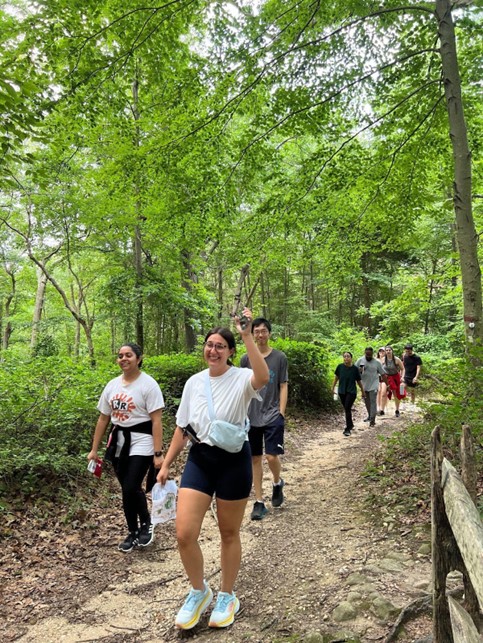
Feeling tired but better prepared for wilderness emergencies. (Lifan Fan)
Overall, the event was well received and enjoyed by the participants, despite being a mandatory outdoor activity at eight in the morning in the muggy, buggy heat. Hopefully, this event inspires others to bring outdoor wilderness medicine education days to their own residencies and provides a framework for planning and creating such an event.