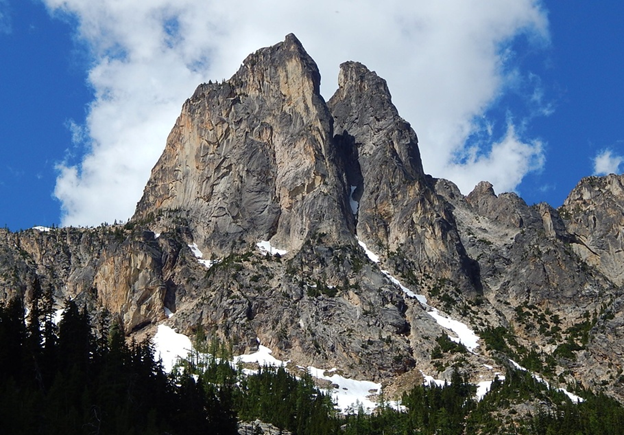
Early Winters Spires. Source: Wikipedia
On Saturday May 10th, three people were killed and one severely injured as a climbing party of four bailed from North Early Winter Spire in the North Cascade Range, WA. Per the surviving member, Anton Tselykh, the party was attempting the route Early Winter Couloir (AI3, M4+), an alpine mixed route requiring navigating both alpine rock and ice. Halfway up the climb, they noticed a storm approaching and made the decision to retreat back down the couloir. They began reversing their route, rappelling down the steep snow-filled gully. During the descent, a piton that the party had been using as an anchor failed suddenly, pulling out of the mountain and causing the team of four to plummet approximately 200 feet into a slanted gulch, and then tumble another 200 feet before coming to rest.
While sliding and rolling down the mountain, Tselykh lost consciousness. After a few hours, he woke up in a mass of tangled ropes and equipment. He was able to locate the bodies of two of his climbing partners, who were clearly deceased. After extracting himself from the ropes and equipment, Tselykh descended slowly back to his car, mostly bushwhacking. Once back at his car, he began driving west. At some point along the way he collided with a guardrail and veered off onto the shoulder of the road, passing out for an unknown amount of time before continuing his drive.
He drove approximately 60 miles to an unincorporated community called Newhalem, which happened to have a payphone which he used to call 911. Roughly twelve hours passed between the accident and his reaching the payphone. He was then transported to Harborview Medical Center where he was found to have internal bleeding and a traumatic brain injury. A three-person search and rescue team reached the site of the accident the following day, using coordinates from a satellite device the climbers had been carrying. There, the bodies of the three climbers who had succumbed to their injuries were found. The deceased were identified to be Vishnu Irigireddy, 48, Tim Nguyen, 63, and Oleksander Martynenko, 36. They were extracted via helicopter due to the treacherousness of the terrain.
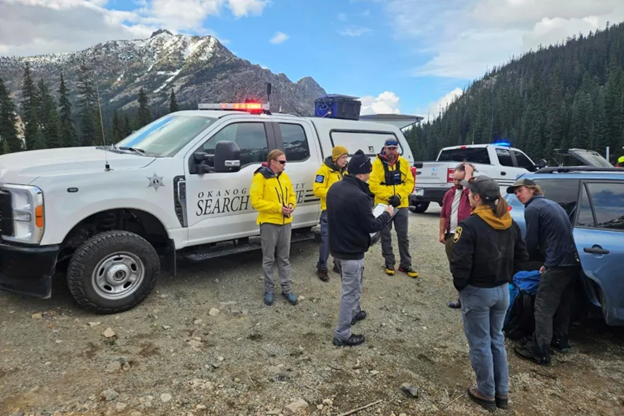
Okanogan County Sheriff's office via AP
The following day, responders pored over the recovered equipment trying to decipher what caused the fall. They found that a single piton was still clipped into the climbers’ ropes. Authorities are in the process of continuing to investigate exactly what occurred during their descent which led to the accident, but the Okanogan County Undersheriff Dave Yarnell did confirm that the team was “equipped with climbing harnesses, ropes, removable protection, and all other technical equipment expected for a party on that route”. He also confirmed that all four men were attached to the same rope when they fell, and that their rope was found attached to a single piton, “which was very weathered and old-looking”. It seems as if the group may have been attached to a single piton which failed, as no other protective equipment has been mentioned to be attached to the ropes.
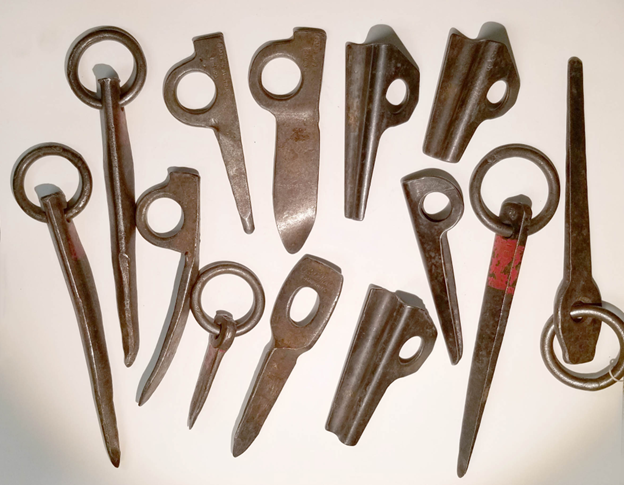
Various pitons. Source: American Alpine Club
A piton is a metal spike, usually steel, which is driven into a crack or seam in a rock wall using a hammer. They come in different sizes and shapes, and are equipped with an eye hole where a carabiner or other material can be attached. They act as an anchor, which a climber can clip their rope to while ascending to reduce the length of a possible fall. They can be incorporated into a rappel anchor to facilitate descent. Pitons can be removed, but are sometimes left in particular locations for a number of reasons including difficulty in placing other types of removable protection in that location, the location being an ideal stance for a belay/rappel anchor, or difficulty in removing the piton after placement.
When left in the rock, pitons can remain for years or even decades. Over the course of that time, they can become less secure due to rust, fractures, or a gradual loosening due to freeze thaw cycles (expansion contraction) of the rock around below-freezing conditions. Per investigators, the piton found attached to the climbers’ rope in this accident “looked old and weathered, and the rest of their equipment looked newer”, so the assumption could be made that the piton had been an old one found on the route and used by the team to aid in their descent.
In situ pitons can be a boon to find when desperate, however they should always be assessed before use. For example, a vigorous bounce test should be performed before going off rappel onto the piton. When possible, pitons should be backed up with additional equipment and incorporated into a multi-piece anchor. Sometimes those additional pieces should be left on the route to ensure the entire party is using a sturdy rappel anchor. Sometimes climbers hesitate to leave additional gear on the mountain due to the financial loss of the gear. To remove this as a barrier, mountain guide Mark Smiley (IFMGA guide/MTN Sense) will replace the gear climbers leave behind as a backup for a sketchy anchor.
An additional topic of importance is that of bringing a satellite communications device when traveling /adventuring in remote areas. Most satellite devices have an SOS button that connects to a 24/7 emergency response center and can be lifesaving in situations like the ones these climbers experienced. Some allow for real-time tracking that can be shared with friends and/or family. It was this tracking functionality which led rescuers to the bodies of the deceased, as one of them had enabled tracking and a friend who was not on the trip was able to see their location on a map. Unlike personal locator beacons (PLBs), many modern satellite devices allow for two-way text communication which can allow for checking in with loved ones or coordinating with rescue teams in the event of an accident or illness. Satellite networks like Iridium or Globalstar provide global coverage, allowing communication even in the most isolated regions like high mountains, deep canyons, or remote forests or deserts.
In the midst of unspeakable tragedy, there was a single survivor. A lone survivor in such an accident may struggle with grief and self-blame, questioning why they lived while their partners did not. This guilt can be compounded by isolation and trauma from the event itself. Fortunately, there are resources available to help: trauma-focused therapy (such as EMDR), support groups for survivors of outdoor-related incidents, and programs such as The American Alpine Club’s Climbing Grief Fund can offer mental health resources tailored to survivors.