The Brazilian Amazon encompasses approximately five million square kilometers. The region's population is heterogeneous and relatively young, comprising around 25 million inhabitants who remain impoverished despite the ongoing expansion of agribusiness and the economic frontier into the area. Among the greatest challenges faced by the Brazilian Amazon are health indicators and access to healthcare services. On one hand, the region's epidemiological profile is widely recognized as diverse and challenging. According to the mortality tables from the Brazilian Institute of Geography and Statistics (IBGE), in 2018, life expectancy at birth in the North Region was the lowest in the country—approximately 2.6 years less than the national average. However, the various complexities of the territory present challenges for health policies, including geographical barriers and natural obstacles, sparse population distribution, and seasonal river water levels, which complicate both provincial and regional integration of services. The presence of numerous rivers and tributaries further complicates the pre-hospital transport network in Brazil, which typically relies on traditional ambulances. The socioeconomic vulnerability of the population, as well as the presence of traditional communities with different needs and cultural specifics further exacerbates these challenges. Access to healthcare in northern Brazil is particularly arduous due to the low number of healthcare professionals, low coverage of ambulances, limited technological availability, long distances between health units, and inadequate transportation networks. In Brazil, Emergency Medical Services (EMS) adopt a model inspired by the French system, in which pre-hospital care is primarily provided by physicians and nurses. This model contrasts with that of the United States, where paramedics play a central role in the initial care. This article presents a description of rural Amazon EMS transport by boat, conducted by an emergency physician, highlighting the particularities and challenges of this type of intervention in the Brazilian context.
Case Series
In January 2024, a series of critical events highlighted the complexities of patient transport in emergency situations within the Brazilian Amazon. The cases involved transporting patients from Calama, a district in the city of Porto Velho, Rondônia, to Humaitá, a city in the state of Amazonas, where the Transamazonica Highway begins and an emergency hospital is located. Calama, a riverine island with a population of approximately 4,000 people, presented unique challenges due to its isolation and the reliance on river transport (Figures 1, 2).
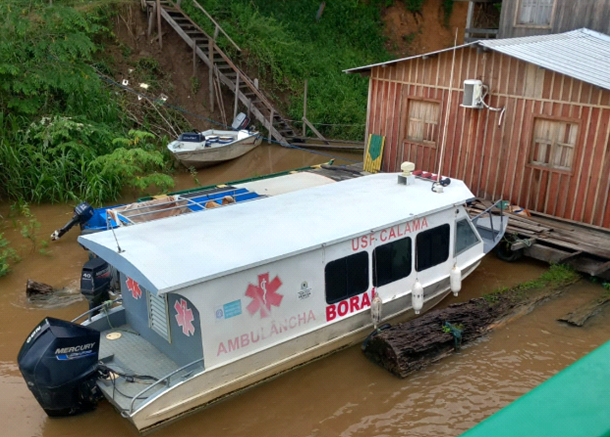
Figure 1: River Ambulance service docked in the district of Calama, Rondônia, Brazil. In the absence of roads, river-based transportation is essential for pre-hospital emergency care in remote Amazonian communities. The image depicts the ambulanch (or ambulância fluvial), aka “Bora”, used by local EMS to transport critically ill patients from Calama to more advanced healthcare facilities. The wooden stairway and muddy riverbanks illustrate the significant geographical barriers faced by both healthcare providers and patients in accessing urgent medical care.
Case 1
A 9-month-old infant was transported following a cranioencephalic trauma due to a fall from a hammock. The patient presented in a drowsy state with vital signs consistent with their age, including a heart rate of 130 bpm, a respiratory rate of 35 breaths per minute, and a blood pressure of 80/60 mmHg. The transport was successfully managed with medical supervision alone, without the need for advanced interventions en route.
Case 2
A 59-year-old woman was admitted with hemorrhagic shock secondary to upper gastrointestinal bleeding. Her vital signs included a blood pressure of 95/50 mmHg and a heart rate of 110 bpm. Initial management involved the administration of 1 liter of normal saline, 1 gram of tranexamic acid, and 80 mg of omeprazole. The patient showed improvement in her blood pressure levels following treatment, which stabilized her condition for further transport.
Case 3
A woman with pre-existing heart failure presented with symptoms consistent with sepsis from a urinary tract infection and hypoglycemia. Her initial blood glucose level was 30 mg/dL, and she was unconscious upon presentation. Vital signs included a blood pressure of 120/70 mmHg and a heart rate of 86 bpm. She was treated with crystalloid solution, ceftriaxone, and glucose. The management of her condition was crucial for her safe transport to Humaitá.
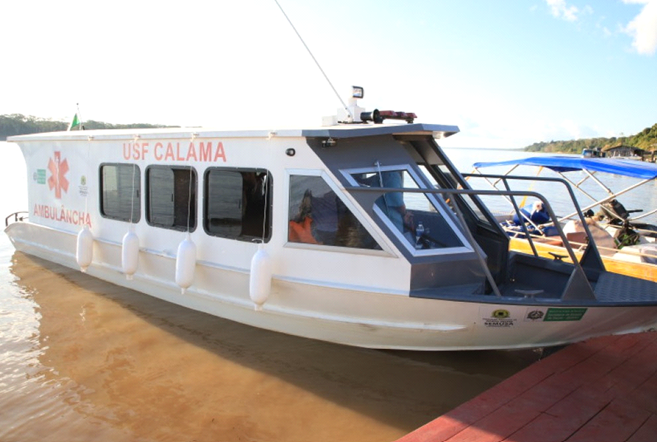
Figure 2: Ambulanch docked in Humaitá, Amazonas, Brazil. This image shows the arrival of the ambulanch “Bora” at the riverside port of Humaitá, a referral city for emergency care in the region. Unlike Calama, Humaitá offers a paved docking platform, improving patient transfer conditions. The vessel’s design accommodates medical equipment and seating for healthcare professionals, highlighting the adaptation of pre-hospital care strategies to the unique logistical challenges of the Amazon basin.
Discussion
Navigation Challenges
The transportation of patients along the Madeira River between the locations of Calama and Humaitá takes approximately 3 to 5 hours, depending on the water level and prevailing weather conditions. The Madeira River, one of the major tributaries of the Amazon, is known for its turbulent waters and floating debris. During torrential rain, visibility is drastically reduced, increasing the risk of collisions with obstacles, making navigation extremely hazardous. The strong current, exacerbated by the rain, complicates vessel control, requiring significant skill and experience from the pilot. These conditions were evident in all three cases, where the challenging navigation contributed to the complexity of the transport process.
Case-Specific Transport Difficulties
The transport of the 9-month-old infant with cranioencephalic trauma was particularly challenging. Due to the adverse terrain and weather, and the lack of space for stretchers or infant chairs, the child was transported in their mother's arms. The steep, muddy banks of the Madeira River turned the terrain into a quagmire, complicating the process of getting the patient onto the boat. This method of transport added to the risk and difficulty of managing the patient's condition under such harsh conditions.
The 59-year-old woman with hemorrhagic shock faced similar logistical challenges. The transport required moving her from her home to the river under heavy rain, which was further complicated by the steep, muddy banks. The improvised methods used to transport her highlighted the difficulties of accessing patients in remote areas during adverse weather.
The woman with heart failure, sepsis, and hypoglycemia was also affected by the challenging conditions. The severe weather and difficult terrain made it necessary to use makeshift stretcher to transport (Figure 4) her to the river, with the risk of further exacerbating her condition due to the exposure to cold and wet conditions.
Patient Safety Concerns
Ensuring patient safety during transport was a significant concern. Vessels rocking violently due to waves and currents increased the risk of falls or sudden movements that could worsen the patients' conditions. Is also well known that the probability of complications in all cases could increase along with the time of transportation to a definitive treatment hospital. For the patients with severe medical conditions, such as the unconscious woman in Case 3, there was an additional risk of hypothermia or hemodynamic shock due to prolonged exposure to adverse weather.
Communication Issues
Effective communication is crucial in emergency medical transport, but it was hindered in these cases. Torrential rain compromised radio and satellite phone communication, affecting coordination between the rescue team and healthcare professionals at the destination. In all three cases, effective communication with EMS was only established upon arrival in Humaitá, illustrating the difficulties faced in coordinating care in remote areas with limited communication infrastructure.

Figure 3. Pre-transport preparation by the emergency response team in Calama, Rondônia, Brazil. The image shows Dr. Júlio César Garcia de Alencar, an emergency physician, and a medical student moments before initiating one of the patient transfers described in this case series.
Conclusion
These cases illustrate the urgent need to strengthen emergency medical services in remote areas of the Brazilian Amazon. River-based transport plays a vital role in ensuring access to lifesaving care, but remains limited by logistical, structural, and environmental challenges. Investments in infrastructure, technology, and professional training are essential to improve the safety and effectiveness of pre-hospital interventions in this region.
This article was written by a multidisciplinary team from the University of São Paulo and the Federal University of Rondônia, united by their shared interest in emergency medicine and healthcare delivery in remote regions of the Brazilian Amazon. Dr. José Henrique Pereira Pinheiro and Dr. Júlio César Garcia de Alencar, both emergency physicians, directly participated in the patient care described in the article. Dr. Pinheiro is also a master’s student at the University of São Paulo, where his research focuses on emergency medicine in remote settings. Dr. Alencar is a professor of emergency medicine with extensive experience in pre-hospital care. Carolina Poltronieri Chiaroni is a final-year medical student engaged in field activities and research in wilderness and rural medicine. Dr. Vinicius Ortigosa Nogueira, an emergency physician and professor at the Federal University of Rondônia, contributes academic expertise from a public medical school based in the Amazon. Dr. Millena Gomes Pinheiro is an emergency physician with professional and academic interests in remote area medicine. Dr. Magali de Lourdes Caldana is a professor at the University of São Paulo who coordinates university extension programs in the Amazon region.