After serving in East Africa for six weeks as part of a medical non-governmental organization, in a country that is in the middle of a civil war and refugee crisis, there were a number of lessons to be learned.
A team of 25 people, rotating in from the United States, Canada, Kenya, Australia, and Germany, served as part of a 90-day temporary Emergency Field Hospital (EFH). The group served alongside national staff and primarily saw women and children who were local or internally displaced persons (IDPs) as a result of the civil war. Following are insights gained from the experience.
Lesson 1: Flexibility is everything
An EFH in an austere, humanitarian disaster environment, does not have large-city-hospital capabilities or capacities. You will not have the tools with which you normally work. You will see acute care patients and hopefully have the ability to send or refer critically or chronically ill patients to a higher level of care. You will need to fix and reuse items, even things like bed pans. Some medical staff will manage these challenges better than others. Think about the old US television show “MacGyver” where the star of the show used a few items in unique ways to get himself out of trouble.
How do you use sandbags and wrist wraps for leg traction and physical therapy? How do you use a shirt button to help with an undescended testicle surgery on a very young boy? What emergency practice guidelines do you have in place to diagnose and treat a woman who stumbles into the triage area covered in ash, not breathing, and with a marginal pulse? How do you treat newborns with “failure to thrive” because their new mothers cannot afford milk, do not breastfeed, and are only able to provide the baby a water and flour mix? Color outside the lines for treatment options. Think like MacGyver.
Lesson 2: Customs
You may not receive everything you shipped. Some countries may not allow some communication systems into the country. Customs might confiscate satellite systems and hand-held radios at the airport or seaport. Be prepared to purchase local phones. Be aware of what is allowed into the country in advance. Be prepared for security checkpoints. Keep multiple copies of required documentation handy and strongly consider not taking photos at checkpoints during a civil war.
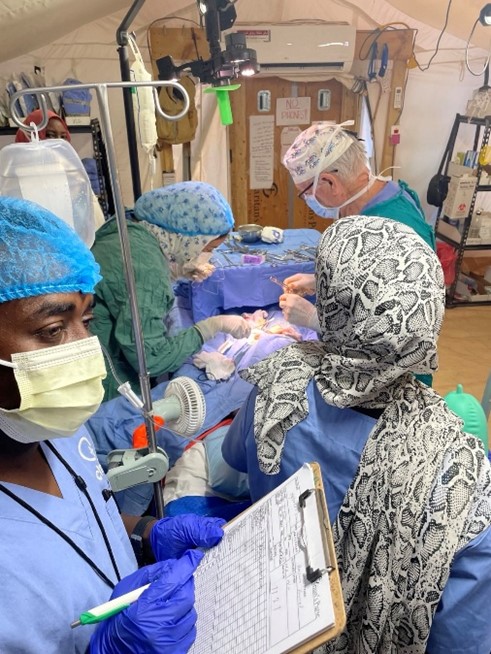
Surgery under austere conditions with national staff (Photo: M. Lopshire)
Lesson 3: Finances
The country may not allow USD and other currencies to be traded in the marketplace. Credit cards may not be an accepted form of payment. Banks may limit the amount of cash that can be withdrawn from an account. Vendors may want only cash in the host nation currency. Be prepared to bring host nation currency with you and watch for an increase in prices as goods become short in supply.
Lesson 4: Pharmacy
Thirty-day prescriptions may not be practical as a result of limited on-hand supplies. Supplies will need to be managed closely and substitutes considered. Acetaminophen capsules may need to be broken open to make a syrup for babies.
Lesson 5: Lab
Test strips for HIV, malaria, Hepatitis B, and others have a climate range for storage around 30ºC/86ºF. Depending on the season and country, storage above 38ºC/100ºF for more than 90 days may render the test strips unreliable.
Lesson 6: Surgery/Anesthesia
Drugs that are commonly used during surgery in a major hospital may not be available or may be in short supply in an austere setting. As a result, this may limit the types of surgery performed. In addition, equipment or monitors may fail due to high temperatures and local power outages. Some equipment may not be able to change power from 110V to 220V. Battery plugs on a patient monitor may get jiggled loose and when the power goes out they will not work. Be prepared to use a stethoscope, monitor a radial pulse, and closely watch the patient.
Lesson 7: National staff
You may work with medical staff from the supported country. There are cultural differences in speed of action, level of knowledge, and position duties. Medical staff from different countries may have a different level of training or standard of care. Some cultures are more physician-centric for decisions, which may slow processes. Cultural differences may also exist. For example, plan for Ramadan in advance and respect the impact fasting may have on the team when accompanied by 38ºC/100ºF temperatures.
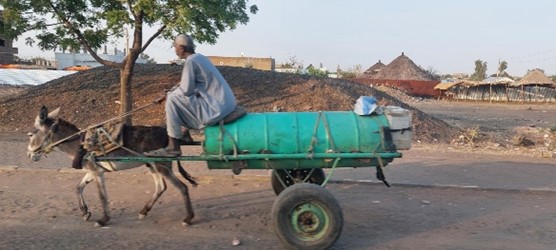
Daily Water deliveries (Photo: M. Lopshire)
Lesson 8: The Positives
Many team members can be very willing to set aside titles, work experience, education, and certifications. ICU nurses may find joy working in a pediatric ward; an ER physician may look forward to overseeing the Outpatient/Triage tent for walk-ins on the night shift. No task is beneath anyone on strong teams. In addition, patience, grace, and forgiveness for mistakes should be the norm.
Lesson 9: Emotional resilience
Be prepared to be challenged emotionally. After a long, extremely hot day, a dehydrated, pregnant woman at full term presents with her baby who is struggling in utero. The baby is delivered immediately via cesarean section but is not breathing. The team starts CPR, however the baby is weak and barely responsive. The outcome will not be the one you hoped for. The mother and baby are placed together in the children’s ward. The baby passes away the next day despite time, effort, and hope. The crying and wailing follows. Be prepared for the worst, especially when dealing with babies and children. Be resilient.
Lesson 10: The inexplicable
And you may have a day that cannot make sense.
A baby was born late one evening. Small, limp, gray, low oxygen saturations, average heart rate, agonal breathing. Our emergency team worked to help this baby survive and finally determined there was nothing more we could do for the newborn. We laid the baby on the mother's chest for her final moments. Our team tried our best.
Then the baby opened her eyes and looked at her mother. In an hour the baby was pink, crying, breastfeeding, and oxygen was 96% on room air. Her heart was beating strong and constant. We all shed tears. The baby and mother went home a few days later.
You may experience events that cannot be explained when working in austere environments.
Be flexible.
Think like MacGyver.
Focus on the patients.