In the late 1970s, I attended the London School of Tropical
Medicine and Hygiene for six months just prior to beginning my infectious
disease fellowship at the University of Alabama in Birmingham. Returning
stateside, I had been at University of Alabama Birmingham for about a year when
my boss, Dr. Glenn Cobbs, approached me with an offer to fly to Brazil and work
there for three months. I pictured the
beaches of Ipanema and Copacabana and readily volunteered. Both hands raised.
In December of 1981, I flew to New York City,
where I met my partner on the venture, Dr. Joe Durrett, and the two of us were
vaccinated for any possible infection on this planet. And some from Mars. We then boarded a plane for beautiful Rio,
where I spent 1 hour in that airport - and then caught another flight to
Salvador. Bye Bye Copacabana and Ipanema. Over the next 2 weeks I spent time learning
Brazilian Portuguese. I was taken to see
Senhor Hugo, the local black marketeer, to change my dollars into cruzeiros - the
inflation rate was 150%. I walked on
the beach, which was so hot I felt like a cookie in an oven. Every few hundred yards, a channel of pure
effluent would cut across the beach and flow into an enormous and otherwise
beautiful-looking bay. Looking across
that bay I could just see the local Club Med. Ho ho! I knew something they did not know as they
swam, snorkeled, and flirted in the water.
I bet those guests hadn’t received as many vaccines as I had, and I was
not about to go into the water.
After 2 weeks Joe and I were loaded into a jeep and driven 9
hours into the jungle. This was in the
state of Bahia, and if you want to know where I was, see if you can find Santa
Ines on the map. I was nowhere near that
place. I was nowhere near anything. We drove into a village named Tres Brasos,
which looked like the setting for “A Fistful of Dollars.” I was moved into a mud house with a veneer of
paint on the outside. If you looked out
the kitchen window, you would see a single tree in which were always perched
vultures. I was to learn these birds
would be a barometer of my health - 1 or 2 in the tree were not too bad, but as
I became sicker the tree became crowded.
When we went downstairs, we were shown the toilet, the contents of which
were expelled into the backyard. We did
have running water piped in from up the mountain.
My job was simple. I
was to walk along mountain jungle paths, find small huts, make a map of the
area and find out who had Leishmaniasis.
This is the result of a bite from the Phlebotomus fly given the
wonderfully deceptive name Asa Branca de Noite or White Wings of Night. The protozoa they carry enters the skin
through their bite, travels through the lymphatics to the face, and in a few
years eats away your nose and lips. The
name for this is espundia. My second night
in Tres Brasos, I was informed that a group of us would go into the jungle to
capture these flies. I was to sit on the
ground with my shirt off and every 30 minutes someone would come by with a
flashlight and small net to pick off any flies that had landed on me. Okay, let me get this straight. I am supposed to go into the jungle at night - where
there are jaguars - sit on the ground half naked, and hope that something comes
to suck my blood that will give me a disease that will eat my face. Have I got this right?
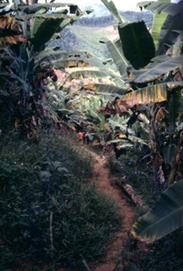
Typical path through jungle. Can see clearing to jungle edge in background. Photo by Wiley Livingston.
As we were leaving, I excused myself briefly and went to rummage through my backpack from which I retrieved my little can of OFF. Which I then sprayed on myself literally from head to toe. Then we went out into the jungle. Whenever the flashlight guys came to me they were surprised to find no flies on my skin. Everyone else had flies on their skin. They concluded that the flies just did not like gringos and I was excused duty. That night we sat in an open field and drank coconut juice from freshly harvested coconut trees. There was no light pollution and the entire galaxy was on display.
At night I would lie on my cot and watch the spiders fight the lizards on the wall. By this time, the toilet had no water and so was inoperable. I was also beginning to feel a bit queasy. I was told the drinking water may not have been as clean as advertised, but not to worry - it had been fixed. To bathe, I walked down a dirt path a half mile to a pretty little pool and plunged in. As I cleaned myself, a small man with few teeth was squatting on the far side of the pool and laughing and pointing at me. My Portuguese was still pretty rudimentary so as I returned to the village I asked one of the English-speaking Brazilians who had stayed on the bank what the man had said. “0h, he was calling you anaconda bait.” The previous day a giant anaconda had been lounging exactly where I was bathing.
Meanwhile people came into town to see the doctor. We had a room with an old cabinet that was filled with bottles of medicines, but most had no labels. I did find some bottles of ampicillin, so old that the sediment had solidified and could not be shaken into suspension. Don’t laugh. They were to save my life.
The town people all wanted the same thing: compromidos de vermin: worm pills. Ascaris worms live in the lumen of the intestines, and maintain their position by flexing their helminthic muscles and wedging themselves against the intestinal wall. The worm pills paralyze them. Take six worm pills and your toilet will be full of 8 inch long white worms the size of pencils. So, worm pills give instant results and the people like them. I saved my last six pills for myself when I got back to the US. Nothing came out.
We had several adult males, including Joe and myself, living in the house. One morning, we walked out the door to find a child of about 3 squatting on our doorstep. No one seemed to know who he was or where he came from. The child showed no inclination to leave, especially after we fed him. And he sort of adopted us. The Brazilians began calling him Bichinho (bicho = bug, inho indicating diminutive) or Little Bug. A couple of days later someone got the bright idea to give him worm pills. Within hours, he was vomiting. An image came to me that I had seen in Manson’s Tropical Diseases textbook, a picture of a dissected intestine so full of worms that the mass impacted the lumen and resulted in death. Bichinho was small, and had a small intestinal lumen. I looked through our old cabinet searching for anything that might help, and miraculously found a Fleets enema. One person held a very unhappy Bichinho, while I administered the enema. Our patient then waddled out onto the doorstep, squatted, and defecated more worms than I thought existed in the entirety of Bahia. After that, the child was fine and in fact was ravenously hungry. Bichinho stayed with us for about two weeks. One day, when the doctors returned from canvassing the area, he was gone. Neighbors told us a couple came to collect him, and we never heard any more about the child.
People came at various hours to see the doctors. One night there was a rap on our door and a couple holding their 2-year-old daughter was ushered in. The child had inserted a hard pea into one nostril apparently weeks ago, and there it still remained. We did have an otoscope and one could see the pea firmly embedded in nasal tissue. I was at a loss, but Joe recalled seeing a technique once before which he decided to employ. He inserted a metal probe through the otoscope and began manipulating the pea. The child was struggling, and it took both parents to hold her. Before long, blood began running from the nostril, and the girl was screaming. At this point Joe removed the otoscope, waited for her to draw a deep breath, and clamped his hand across her mouth. With no other outlet, the child blew explosively through the nostrils, propelling the pea across the room. The parents were appropriately grateful, and I was duly impressed.
Meanwhile I needed a place to bathe. And I found the perfect place. Below the anaconda pool was a beautiful large waterfall; this thing must have been four stories in height, and when I climbed down halfway I found a perfect spot - a tiny pool, bath tub size that fit me perfectly. I lay down in the pool with the waterfall bubbling over me and looked out on the jungle canopy. Red and yellow birds flew overhead in large numbers, and the magnificent Morpheus butterfly flitted about. It was Paradise. Then I stood up. I was covered in leeches.