Famous Norwegian med school drop-out (and polar explorer) Roald Amundsen often attributed his successes in Arctic environments to the knowledge and skills he learned from studying with and living along Netsilik Inuit communities. His adaptation of dog sledding and layered cold-adapted fur clothing inspired by Inuit designs helped him beat Englishman Robert Falcon Scott to be the first to the South Pole. Some sources note he may even have adopted some Inuit medicinal practices as well. Amundsen’s colleague on his earlier Belgica Expedition, American Dr. Frederick Cook, also avoided tragedy for his crew by adopting Arctic traditional cuisine; his realization that Inuit dietary staples like caribou, fish, and walrus meat were rich in Vitamin C would help ward off scurvy during the multi-year voyage. (Although Dr. Cook substituted these for penguin and seal meat in the Antarctic.) Undoubtedly, these early practitioners of wilderness medicine benefited from time-proven local knowledge and practices.
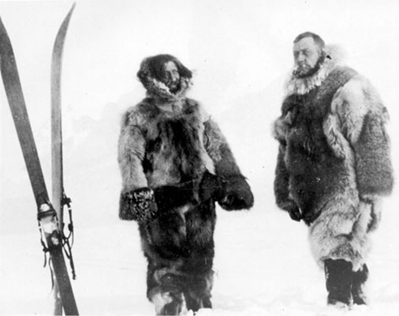
Dr. Frederick Cook (L) and Roald Amundsen (R) modeling their boots with the fur. (Credit: Dr. FA Cook Archives)
Modern wilderness medicine draws from many sources and traditional practices have often been a source of inspiration. Not to be outdone by Amundsen and Cook, during a recent trip as expedition physician for glacial researchers in Alaska, I also looked into getting inspiration from traditional local designs.
Polar explorers can be prone to snow blindness, a type of photokeratitis, caused by the reflection of UV light rays off the reflective white surface of snow (known as the albedo effect). The UV rays damage the outer epithelial layer of the cornea, similar to a sunburn, and can cause intense pain, foreign body sensation, vision loss, and photophobia. High-altitude explorers have an increased risk due to the increased penetration of UV rays in the thinner atmosphere. Treatment includes topical antibiotics to prevent superimposed infections as well as supportive care with artificial tears and analgesics. Symptoms can be delayed (30min-12h after exposure) and generally resolve after 24-72 hours; long-term damage is rare. Although usually a self-limiting disease, the pain and vision loss can be debilitating for adventurers who need to be mobile in unstable environments and can complicate evacuations.
Arctic cultures, such as the Yup’ik, Inuit, Tlingit, and Iñupiaq, have long dealt with the risks of snowblindness and developed their own preventative measures: one of the earliest versions of sunglasses. Yuktuktaak, or snowgoggles, have come in various ergonomic designs and were made of locally sourced materials such as driftwood, bone, walrus ivory, caribou antler, sea glass, sinew, and various-ply cords. Designs ranged from the functional to the portable or decorative, however, all included small circular or slit eye holes to limit entry of harmful UV rays while improving visual acuity. They were often custom fit to the wearer’s face for an ideal seal and often accompanied by a coat of reflective black soot (similar to modern NFL/MLB players). Regardless, the designs appear timeless and have even inspired some modern influencers.
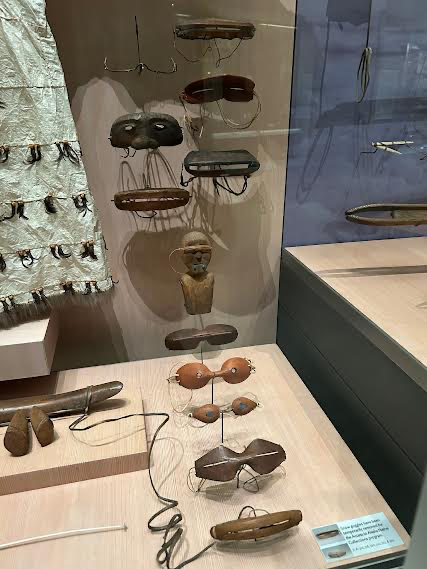
Various yuktuktaak designs from upiaq and Yu’pik artists as seen at the Alaska State Museum (Marc Cassone)
Modern glacier goggles- the current standard for snow blindness prevention- have the benefit of using pliable plastics, leather/fabric flaps, and polarized lenses. However, like most pairs of glasses, you or your team members’ glacier goggles are prone to being lost, stepped on, crushed in a pack, and/or left behind. Duct-tape repairs notwithstanding, expedition members may find themselves making improvised glacier goggles.
While teaching the Alaska expedition’s WFA course, I encouraged students to make improvised glacier goggles using native designs. Although the materials were cardboard, paracord, and duct tape, the designs were drawn from native protypes as seen at the Alaska State Museum in Juneau. While not as effective as their modern equivalents, they did decrease glare and with some customization made for a comfortable and sturdy fit. Some even included nose sunburn protection. I’d invite other wilderness medicine workshops to try their hand at this improvised eyewear with local inspiration!
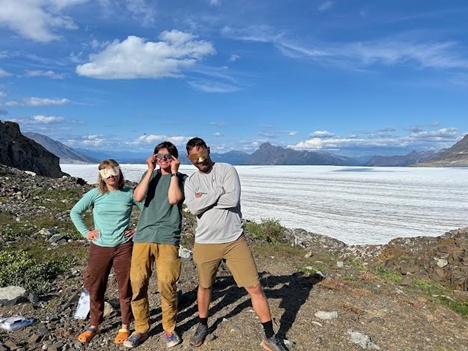
The author and WFA students demonstrating improvised glacier goggles from atop a nunatak in the Juneau Icefield. (Marc Cassone)