On Christmas Day, December 25, 2024, the Communications Center in Skamania County, Washington received a call concerning two men who were overdue and reported missing. The men, ages 59 and 37, were from Portland, OR. They had traveled to Washington state to search for Sasquatch (aka Bigfoot). Upon notification, the Skamania County Sheriff’s Office accessed cameras that identified their vehicle near Willard, WA, about an hour and a half’s drive from Portland. An extensive ground and air search was initiated. The men were ultimately found deceased, presumably from exposure, “based on weather conditions and ill-preparedness”.
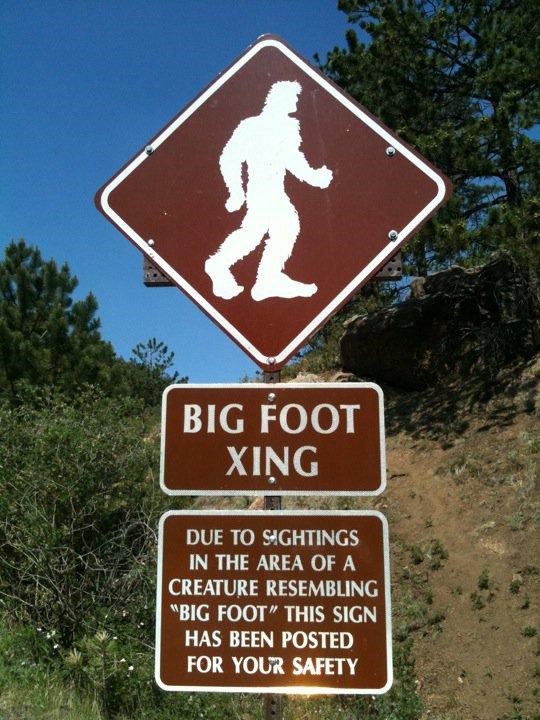
Big Foot Sign. Source: Wikimedia
While there have been “credible” sightings of Sasquatch in 49 states (Hawaii being the exception), the Pacific Northwest is a particularly hot spot. Skamania County, located in southwest Washington, is especially popular for Sasquatch studying and hunting. It has become such a common activity that the county determined a need for the protection of the local public from armed searchers. In 1969 a county ordinance was passed that “forbids the slaying of any “nocturnal primate mammal...generally and commonly known as a ‘Sasquatch’, ‘Yeti’, ‘Bigfoot’, or ‘Giant Hairy Ape’”, subject to a maximum penalty of a $10,000 fine and five years imprisonment.” In 1984 the ordinance was amended to declare the county a Sasquatch refuge for this supposedly endangered species.
In searching for the two Portland men, more than 60 people volunteered over three days, including Christmas Day. This included search and rescue (SAR) personnel from three counties, four private volunteer SAR organizations, and the US Coast Guard. Conditions were difficult for the rescuers due to cold, wet conditions, and difficult terrain. Assets utilized in the search included highly trained dogs and SAR drones.
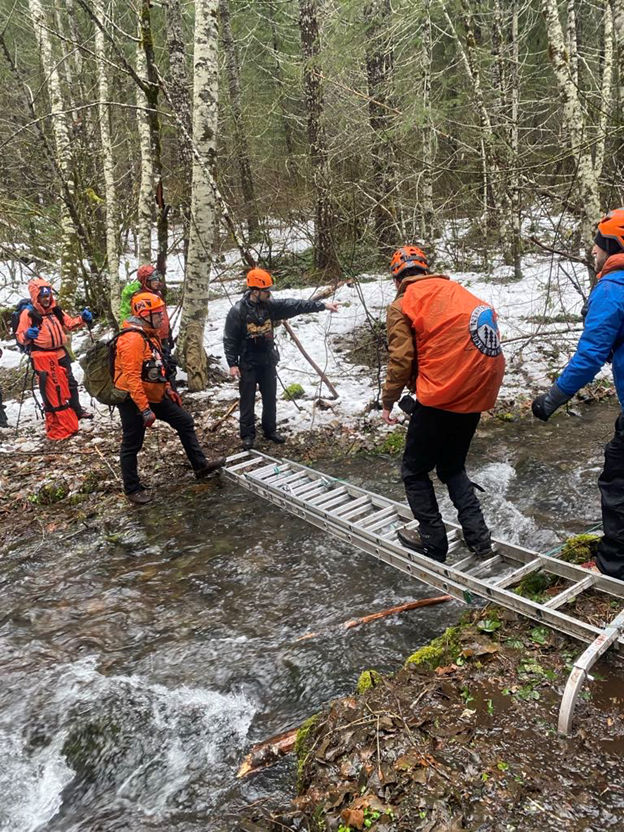
SAR rescuers cross a stream. Source: Skamania County Sheriff’s Office Facebook page
Dogs assist SAR teams in finding lost persons through their sense of smell, which is highly enhanced compared to humans. Dogs have more than 100 million sensory receptor sites in the nasal cavity (humans have 6 million) as well as an odor-analyzing area of the brain 40 times larger than that of humans. SAR dogs are categorized as either air-scenting dogs or trailing dogs. Air-scenting dogs follow wind-borne scents to cover large areas of land, finding the origin of human scent. Their performance can be affected by wind conditions and by the rain that was present in Washington during this search. By contrast, trailing dogs follow a scent left by a specific person, either on the ground or on vegetation.
SAR drones with video capability can cover large areas of rough or dangerous terrain in much less time, and with less risk, than can human searchers. Analysis of a drone’s video feed can also be enhanced by artificial intelligence, efficiently scanning video feed for specific colors or objects. In this Washington search, helicopter air support was provided by the US Coast Guard. This asset had FLIR thermal vision capability, enhancing the ability to find warm human bodies in a cold environment. This is particularly useful in the dark or where heavy tree canopy limits visibility.
The Skamania County Sheriff Summer Scheyer recommends bringing following "essentials" when traveling in the winter: fire making capabilities, analog map and compass, extra clothing, and an inReach device or similar satellite communicator.
The WMS CPG for the Out-of-Hospital Evaluation and Treatment of Accidental Hypothermia classify hypothermia by clinical signs. “Rescuers should classify hypothermia as mild, moderate, severe, and profound on the basis of clinical observations, remembering that shivering can occur below 32°C, usually with altered mental status, and that patients can have detectable vital signs with core temperatures below 24°C. Furthermore, rescuers should be aware of core temperature overlap between classification categories.”