Introduction
The Army’s expeditionary Security Force Assistance Brigades (SFABs) support burgeoning democratic nations around the world, including areas of extreme heat and cold. With heat injuries being a common cause of disease/non-battle injury (DNBI), 2SFAB, aligned with Africa, conducted product reviews of various containers for ice and normal saline transport. Of course, with the primary treatment of heat illness being cold water immersion per both Army and Wilderness Medical Society Clinical Practice Guidelines, ice water retained in the cooler deserves note. Though chilled saline only serves as an adjuvant treatment, the authors may apply lessons learned to formal research on chilled blood product storage and transportation. We aimed to study which containers kept saline sufficiently cold while considering price and ease of use.
The Trial
In the heat of the Mojave Desert in July 2024, we charged the containers as recommended by manufacturers and put into each two units of normal saline 500 mL. Given recent cooler thefts in the area, the units were stored in a foam-covered tent rather than the beating sun as originally planned, with a constant temp of 80℉ (27℃). After 72 hours, we measured the ambient temperature, and the temperature of the saline in each bag.
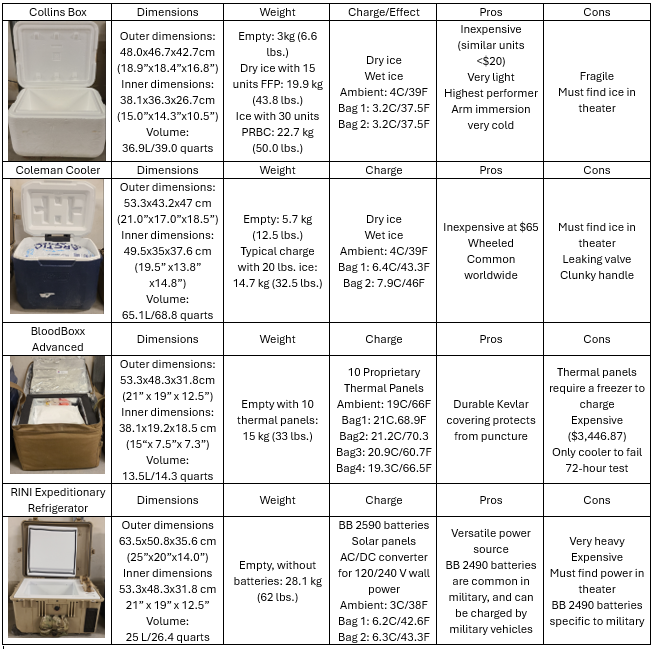
Figure 1. Comparison chart of coolers.
The Contenders
Collins Box
A simple Styrofoam cooler made for transporting blood, Collins Boxes can be found in military medical facilities and do not differ significantly from commercial off-the-shelf (COTS) coolers. This simple box filled with ice outperformed the other options, with the slurry of melted ice enough for a brisk arm submersion and certainly enough liquid to administer an ice bath. For the light weight and availability, the Styrofoam cooler charged with ice would be a great option for three-day missions.
Camper Cooler
Widely available across the globe, camper coolers have been trusted for generations for their cooling capacity. Though inexpensive, the unit salvaged from an Advisor’s garage has a broken water release valve, making it incapable of holding the melt-off. Moreover, though wheeled, its handle tends to be fickle, with multiple Coleman reviews noting these two common problems, and a lack of replacement products. Nonetheless, the normal saline inside remained cool enough to be clinically useful for a hyperthermia adjunct, even if the lack of water meant no arm submersion. Perhaps we’ll repeat with a newer cooler to see if it makes a difference.
BloodBoxx Advanced Nesting System
This “medical lunchbox” had tested well among junior medics in 1st Brigade 1st Cavalry Division as easily transported and incredibly durable, and we harbored high hopes for it. With ten thermal panels, consisting of electrolyte solution frozen for 24 hours prior to use, manufacturers claim it could keep packed red blood cells at 4-10℃ for up to 120 hours. Could it keep the normal saline cool for three days and, moreover, have some residual coldness left over that the thermal panels could make a cold-water bath? Sadly, no. After 72 hours, both units had risen to room temperature. With a $3000+ price tag, we had hoped for more.
RINI Expeditionary Refrigerator
A ruggedized fridge made to be compatible with standard wall sockets, military vehicles and batteries, and included solar panels, it did exactly what we needed it to do. Plugged in for three days, the internal temp and the temp of the saline within remained cool. With the large size and emphasis on military radio batteries (BB-2590), it would perfectly fit atop a tracked ambulance (M113), inside a wheeled ambulance, or in the back of a transport truck (LMTV).
Conclusion
For a military unit with the resources, space, and muscle, the RINI Expeditionary Refrigerator, with its versatility in power sources, proved the clear winner. For applications such as unconventional military use, search and rescue ops, athletic events, and missionary work, a Styrofoam or camper cooler could save some cash. The BloodBoxx, noted for being covered in aluminized Kevlar, has use limited to short transport of fluids in heavy combat.