Overview: On September 29, 2024, the rural areas of northwest North Carolina experienced severe flooding as a result of the rains from a tropical storm and Hurricane Helene. As a part of a humanitarian team that usually deploys overseas, we responded to support rural and remote hospitals in the affected region.
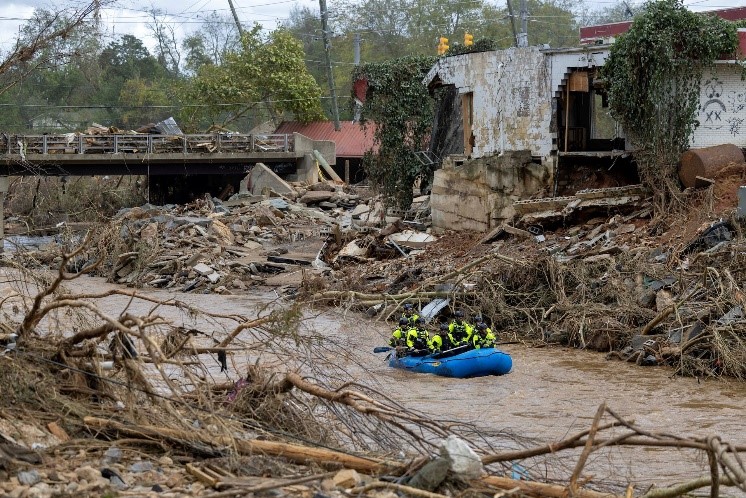
Swannanoa, NC Rescue Operation (Courtesy Reuters)
Background: Between September 25 and September 27, 2024, northwest North Carolina received an average of 30 inches of rain from a tropical storm. Shortly after, Category 2 Hurricane Helene came through the region on Friday, September 29, dumping another 12 to 25 inches of rain on the soaked ground. These dual events caused creeks and rivers to overflow, washing away bridges, roads (including parts of Interstate 40), buildings, and homes. Small communities in the area were devastated by the destruction and the deaths of over 100 community members. Some weather forecasters estimated that 40 trillion gallons of water fell on the region. Others estimate these rains are the equivalent of filling the Dallas Cowboys stadium 51,000 times.
On the ground on Saturday, September 30, in Boone, NC, the region was without power and had very little access to the mountainous areas due to washed out roads and downed power lines. While usually working overseas in a disaster environment, our group experienced a number of very different lessons learned while working in northwest North Carolina.
Lessons Learned:
- Rural hospitals: The small, critical care access hospitals in the region were severely affected. The American Hospital Association defines these small hospitals as a facility that is in a rural county more than 35-miles from a regional hospital and designated by the state as a needed provider of health care services. These hospitals may have only a few beds for emergency cases and inpatients, meaning their capacities can be quickly overwhelmed.
- Power and Water: When the power fails, small hospitals have back-up generators that will keep the lights on. However, they remain without water when the county or city water pumps have stopped functioning. For hydration, patients and staff must rely on a limited supply of bottled water. And without water and pressure, toilets and kitchens also cease to function. Portable toilets must be brought in, along with portable cooking facilities, which can be challenging with blocked roads. It was 3-4 days until electricity was restored in some areas and water was back on. While the small regional hospital in Boone had water and power restored in a few days, other areas such as Linville, Spruce Pine, Jefferson County, and Asheville were without power for much longer. Water is a critical priority.
- Oxygen: Small, rural hospitals rely primarily on bottled oxygen for patients. Without power or accessible roads, local oxygen bottle providers cannot function and hospitals do not have bottle refill capability. In addition, for patients in homes without power, oxygen concentrators are non-operational, and portable oxygen bottles are quickly emptied, even when running at just 2 to 4 liters per minute. Oxygen replenishment quickly becomes a priority for these patients.
- Emergency access and communications: The hospitals had back-up power, however homes and some rural emergency services were without power. Phones were not charged, batteries were dead, and even if generators were accessible, many cell towers were non-operational. Most land lines were out of order due to power outages and downed lines. Radio and Starlink communications often provided a reliable back-up.
- Staffing and First Responders: Many staff were working around the clock and it showed on their faces and in their demeanor. One first responder was shocked at the devastation. When notified that a home was swept away with a 14-year-old inside, a team wanted to conduct an immediate search. However, their leadership could not allow it because of the dangerous, raging waters. These events deeply impact staff, first responders, and the community. More positively, our team collaborated with an ER physician and we were able to provide staff and mobile oxygen generators for patients at the hospital and those in the community
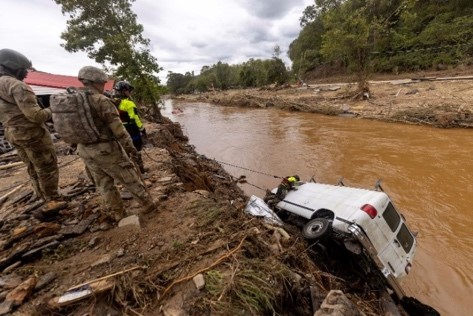
Swannanoa, NC Rescue Operation (Courtesy Reuters)
- Toxic rivers and streams: Many community members could be seen standing in streams and along river banks searching for belongings. These waterways, in many cases, had also been filled with run off from large animals and light industrial operations. While searching in these areas, cuts on hands and legs are at a very high risk of infection. Appropriate personal protective equipment was flown into some areas for search and rebuild operations.
- Wasps and yellowjackets: In North Carolina, specific types of wasps and hornets maintain their hives underground. During heavy rains and flooding they become extremely active above ground. As a result, many first responders, home owners, and relief teams suffered numerous stings. Benadryl and topical ointments were quickly in short supply. Some organizations were able to purchase supplies from communities in eastern North Carolina, and the supplies were flown into remote areas.
- Dehydration: As a result of the lack of water in many areas, elderly and at-risk patients suffered from dehydration. When asked about their needs, emergency teams requested IV kits to help these patients. Many of these supplies were also flown into remote areas.
- Aircraft: During the first few weeks, helicopters from private and National Guard organizations were critical to supporting the rural areas with limited roadway access.
- Seasons: Winter and colder temperatures are on their way, and snow can be expected in North Carolina. Teams should be prepared for low temperatures, wind, and snow.
In conclusion, while supporting Boone, Linville, Spruce Pines, and Jefferson County staff and patients, there were challenges not typically seen in overseas humanitarian disasters. The best lesson learned in this austere setting was to see the spirit in these rural communities to solve disastrous problems and support each other! Homes and businesses are being rebuilt and hearts are open to those in need.