The birth of Jesus of Nazareth represents one of the most well-known stories of faith across the globe, providing the basis upon which the text of the New Testament and arguably Christianity are built. The details surrounding this event are described in the New Testament of the Bible, however, detailed description of the conditions of the birth are scarce. Historical and religious texts do not report any complexities or complications around this highly significant childbirth – this supports the assumption that the birth, transition to life, and the neonatal period of Jesus were relatively uneventful from a healthcare point of view. However, the theoretical medical management of an infant born in such austere conditions would be interesting to consider. By today’s modern medical standards and expectations, this would have been thought of as a remote location homebirth in an austere environment. However, it would still be comparable to a modern day freebirth in a rural setting or typical in regions with limited medical infrastructure. In honor of the upcoming holiday season, I’ll discuss the potential austere medical considerations for such a birth based on descriptions from scripture and common artistic depictions of the event.

Figure 1: Geographical location of Bethlehem
Environmental Considerations
Although the birth of Jesus is commonly celebrated on December 25th and accepted to have been in the city of Bethlehem in Judea (part of modern-day Palestine), the exact date and location of his birth remains imprecise, with scholars considering it to have occurred between 6 BCE and 4 BCE. This event is reported to have taken place at night and scripture reports placement of the newborn infant in a manger, a stable-like structure, likely containing straw. The thermal properties of straw can act as an insulator, which could be helpful to the thermal protection of a temperature-sensitive neonate prone to hypothermia. Classical depictions of this scene also show a newborn fully swaddled, which takes into consideration the large surface area of the head and its inherent heat loss and further serves to maintain body temperature. The presence of additional people (Mary, Joseph) and farm animals (cattle, sheep, and donkeys are among those commonly depicted) at the manger-side may have served to collectively raise the room temperature within the enclosed space of what may have been a cold night. Standard methods of environmental control as practiced in modern newborn resuscitation –such as elimination of drafts – would also be beneficial in such an environment, albeit challenging if in an open-air setting instead. Another newborn thermoregulation support technique which is still considered invaluable, even today, is kangaroo mother care (also known as skin-to-skin care), which provides numerous benefits to newborns beyond simply temperature control and would certainly have been available to the baby Jesus as well.
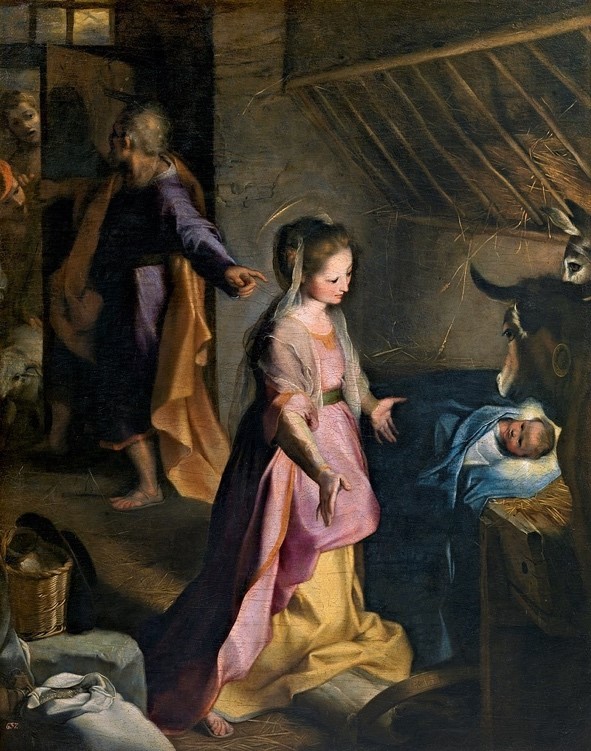
Figure 2: Barrocci’s Nativity (1597) exhibiting swaddling, straw bedding, attempted draft reduction, and animal exposure.
Cord Care
Delayed cord clamping is a mainstay of modern delivery-room care for term newborns. This practice allows for further transfusion of placental blood into the newborn, improving their hemodynamic stability as well as their hemoglobin and iron stores and ultimately benefiting developmental and cognitive outcomes. The minimum recommended sixty seconds delay before umbilical cord clamping or cutting may or may not have occurred in setting of the nativity, simply due to a lack delivery-room assistance and available tools. This practice, as recommended by the World Health Organization (WHO), is of particular significance in low resource settings, impacting nutritional health beyond the neonatal period and into infancy, in areas where access to iron-containing foods for weaning may be limited.
It is widely recognized that cord cutting prior to placental delivery arose in the 17th century; it is unclear if cord cutting following placental delivery may have been standard practice at the time of the nativity, however the Old Testament’s Book of Ezekiel does indeed reference the practice. Alternatively, some cultures have been known to tie off the umbilical cord and allow it to then detach from the placenta naturally in coming days, representing an instrument free method of baby becoming separated from placenta.
Infection Considerations
Delivery of a baby by spontaneous vaginal delivery by a primigravida woman can take up to 24 hours. Given that prolonged rupture of amniotic membranes is a risk factor for early onset neonatal sepsis and that this is defined as over 24 hours in term deliveries, it is unlikely for baby Jesus to have been at higher risk of infection due simply to duration of labor. Additionally, infection control via good hand hygiene and access to clean water is especially important in remote deliveries. This remains a challenge even today, with the WHO and the United Nations Children’s Fund (UNICEF) reporting over a third of healthcare facilities in low- and middle- income countries lacking access to any clean water whatsoever. This may have been a challenge to maternal health for both our expectant mother and her birth partner Joseph.

Figure 3: Rest on the Flight into Egypt by Gerard David (1512-1515) depicting breastfeeding of an infant Jesus
Additionally, the risks of neonatal zoonoses must also be considered – although uncommon in medical literature, these have been reported in various circumstances. Literature reveals Pasteurella sp. to be of particular significance within zoonotic infections of the neonate, transmitted by animal bites, licks, or scratches and transmissible not only from domestic pets, but also from farm animals such as sheep. This may therefore have been a principal infection control concern, given the birth occurred in such close proximity to livestock.
Risk of neonatal tetanus from using nonsterile instruments for cord cutting may have been of importance had instruments been used for this purpose; a lack of historical or biblical reports about illness in the newborn period following the nativity suggests this was however avoided. Neonatal tetanus remains a WHO concern – their Maternal and Neonatal Tetanus Elimination Initiative launched in 1999 is still active today, demonstrating how some neonatal care concerns have persisted in lower resource environments.
Feeding
Like all babies at the time, feeding was only possible in the form of breastfeeding. Artificial formula feed as we know it today would not exist for millennia, though the concept of feeding by someone other than an infant’s biological mother – a wet nurse – began thousands of years before the Christian era. It is assumed, however, that this was not immediately accessible in the remote environment of a rural stable, nor would it have been affordable as this was typically utilized by the upper social classes. Early feeding within one hour of birth remains a WHO recommendation, protecting against neonatal hypoglycemia and conveying protection against acquired neonatal infection. Across the millennia, the role of early breastfeeding has also been recognized to enhance attachment and subsequently milk flow, further securing nutritional advantages in the newborn period and infancy. In both scripture and art, Mother Mary is portrayed as performing the act of breastfeeding – often referred to as the Nursing Madonna.
Conclusions
The natural process of childbirth and the principles of modern evidence-based neonatal care often overlap, with key healthcare elements having crucial importance throughout human history. Concepts of care for full term newborns in rural or resource-limited environments may be similar across periods of human history, with natural mechanisms and instincts providing survival advantages which have allowed the human race to thrive.