Photo credit: National Park Service
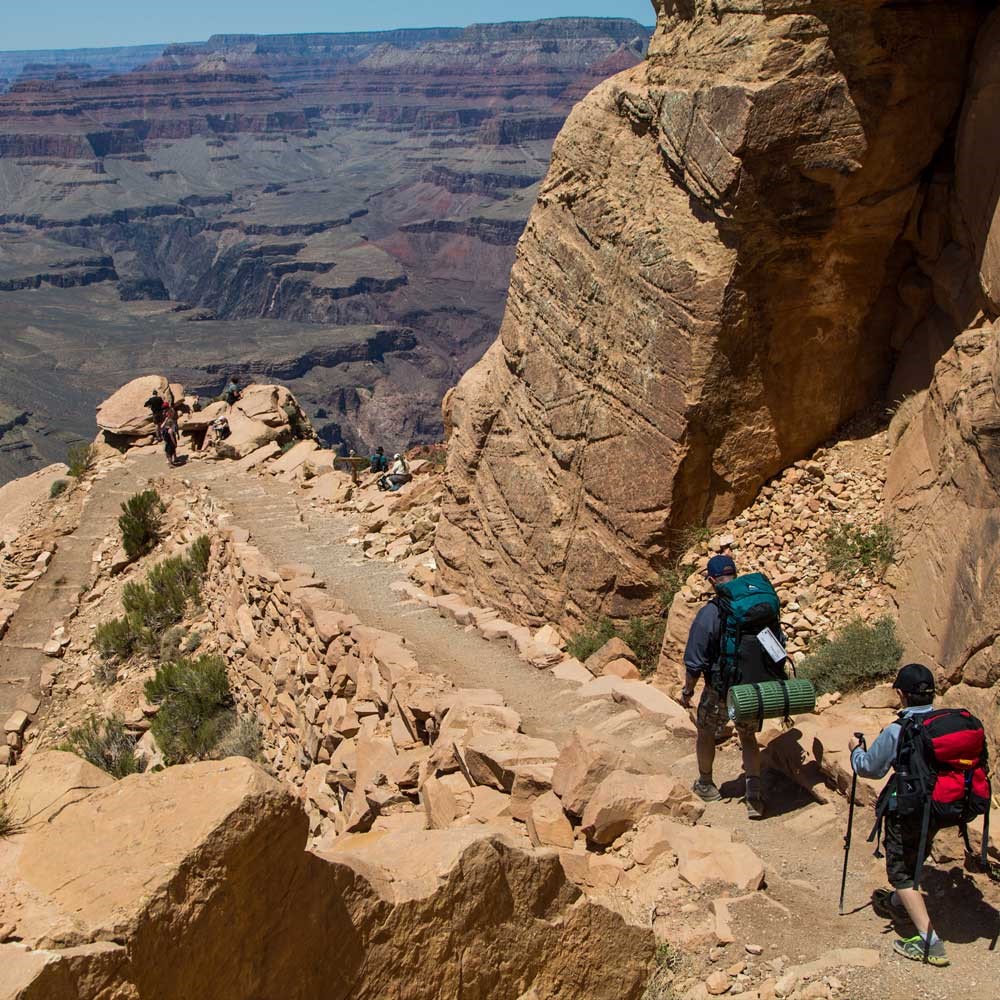
The stunning Grand Canyon is often called the "Inverted Mountain" because it looks like a mountain that's been turned upside down. It averages about 4,000 feet deep, 10 miles wide and is 277 miles long. Within Grand Canyon National Park (GCNP), the Bright Angel and South Kaibab trails are the most popular and well maintained for hikers, backpackers, and trail runners into the canyon. Bright Angel trail drops 4460 vertical feet over 7.8 miles (10.8% grade), and South Kaibab trail drops 4860 feet over 6.3 miles (14.6% grade). The popularity of these trails can present many physical challenges for an unwary individual, despite relative fitness. Consequently, GCNP Rangers and Preventive Search and Rescue (PSAR) volunteers proactively patrol these trails and tell visitors that there is no easy hike into or out of the canyon, often adding the sardonic, but very true Canyon quip: “Downhill is optional, uphill is mandatory.” Their goal is to educate those descending into the Grand Canyon about how to safely enjoy hikes, and how to avoid becoming a morbidity or mortality statistic before it’s too late. They point out common mistakes hikers often make, as well as the natural hazards, and how to mitigate or avoid them. Most importantly, they try to identify hikers at highest risk, and encourage them to turn around before descending too far.
Many hikers and joggers can be enchanted by a feeling of relative ease from negative work going downhill on a trail, especially when in canyons. Gravity and momentum do most of the work moving one forward while muscles and joints slow advancing motion with each step to prevent falling. However, even those who are fit, but unaccustomed to prolonged downhill activity, can experience symptoms of exercise-induced muscle damage (EIMD). The following is a quote from M. P. Ghiglieri, PhD and T. Myers, MD in their book called, Over the Edge: Death in the Grand Canyon (2012):
“In any group of mountaineers, the number of potential summiteers shrinks as the mountain lets people know just how hard it really is to gain altitude solely via one’s own power. In other words, mountains often weed out the unfit so early in the game that, once they realize they have bitten off more than they can chew, they can often return fairly easily downhill to their staging zone. In complete contrast, canyons do the opposite. While descending most canyon trails, the ease and coolness of the descent are seductive. It’s a breeze even for the unfit or the unprepared. Until the time comes to hike back up. Then, when it’s all too often a hot, dry, hard, agonizing, and often tortuous physiological contrast to the descent, the unfit get weeded out late in the game and get weeded out brutally.”
Two recent case reports in Wilderness & Environmental Medicine journal provide details of EIMD including exertional rhabdomyolysis, lower extremity compartment syndrome, and acute kidney injury caused by prolonged hiking or running downhill. These complications from downhill activities can be further exacerbated with exercise-associated hyponatremia or heat related-illness.
What is Mild to Severe Exercise-induced Muscle Damage?
Exercise-induced muscle damage is typically triggered by an unaccustomed exercise bout, or during extreme fitness activities. Many forms of exercise can cause acute muscle damage from microscopic tearing of muscle fibers. It is more common to experience EIMD with eccentric muscle contractions due to an overload of mechanical stress. Typical examples of eccentric muscle actions result in lengthening of the muscle-tendon complex, such as in the thigh muscles as they brake against your body’s momentum during prolonged hiking or running downhill, or in lowering a dumbbell during a biceps curl. This type of mechanical stress alters muscle structure, muscle function, and cause a strong inflammatory response. Mild symptoms of EIMD can occur early with acute pain/soreness, and then may become more intense, with an onset between 12-24 hours after a workout with peaks soreness between 24-72 hours. This is known as delayed-onset muscular soreness (DOMS) and is generally self-limited, not requiring medical consultation. Other EIMD signs and symptoms include muscle edema, increased blood biomarkers caused by muscle cell damage (e.g., creatine kinase), decreased range of motion, and a decrease in exercise performance.
In severe cases of EIMD, exertional rhabdomyolysis (ER) may develop as a progression of DOMS. Exertional rhabdomyolysis and DOMS can have overlapping symptoms, but key symptoms, e.g., persistent or worsening pain/soreness, assist in distinguishing it from mild muscle breakdown as experienced with DOMS – see Table 1. The onset of ER can occur in all different types of sports. Unaccustomed strenuous exercises, however, are a predominant cause, such as military recruit training, ultramarathons, triathlons, or heavy weightlifting, including CrossFit and other high-intensity training. Exertional rhabdomyolysis is characterized as further breakdown of the skeletal muscle that releases cellular components, such as myoglobin, sarcoplasmic proteins (creatine kinase, lactate dehydrogenase, aldolase, alanine, and aspartate aminotransferase), and electrolytes into the extracellular fluid and the circulation. Once significant amounts of myoglobin are released into the bloodstream it may block the kidney tubule resulting in acute kidney injury, and in the worst case scenario, kidney failure. In 50% of patients, severe complications of ER can include acute renal failure, acute cardiac arrest, and lower extremity compartment syndrome. With a compartment syndrome, muscle (edema) swelling can get trapped within the confines of the surrounding fascia causing muscle necrosis and cellular death. This is commonly referred to as exertional compartment syndrome as a result of strenuous exercise - see Table 2 for signs, symptoms and treatment.
Even an experienced hiker can suffer a severe case of ER; this one occurred during a 2-day rim-to-rim-to-rim hike in the winter in the Grand Canyon.
Table 1: Exertional Rhabdomyolysis Signs and Symptoms and Complications. (Myers et. al, 2024)
|
Exertional Rhabdomyolysis
|
Signs and Symptoms
|
|
Prehospital Setting
or
In-hospital assessment
|
- Acute or delayed muscle soreness
- Out of proportion pain intensity
- Tenderness to palpation
- Limitations in active and passive range of motion
- Muscle swelling
- Myalgias
- Weakness
- Fever
- Anuria
- Dark brown urine (myoglobinuria).
- Persistent or worsening pain/ soreness >5-7 days after strenuous activity.
- Compartment syndrome
- Creatine kinase (>20,000 U×L-1)
|
|
Acute Kidney Injury
|
- Serum creatinine increase of
≥0.3 mg⋅dL-1 within 48 h, or
- Serum creatinine 1.5 times baseline level with previous 7 d, or
- Urine output of <0.5 ml/kg/h-1 for 6 to 12 h.
|
|
Other Severe Complications
|
- Acute compartment syndrome [fluid shifts into injured muscle tissues in response to large scale spillage of intracellular proteins and electrolytes];
- Acute tubular necrosis and renal failure [because of kidney hypoperfusion, metabolic acidosis, and myoglobin sludging in renal tubules];
- Disseminated intravascular coagulation [caused by tissue damage releasing procoagulant factors];
- Cardiac dysrhythmia [caused by electrolyte disturbances]
|
Table 2: Signs and Symptoms of Exertional Compartment Syndrome (Myers et. al, 2024)
|
Signs and Symptoms
|
Treatment
|
|
Five P’s:
- Pain (bilateral)
- Pulseless
- Paresthesia
- Paralysis
- Pallor
Other:
- Tender to palpation
- Feels tight (“wood like”)
- Decreased sensation
- Weakness
- Coolness
|
Prehospital:
- Supplemental oxygen
- Remove any constricting clothing, bandages, dressings, etc.
- Rest
- Immobilize
- Elevate
- Cool (ice) extremity
- Oral or IV fluid therapy – (only when no suspicion of exercise-associated hyponatremia)
In-Hospital:
- Fasciotomy – maybe required when intracompartmental pressures >30 mmHg (0 to 8 mmHg normal range)
|
Prevention and Management of Exercise-induced Muscle Damage
Here are two resources about the cause, prevention and management of EIMD. The first is an article from Runner’s World, and the second, from the American College of Sports Medicine (ACSM). The latter provides an excellent two-page handout about key points to reduce the severity and recover from EIMD/DOMS. Some of these key points from ACSM include:
- Allowing the muscle time to adapt and recovery from new exercise routine should help to minimize the severity of symptoms.
- Participating in the same exercises on subsequent days should to be done judiciously.
- Little evidence that warm-up will be effective in preventing DOMS symptoms.
- Best to stretch after the body is warmed up and after exercise, but has not been shown to reduce or prevent symptoms of EIMD/DOMS.
- Light exercise activity should not impair your recovery, but not much evidence that this will hasten your recovery.
- Refrain from the activity for a few days if your symptoms make it difficult or too painful to perform the activity; return to the activity as symptoms subside.
- To treat EIMD/DOMS symptoms, ice pack application, massage, acupressure, and oral pain relief agents may be useful in easing pain.
- There is little evidence that treatment strategies will hasten recovery and return to normal function, and may only be effective in reducing symptoms of pain.
- EIMD/DOMS symptoms do not typically necessitate the need for medical intervention. If the pain level becomes debilitating, if you experience heavy limb swelling or if urine becomes dark, then seek out medical assessment for early diagnose of exertional rhabdomyolysis.
To reduce the risk of EIMD, it is recommended to start specific training before hiking into a canyon or up a mountain trail. Research indicates that incorporating gradual training sessions, such as downhill hiking or running once a week, is an effective strategy to minimize muscle damage from downhill sections. It is also advisable to begin this preparation at least 4 to 6 weeks before any extended downhill activity. However, preparing can be challenging if you lack access to a canyon or mountain for training nearby. Below are some resources for preparing for downhill activity when hills are available or not for weekly exercise sessions.