I once found myself in a park, removing sutures from a patient’s lower leg. She was sitting along the cargo footwell of a van with her legs dangling out and I was on the ground, supply tray next to her in the van. Those sutures were two weeks overdue, so removing them comfortably took some care. As I worked, a few of her neighbors gathered around, chitchatting, listening to music on a stereo. Then, the puppies arrived—eight of them, running circles around the van. One eventually climbed into my lap, settling in as I continued my task. Working in the sun, surrounded by a sense of community, with a puppy in my lap—I don’t know that I’ll ever have another moment in medicine quite as perfect as this one.
During physician assistant school, I struggled to choose a clinical path. I appreciated the breadth of primary care but felt I would thrive on the “life in the fast lane” vibes of emergency medicine. I also missed the focused proficiency in austere medicine I experienced as an Army medic. After an unforgettable family medicine rotation, I knew I had a home in that specialty and began my practice in a very small, very rural town. It wasn’t the wilderness, but I’ve always described it as “medicine on hard mode.” Eventually, I transitioned to a more urban setting, but that’s where I found my first taste of austere medicine as a PA.
The county I moved to asked clinic systems to bid on running street medicine programs in its cities. A team—comprised of a nurse, a community health worker, a social worker, and a clinician—would take a van to areas with a high density of unsheltered people. Our mission was to provide whatever services folks might need: signing up for health insurance, accessing housing systems, providing supplies and ID vouchers. But it also meant meeting patients where they were to offer urgent, chronic, and preventive care. When I was invited to fill in for a colleague on leave, I jumped at the chance.
Our team got into a routine of visiting the largest unsheltered encampments in our city. We’d bring the van out, throw on our backpacks, walk around greeting people, and offer our services. Some were indifferent to our presence, others amused, and many had questions or needs we hoped to address. But just like earning a patient’s buy-in for a treatment plan in a traditional setting, offering unsolicited healthcare requires building trust. Some of that trust came with time, some from the credibility previous clinicians had built, and I like to think a lot of it came from good conversations and useful recommendations.
For some concerns, we would solve the problem on the spot: basic wound care, talking over blood sugar logs after a change in diabetes management, assessing musculoskeletal complaints. Other concerns were more complex, requiring a return to the van: medication-assisted treatment for substance use, simple procedures, complex hospital follow-ups. Anything you might encounter in a primary care clinic, we saw at the encampments. We just did it with less likelihood of follow-up or ever seeing test results, relying mostly on medications and supplies we could drive out with us, and with the occasional police officer approaching you very cautiously while you’re doing an I&D.
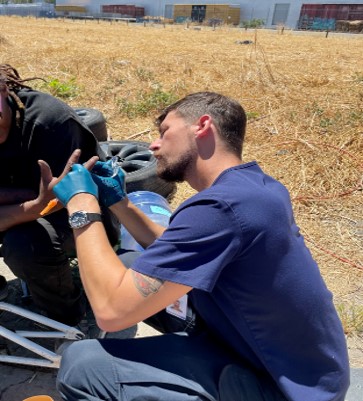
Foreign body removal at one of our encampments. (Zack O’Leary)
Aside from budget and space restrictions, access issues were rampant. This was driven by socioeconomic limitations rather than remoteness. Because all of our patients were on Medicaid, which we could start the process of enrolling them in if needed, they had insurance. But if a patient needed a specialist consult, especially for psychiatric or surgical concerns, the wait time was likely to be measured in months rather than weeks. Coverage for medications and tests for California’s Medicaid program were actually pretty good, but the state of health insurance in the US aside, suggesting someone leave all their worldly possessions unsecured to go to the lab, pharmacy, or hospital was often an impossible ask.
This meant changing the way I practiced. Wilderness medicine demands a deep understanding of conditions and management options. We all know the standards of practice, but out there we need minimum viable options, and a few other choices in between. It requires knowing what will be effective in a situation, not just what might be efficacious. Thankfully, these skills translate directly back into more typical practice, where having options allows you to tailor care plans to patient needs. Working out in the world also enhances our appreciation for all the other staff that normally support us when it’s not just a team of four. Practicing in the elements has certainly also deepened my love for air-conditioning. Yearning for wilderness medicine opportunities, I knew I would get to experience these things eventually, I just never expected I’d get them while using an EMR and going home at night.
The challenges of street medicine must sound familiar to readers of this magazine, whose passion lies in being prepared for work in undeveloped areas, with limited resources and poor access. While the encampments we visited were not geographically distant, they were a world away from the medical system I usually practice in. There was less physical stress involved in street medicine, but the emotional stress of managing emergencies in inaccessible settings was absolutely present. This created a cognitive dissonance I still think about frequently. It was akin to the loneliness of living in a new city, surrounded by people, but without a social support system to lean on just yet.
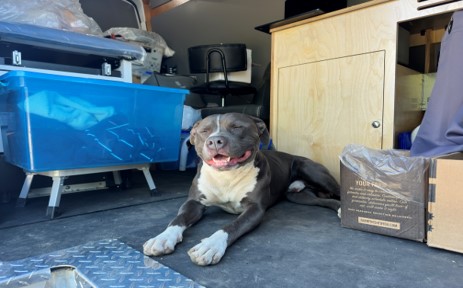
One of our patients cooling off in the van even though she’s not supposed to. (Zack O’Leary)
While I wish there were no need for this role, I have to admit I had the time of my life on the street medicine team. I never imagined I could have an experience like this in my own backyard. For me, the heart of wilderness medicine is preparing for environments other clinicians might avoid and being ready for situations we all hope never arise. So, with this unconventional form of wilderness medicine in mind, I encourage you to seek out opportunities that extend beyond the forest, slopes, or sea. In medicine, we must meet our patients where they are, not where we wish they were—and in our business of wilderness medicine, that’s quite literal.