On Friday, August 9th, 2024, ARS Pharmaceuticals received approval from the US Food and Drug Administration (FDA) for neffy® (epinephrine nasal spray) 2 mg, marking the first and only needle-free emergency treatment of type I allergic reactions, including life-threatening anaphylaxis, for adult and pediatric patients weighing at least 30 kilograms, or approximately 66 pounds. neffy® is administered as a single dose into one nostril. As with its well-established and widely-used injectable counterpart, EpiPen®, a second dose may be warranted if symptoms worsen or if there is no improvement. Furthermore, patients are advised to go to the emergency department for close monitoring after administration of neffy®. While the new drug’s mechanism of action is virtually identical to the traditional EpiPen, the alternative route of administration presents a viable option for patients, adult and pediatric alike, who may otherwise be averse to needles.

neffy epinephrine nasal spray device
neffy® is indicated in the emergency treatment of anaphylaxis, an acute, life-threatening type I hypersensitivity reaction in which a rapid-onset systemic immune response triggers respiratory, circulatory, gastrointestinal, and/or skin/mucosal changes. The National Institute of Allergy and Infectious Disease defines anaphylaxis according to three criteria: acute onset skin/mucosal involvement with respiratory or cardiovascular compromise, two system involvement after exposure to a likely allergen, or cardiovascular compromise after exposure to a known allergen.
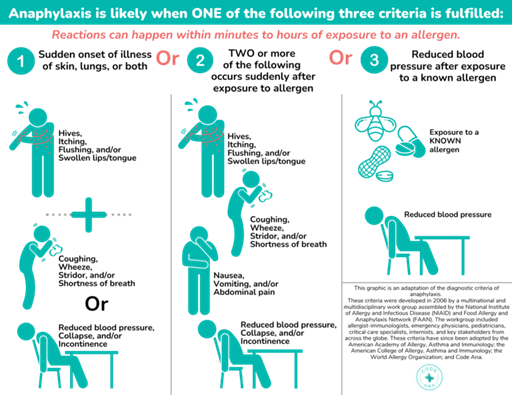
Anaphylaxis Criteria. Source: CodeAna
Anaphylaxis may manifest as shortness of breath, generalized weakness, dizziness, cough, chest tightness, trouble swallowing, generalized itchiness, abdominal cramping and/or nausea and vomiting. Physical exam findings may include tachycardia, stridor and wheezes with labored breathing, hives, and facial swelling. These symptoms can be non-specific so careful evaluation for a possible allergen source and immediate removal once identified is paramount to avoid continued or worsening reactions. In the wilderness setting, anaphylaxis commonly occur when the immune system responds to a foreign protein injected into the body through bites and stings from insects, reptiles or marine creatures, as well as through ingestion of contaminated foods or medications. Rebound allergic reactions can happen within 24 hours following the initial episode so all patients with suspected anaphylaxis should be evacuated immediately, according to the WMS Clinical Practice Guidelines for the Treatment of Anaphylaxis.
The makers of neffy® tout its “compact, ready-to-use” design. Due to its needleless modality, there is virtually no risk of accidental needlestick injuries. Furthermore, the intranasal route of administration means that using neffy® eliminates the need to undress the patient or remove articles of clothing to locate a suitable large muscle group for injection, which is advantageous in cold environments or when there is limited space to maneuver. neffy® does require a clear nasal passage in order for the drug to be absorbed. Therefore, excess mucus and any nose coverings should be removed prior to administration.
However, the groundbreaking drug is not without risks. The most common side effects of neffy® include throat irritation, intranasal paresthesias, nasal congestion, nasal discomfort, nasal pruritus, rhinorrhea, sneezing, gingival pain, oral hypoesthesia, headache, dizziness, fatigue, tremor, feeling jittery, nausea, vomiting, and abdominal pain. Temperature also dictates neffy's proper storage, which poses a significant consideration for outdoor excursions that involve extreme heat or cold. While neffy® may be stored for a few days even at temperatures as high as 122ºF (50ºC), it should be ideally stored at room temperature between 68ºF and 77ºF (about 20ºC to 25ºC). At this time, it is unknown whether neffy® passes into a woman’s breast milk or if it poses harm to the unborn child.
The drug should be available in about 2 months. For those with commercial insurance, neffy® should cost $25 for two single-use devices; it will be available for $199 (2 doses) for those without insurance, and possibly offered free of charge for those without the means to pay for it.