In an extraordinary testament to survival instincts and the selfless tenacity of volunteer search and rescue teams, 48-year-old hiker Scott A. Hern was found alive in Kentucky's Red River Gorge after he went missing for two weeks. The search for Hern began in earnest, following his family’s report of his disappearance. Hern's car had been parked at the Gorge since July 6, and he had not been seen since July 5. He hadn’t told anyone he was going there, but his diary indicated he intended to spend months in the Gorge searching for waterfalls. The Red River Gorge is part of Daniel Boone National Forest, which hosts over 600 miles of hiking trails.
Search crews employed tracking dogs and used information from Hern's diary, which detailed the locations he intended to explore. “The search itself was conducted over just about four days, after it became known to local authorities that he was missing in our jurisdiction. We had some pretty good information early on that he was attempting to hike to a particular waterfall fairly close to where his car was parked, so search efforts logically began in that area.” David Fifer, Powell County EMS Special Operations and the Coordinator for RedSTAR Wilderness EMS explained. “As we moved through a couple of operational periods and especially as we were able to involve additional agencies to get enough people-power on scene, we expanded the search area to include other waterfalls and creeks in a larger radius that he might have mis-identified, or simply been interested in checking out in addition the one we believed he was most interested in. And that's basically where he was found: about a mile above a different waterfall.”
Rescuers intuitively decided to do a secondary search in the Bell Falls area, a previously searched location. While the lower falls can be seen to the road, hikers must travel up a steep incline to reach the top of the lower falls to see the upper falls. This trail is unmarked and unmaintained. Rescuers noticed a footprint and then were drawn to Hern's location near a cliff line after hearing a faint cry for help. Rescue team member Eric Wolterman described the moment they realized it was Hern calling for help. “I have never moved faster uphill in my entire life!” Wolterman was the first to reach Hern and described the emotional encounter. Hern, in dire need of medical attention, was immensely grateful and asked for a hug. "It was the best hug of both of our lives," Wolterman recounted.
Hern, originally from Ohio, had been hiking in the area to explore waterfalls, as noted by his family. The Wolfe County Search and Rescue Team, RedSTAR Wilderness EMS, Powell County EMS Special Operations and Search and Rescue, and others announced the discovery of Hern July 20, nearly two weeks after he was first reported missing.

The Rescuers stabilizing injuries prior to transport. Courtesy of David Fifer.
Fifer credits the smooth operation to the volunteers and the effective establishment of an Incident Command System (ICS). “Good use of ICS (incident command system) was crucial in effective search operations, and avoiding a disjointed, unorganized effort. When he was found, we applied the wilderness ALS capabilities that we have spent years building and refining through many previous missions: physically fit, SAR-trained ALS providers operating under medical direction at full scope of practice, outfitted, trained, and equipped specifically for wilderness care in difficult terrain. This meant that RedSTAR providers were well-trained on the Sked that we packaged him in, as well as the helicopter hoist rescue techniques that were used to extract him, in addition to the fundamental clinical skills and equipment needed to provide good care in remote wilderness.” The entire operation was documented with videos and images, which were later shared on social media.
Fifer noted that finding Hern after 14 days was “Pretty incredible. Again, in this region, legitimately missing people are fairly rare, and most of our responses are rescues for people in a known location experiencing illness/injury. Couple that with the duration of his experience, and it really defies expectations. Of course, there is a clinical explanation that we can theorize about how he was able to survive for so long in high temps with little water, but even with that understanding of medicine it's a pretty incredible story.”

Rescuers reassess Hern during the litter carry. Courtesy of David Fifer.

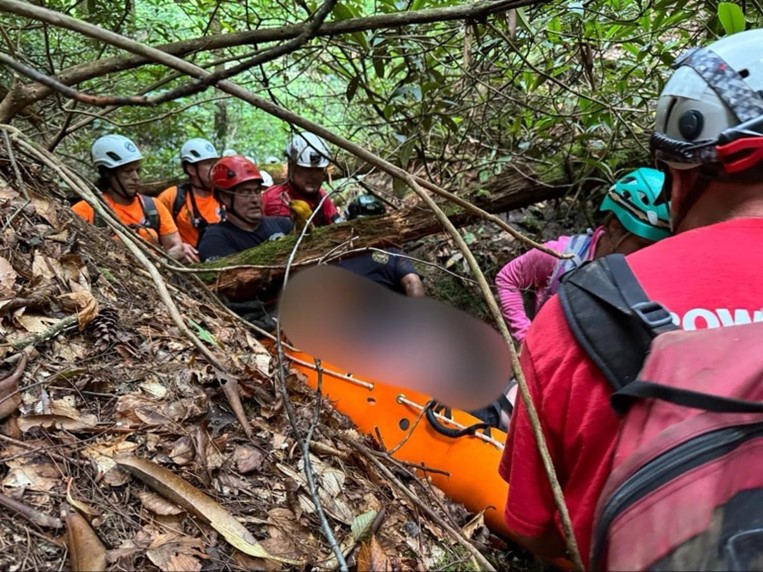
Members of the Search and Rescue Effort perform a litter carry to the helicopter landing zone. Source: Wolfe County SART Facebook.

Scott Hern in the hospital after his miraculous rescue. Source: Wolfe County SART Facebook.
Hern's survival after 14 days in the harsh environment of the Red River Gorge is nothing short of miraculous. His discovery and rescue underscore the importance of notifying friends and family of the intended route to be taken and estimated return, as well as the relentless search efforts and the critical role of coordination among various rescue teams.